
TL;DR: HVAC Marketing Agency Contracts
Know exactly what you're paying for. Your contract should clearly list monthly services, deliverables, management fees, and additional costs.
Make sure you own your marketing assets. Keep control of your website, domain, Google Business Profile, Google Ads account, and customer data.
Focus on booked jobs, not just leads. Your agency should track qualified calls, booked appointments, and the actual business your marketing generates.
Understand the cancellation terms. Check contract length, automatic renewals, cancellation fees, and what happens to your assets if you leave.
Get everything in writing. Make sure the agency's promises, first-90-days plan, communication expectations, and responsibilities are clearly documented.
Hiring an HVAC marketing agency can be a great investment for your HVAC business. But a bad contract can cost you thousands, even if the marketing itself doesn't work.
I've seen HVAC companies pay agencies thousands of dollars every month without knowing exactly what they're getting. Some don't have access to their own HVAC Google Ads accounts. Others discover they can't take their website with them when they leave.
Then there are the contracts that automatically renew, charge expensive cancellation fees, or promise results without explaining how success will be measured.
I'm not saying every marketing agency operates this way. Plenty do great work and have fair agreements (I would like to think this is me).
But before you sign an HVAC marketing agency contract, you should understand what you're paying for, what you own, and what happens if things don't work out.
Here are 10 things I'd check before signing.
1. Does the Contract Clearly Explain What You're Paying For?
If you're paying an agency $2,000 to $5,000 per month, you should know exactly what they're doing for that money.
Descriptions like these aren't enough:
Ongoing SEO optimization
Google Ads management
Website improvements
Monthly marketing support
What does "SEO optimization" actually mean? Are they writing blogs, improving service pages, fixing technical problems, or managing your Google Business Profile?
How often are they doing these things?
Look for Specific Deliverables
For example, an HVAC SEO package might include:
An initial website and SEO audit
Optimization of existing service pages
Four new blog articles per month
Google Business Profile management
Local SEO improvements
Monthly performance reporting
The exact services will depend on the package, but the contract should clearly explain what's included.
The same goes for Google Ads. Does management include building campaigns, testing ads, managing negative keywords, improving landing pages, and tracking conversions?
If you want to launch a new furnace replacement campaign, is that included or an additional charge?
And if the agency promises four blogs per month but only delivers two, what happens to the other two?
Ask before signing: "Can you show me exactly what you'll deliver each month, what's not included, and what happens if something isn't completed?"
2. Who Owns Your Website, Google Business Profile, and Google Ads Account?
This is one of the biggest things I'd pay attention to.
Your website, domain, Google Business Profile, advertising accounts, and customer data are valuable business assets. You shouldn't lose access to them just because you stop working with an agency.
Website and Domain Ownership
Let's say an agency builds your HVAC company a new website. A year later, you're unhappy with their service and decide to leave.
Can you take the website to another hosting provider, or does the agency own it?
Some agencies use proprietary website platforms that make transferring difficult. Others retain ownership of certain designs, templates, or software licenses.
There's nothing inherently wrong with that arrangement if it's disclosed upfront.
But I'd want answers to these questions:
Who owns the domain?
Who owns the website design and content?
Can the website be moved to another hosting provider?
Will you receive access to the website files?
Are there any fees to transfer everything?
Google Business Profile Ownership
Your Google Business Profile is one of your most important local marketing assets.
For many homeowners, it's the first thing they see when searching for furnace repair, AC replacement, or an HVAC company nearby.
Your business should retain primary ownership of its Google Business Profile.
Your agency can have manager or owner access to make changes, but you should maintain control.
Google Ads Account Ownership
I'd recommend that your HVAC business maintain its own Google Ads account with appropriate administrative access.
The agency can manage campaigns through its Google Ads Manager account.
If you leave, you should retain your campaigns, historical performance, keywords, conversion data, and account settings.
Also clarify ownership of your Google Analytics, Search Console, call-tracking data, landing pages, and customer information.
Ask before signing: "If I cancel tomorrow, what accounts and marketing assets can I take with me, and are there any restrictions or transfer fees?"
3. Are the Management Fees, Advertising Budget, and Additional Costs Clear?
Make sure you understand the difference between what you're paying the agency and what you're spending on advertising.
For example:
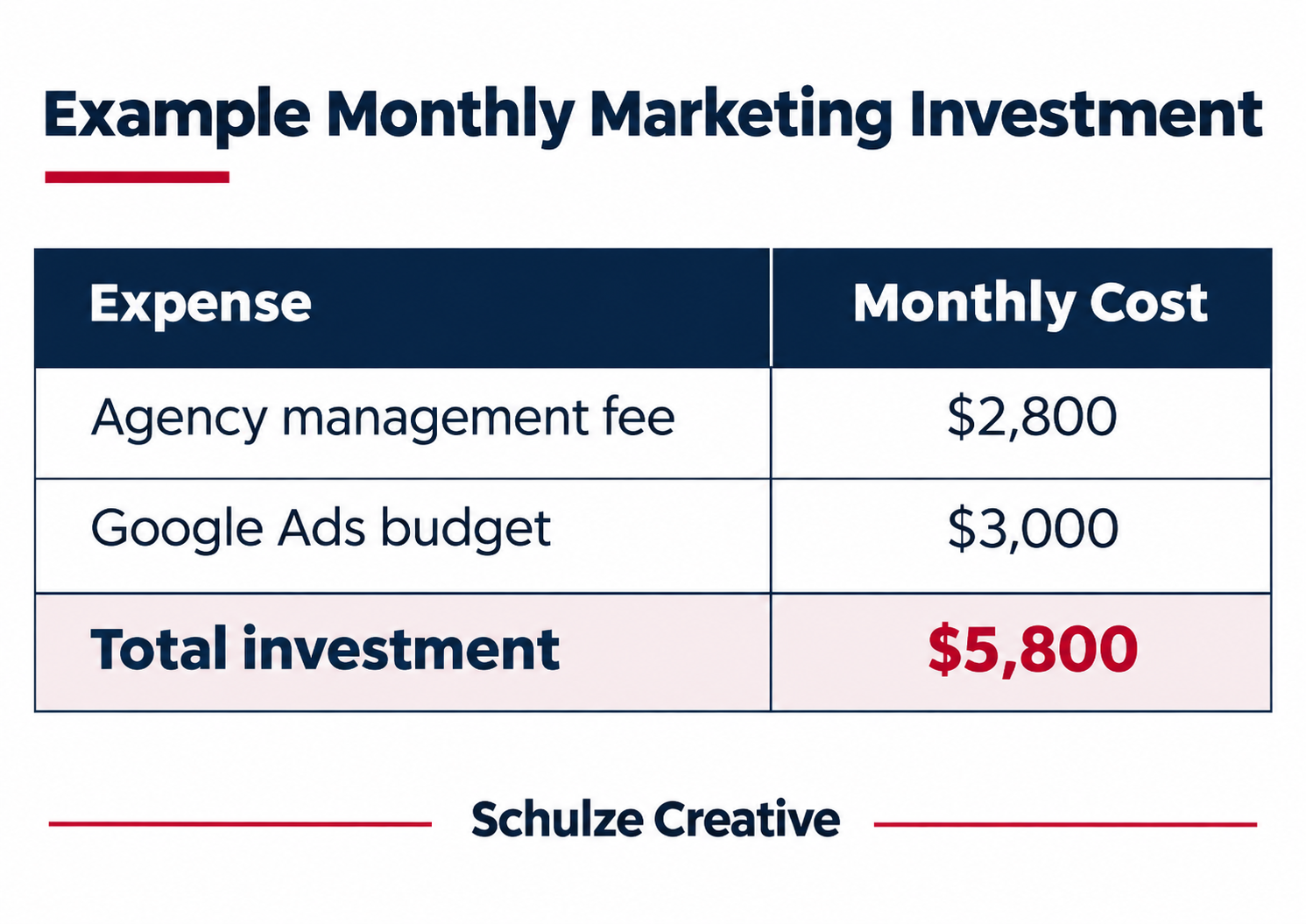
In this example, $2,800 pays for the agency's services, while $3,000 goes toward advertising.
Some agencies charge a flat monthly fee. Others charge a percentage of ad spend. Neither structure is automatically bad. But you should understand how the agency gets paid and whether increasing your advertising budget also increases its fees.
Watch for Additional Charges
Find out whether you'll pay extra for:
Campaign setup
Website hosting and maintenance
Landing page development
Call tracking software
Additional blog articles
New advertising campaigns
Reporting tools and integrations
Also establish who can approve changes to your advertising budget.
If you're spending $3,000 per month on Google Ads, you shouldn't unexpectedly discover that your budget increased to $5,000 without your approval.
Compare Results, Not Just Retainers
A cheaper agency doesn't necessarily mean cheaper customer acquisition.
If one agency charges $1,000 per month but generates almost no booked jobs, and another charges $2,500 but consistently produces profitable customers, the second agency could be the better investment.
That's why I recommend understanding your customer acquisition cost, not just your monthly marketing bill.
Ask before signing: "What's my total monthly investment, what additional charges could come up, and who approves increases?"
4. Is There a Clear First-90-Days Plan?
I would hesitate to sign with an agency that can't explain what it intends to do during your first three months.
You don't need a complicated strategy document. But you should understand what happens after the first invoice gets paid.
A reasonable plan might look like this:
Days 1–30: Audit and setup
Review your website, SEO, Google Business Profile, advertising campaigns, conversion tracking, and competitors. Identify the biggest opportunities.
Days 31–60: Implementation
Fix technical problems, optimize service pages, launch or improve campaigns, publish content, and update your Google Business Profile.
Days 61–90: Optimization
Review early results, identify wasted spending, evaluate lead quality, and adjust the strategy based on what's working.
These aren't rigid deadlines. A company starting from scratch will have different needs than one already spending $10,000 per month on ads.
But the agency should have a plan.
Does the Strategy Account for HVAC Seasonality?
HVAC marketing isn't the same throughout the year.
A company in Denver might need more advertising for AC repairs during a July heat wave and furnace repairs in November.
During milder months, maintenance and replacement campaigns may make more sense.
Your agency should understand when your services are in demand, which jobs are most profitable, and how much work your technicians can handle.
There's no point paying for 50 emergency AC repair leads when your team can't schedule anyone for three weeks.
And an emergency repair campaign shouldn't be structured exactly like an equipment replacement campaign. As I explain in my article on HVAC Google Ads landing pages, those customers have different needs.
Ask before signing: "What are your priorities for the first 90 days, and how will the strategy change with the HVAC season?"
5. How Will You Know Whether the Marketing Generates Profitable Jobs?
This is where I'd spend the most time during an agency sales conversation.
Too many marketing reports focus on clicks, impressions, website traffic, and the number of leads generated.
Those numbers can be useful, but they don't tell you whether the advertising is making money.
I'd rather know how many qualified calls came in, how many appointments were booked, and how many jobs were sold.
Cost Per Lead Doesn't Tell the Whole Story
Consider two hypothetical HVAC advertising campaigns.
Both spend $2,000.
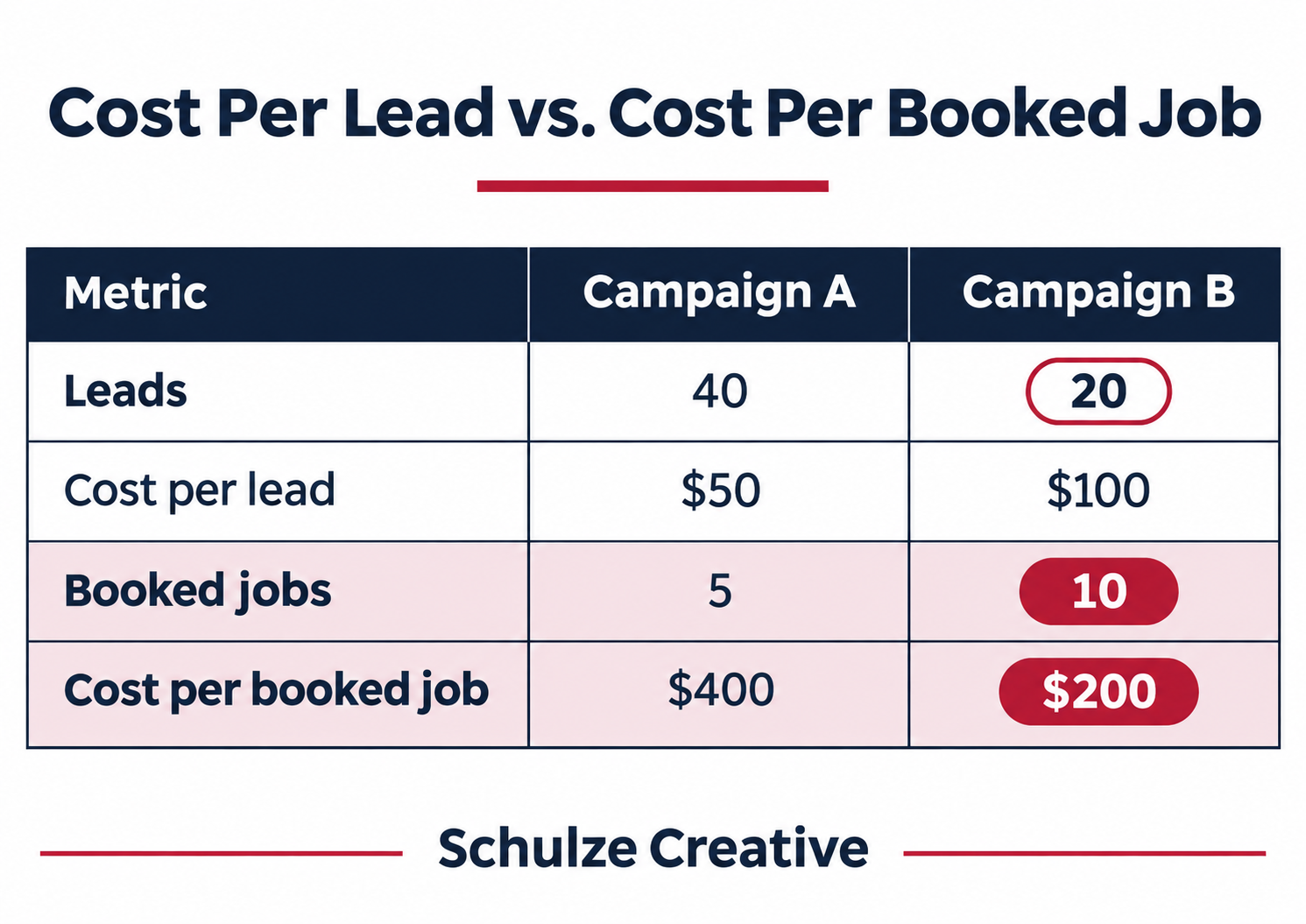
Campaign A generates twice as many leads for half the cost.
Looks great, right?
Except Campaign B produces twice as many booked jobs with the same budget.
Which campaign would you rather have?
And even booked jobs don't tell the complete story. Ten $150 repairs are very different from ten $8,000 installations.
Eventually, you want to understand the revenue and profit generated by your marketing.
Define What Counts as a Qualified Lead
Before signing, discuss what the agency considers a lead.
Does a five-second phone call count?
What about someone looking for an HVAC job?
Or a homeowner outside your service area?
Those shouldn't automatically be treated the same as a homeowner calling to schedule a furnace replacement estimate.
Your agency should explain how it tracks phone calls, website forms, Google Ads conversions, and Local Services Ads leads.
If you have a CRM, ask whether it's possible to connect leads to booked appointments and sold jobs.
Not every HVAC company needs a complicated tracking system immediately, but you should have a plan for measuring real results.
Ask before signing: "How will you show me whether the marketing is producing qualified calls, booked appointments, and profitable jobs?"
6. Who Will Actually Manage Your Marketing?
The person who sells you the marketing package isn't always the person who manages your account.
That's not necessarily a problem. Agencies often have separate salespeople, strategists, and specialists.
But you should know who you'll be working with.
Find out:
Who manages your Google Ads and SEO?
Who makes strategic decisions?
Who do you contact with questions?
How often will you review results?
Will you have access to reports and account data?
I'd also ask what happens if the account manager leaves the agency.
Understand Your Responsibilities
Marketing is a two-way relationship.
If your office misses half the calls coming in, the agency can't magically turn those calls into booked jobs.
If you're booked three weeks out, you need to communicate that before the agency increases spending on emergency repairs.
You'll also need to provide information about your services, pricing, offers, service areas, and availability.
The contract should make it clear what the agency is responsible for and what it needs from you.
Ask before signing: "Who will manage my account, how often will we communicate, and what do you need from me?"
7. Can the Agency Work With Other HVAC Companies in Your Area?
This is something a lot of HVAC owners don't think to ask.
Imagine hiring an agency to improve your Google rankings and generate furnace repair leads in Denver.
A few months later, you discover it also works with three of your direct competitors.
Would you be comfortable with that?
Some owners wouldn't mind as long as the agency delivers results and protects confidential information.
Others want exclusivity.
Neither approach is automatically wrong.
Understand Geographic Exclusivity
If an agency offers exclusivity, find out exactly what that means.
Does it cover your city, your entire metro area, or a certain radius?
Does it apply to all HVAC services?
Does it include plumbing and electrical companies?
And is the exclusivity agreement actually included in the contract?
Even without exclusivity, the agency should protect your customer data, pricing, campaign information, and other confidential business details.
Ask before signing: "Do you work with my competitors, and what protections do I have regarding exclusivity and confidential information?"
8. How Long Is the Contract, and Does It Automatically Renew?
Marketing agencies commonly offer month-to-month, three-month, six-month, and twelve-month agreements.
Longer contracts aren't automatically bad.
SEO takes time. Building a website requires upfront work. And some marketing strategies need several months of data before you can properly evaluate them.
But you should understand why the agency requires a particular commitment.
A twelve-month contract with clearly defined deliverables and reasonable terms is different from a twelve-month contract that simply promises "ongoing marketing."
Watch the Renewal Clause
Let's say you sign a six-month contract.
You're unhappy with the results and decide not to renew.
But the agreement automatically renews for another six months unless you provide written notice 60 days before the end of the initial term.
If you miss that deadline, you may have another financial commitment.
Before signing, find the exact language covering:
Initial contract length
Automatic renewal
Renewal duration
Required cancellation notice
How notice must be delivered
Ask before signing: "When does the contract end, does it renew automatically, and what's the exact deadline for canceling?"
Put those dates on your calendar.
9. What Happens If You Cancel or Switch Agencies?
You should know how to leave an agency before you hire it.
That doesn't mean you're expecting things to go badly. It means you want to protect your business.
Understand Early Cancellation Fees
Say you're paying an agency $2,800 per month.
You decide to cancel with three months remaining on your contract.
If the agreement requires payment for every remaining month, that could mean another $8,400, even if you're no longer using the service.
Not every contract works this way, but some do.
Read the termination clause and understand whether you owe a fixed cancellation fee, the remaining contract balance, or payment only for completed work.
Make Sure Your Marketing Can Be Transferred
Leaving an agency shouldn't mean losing years of valuable marketing work.
Your contract should explain what happens to your website, domain, content, advertising accounts, analytics, landing pages, and call-tracking information.
Pay special attention to third-party software and tracking phone numbers. You may not automatically own or be able to transfer everything the agency uses.
Also ask whether the agency provides transition assistance.
If your new marketing company needs access to Google Ads, Search Console, and your website, will the outgoing agency cooperate?
How quickly?
And will it charge additional fees?
Ask before signing: "What will I owe if I cancel, what assets can I take with me, and what's the process for transferring everything?"
10. Are the Promises and Guarantees Actually in the Contract?
Don't sign a marketing agreement based entirely on what someone tells you during a sales call.
If an agency promises eight blogs per month, those eight blogs should be in the scope of work.
If it promises monthly strategy calls, that should be documented.
If it says you own your website and advertising accounts, make sure the agreement reflects that.
And if it guarantees results, find out exactly what's being guaranteed.
Be Careful With Guaranteed Rankings and Leads
I'd be skeptical of an agency promising that your HVAC company will rank first on Google within 30 days.
Or that you'll generate 100 leads every month regardless of your budget and market.
The agency can control the work it does, but it can't fully control Google rankings, competitors, seasonal demand, or whether homeowners decide to hire you.
I'd rather see an agreement with realistic goals, specific services, and transparent reporting.
What If the Agency Doesn't Deliver?
What happens if your agency promises four monthly blog posts but only delivers one?
Or misses a scheduled website launch?
The agreement should explain how missed commitments are handled and whether the agency has an opportunity to correct them.
Also check who approves changes to advertising budgets, customer offers, and published marketing claims.
Review any confidentiality, liability, and dispute-resolution provisions, especially for a significant financial commitment.
Ask before signing: "Which promises are written into the agreement, and what happens if the agency doesn't deliver?"
HVAC Marketing Agency Contract Checklist
Before signing, make sure you can answer these ten questions:
Services: Do I know exactly what I'm paying for each month?
Ownership: Do I control my website, domain, GBP, advertising accounts, and data?
Pricing: Are management fees, advertising spend, and additional charges clear?
Strategy: Is there a first-90-days plan that accounts for HVAC seasonality?
Tracking: Will I know how many qualified leads and booked jobs my marketing generates?
Communication: Do I know who manages my account and how often we'll communicate?
Competition: Does the agency work with competitors in my service area?
Contract Length: Do I understand renewal terms and cancellation deadlines?
Cancellation: Do I know what it costs to leave and how my assets will be transferred?
Promises: Are deliverables, guarantees, and responsibilities documented?
If you can't answer these questions, get clarification before signing.
Before You Sign, Know Exactly What You're Getting
Hiring an HVAC marketing agency should help you generate more profitable jobs, not create another expensive problem.
Before committing thousands of dollars every month, make sure you understand what the agency will deliver, how results will be measured, who owns your marketing assets, and what happens if you decide to leave.
You don't need to become a marketing expert to hire a good agency.
But you should know enough to ask the right questions and recognize a bad deal.
At Schulze Creative, I help HVAC and home service companies book more profitable jobs through clear branding, stronger local SEO, and high-converting Google Ads.
If you're unsure whether your current marketing is producing the results it should, or you're considering hiring an agency, let's talk.
We'll look at what you're currently doing, what's working, and where you could be getting better results.
Disclaimer: This article provides general business information, not legal advice. Contract terms and their enforceability depend on the agreement and applicable law. Consider having an attorney review significant agreements before signing.
FAQs: HVAC Marketing Agency Contracts
How Long Should an HVAC Marketing Agency Contract Be?
It depends on the services.
Month-to-month agreements offer flexibility, while longer commitments can make sense for SEO or projects requiring significant upfront work.
I'd focus on the deliverables, expectations, cancellation terms, and the agency's explanation for the required commitment.
Should an HVAC Company Own Its Google Ads Account?
Yes, that's what I recommend.
Your company should retain appropriate control of its Google Ads account and historical campaign data.
The agency can manage advertising through authorized access without taking control away from your business.
Can You Cancel an HVAC Marketing Contract Early?
That depends on the agreement.
Some contracts allow cancellation with written notice. Others require early termination fees or payment for the remaining term.
Review the exact language before signing. The enforceability of specific terms can also depend on applicable law.
What Happens to Your Website If You Leave a Marketing Agency?
That depends on the ownership terms and how the website was built.
If you own the files and can access the hosting and domain, transferring may be straightforward.
If the website uses a proprietary platform or licensed components, moving it might require additional work or a rebuild.
Should an HVAC Marketing Agency Guarantee Results?
Be cautious with guarantees that aren't clearly defined.
An agency can commit to specific work and measurable service standards, but it can't fully control Google rankings or customer demand.
If results are guaranteed, find out exactly what's promised, how it's measured, and what happens if the guarantee isn't met.
Can Two Competing HVAC Companies Use the Same Marketing Agency?
Yes, unless an agreement or another obligation prevents it.
Some agencies serve competing contractors. Others offer geographic exclusivity.
If this matters to you, discuss it before signing and have any exclusivity terms documented.
