
TL;DR: How to Audit Your HVAC Competitors on Google Maps
Find your real competitors. Search Google Maps for your most profitable HVAC services and identify the 3–5 companies consistently appearing in the results.
Compare their Google Business Profiles. Look at business categories, services, reviews, photos, and how easy they make it for homeowners to contact them.
Analyze their websites and customer reviews. Identify what competitors are doing well, what customers complain about, and where your business could offer something better.
Use free tools. Google Maps, Google Business Profile, and Google Sheets are enough to conduct a useful initial competitor audit without expensive SEO tools.
Turn your findings into action. Prioritize three improvements that could help your HVAC company attract more qualified calls and profitable jobs, not just higher rankings.
If you're trying to get your HVAC company to rank higher on Google Maps, one of the first things I'd recommend is looking at the companies that are already showing up where you want to be.
Not just how many Google reviews they have, but what services they're ranking for, how their Google Business Profiles are set up, what their websites look like, and why homeowners might choose them over you.
And the good news?
You don't need expensive SEO software to start figuring this out.
I work with HVAC companies on Google Ads, SEO, and Google Business Profile optimization, and I think a lot of contractors overcomplicate competitor research.
You can learn a surprising amount with Google Maps, a spreadsheet, and about 30 minutes.
In this article, I'll show you exactly how I'd audit your HVAC competitors on Google Maps, what I'd pay attention to, and how I'd use that information to improve your own HVAC digital marketing.
Why You Should Audit Your HVAC Competitors on Google Maps
Here's something I think a lot of HVAC owners misunderstand.
Your biggest competitor isn't necessarily the biggest HVAC company in town. It's whoever keeps showing up when your potential customers search for the services you want to sell.
For example, you might be competing with a large franchise for "HVAC company near me," but an entirely different local contractor for "furnace replacement in Arvada."
Those are two different searches, potentially with two very different values to your business.
That's why I recommend starting with the specific services you're trying to grow.
If furnace replacements produce your highest gross profit, I'd prioritize understanding who's ranking for furnace replacement searches rather than obsessing over every HVAC keyword.
This is a fundamental part of local SEO for HVAC companies: getting found by the right homeowners, in the right locations, for the right services.
How Google Determines Which HVAC Companies Rank on Google Maps
Before auditing competitors, you need to understand what Google actually considers.
According to Google's own local ranking documentation, local results are mainly based on three factors.
Relevance
How closely your business matches what someone searches for.
If someone searches for furnace repair, Google needs to understand that your company provides furnace repair services.
Your business categories, services, and complete business information help establish that relevance.
Distance
How far your business is from the person searching.
This explains why your HVAC company might appear near the top of Google Maps in one neighborhood but not another.
You can't simply optimize your way around physical distance.
Prominence
How established or well-known your business is.
Google considers information such as reviews, ratings, and links from other websites.
This is why SEO for HVAC companies involves more than updating a Google Business Profile.
The important thing to understand is that no single factor guarantees the #1 position.
A competitor having more reviews doesn't automatically explain why they're outranking you.
Step 1: Find Your Actual HVAC Competitors on Google Maps
Start by opening Google Maps and searching for the services that matter most to your business.
For example, if I were auditing an HVAC company in Arvada, Colorado, I'd begin with:
Furnace repair Arvada
Furnace replacement Arvada
AC repair Arvada
Emergency heating repair Arvada
I'd record the first three to five businesses appearing in the organic Maps results for each search.
Make sure you're separating sponsored listings from organic results. A company appearing in an ad isn't necessarily ranking there organically.
Check More Than One Location
This is important.
Google Maps results change depending on the searcher's location.
A contractor might rank well near its office but have much less visibility ten miles away.
If the HVAC company services Arvada, Westminster, and Lakewood, I'd want to understand its competition across those areas.
You can use Google Maps to explore different locations, but moving the map or adding a city name isn't a precise simulation of a search from that location.
For accurate neighborhood-level ranking comparisons, you'd need searches performed from those locations or a properly configured local rank-tracking tool.
For a free initial audit, though, manually comparing service-and-city searches gives you a useful starting point.
Step 2: Compare Your Google Business Profile With Your Competitors
Once you've identified the main competitors, start opening their Google Business Profiles.
I'd pay attention to five things.
Business Categories and Services
Look at the category displayed on each competitor's profile.
Is it HVAC Contractor, Air Conditioning Contractor, or something else?
Then look at the services they advertise.
If you're trying to rank for furnace replacement and your profile barely mentions it, that's something I'd investigate.
Free tools such as GMB Everywhere can help inspect additional category information.
Don't blindly copy a competitor's categories, though. They still need to accurately represent your business.
Photos and Business Information
Are competitors showing real technicians, service trucks, completed installations, and actual projects?
Or are their profiles full of generic stock photos?
I'd also check operating hours, service information, website links, and contact options.
Here's the question I'm trying to answer:
If I were a homeowner with a broken furnace, which of these companies would I feel most comfortable calling?
Because getting found on Google Maps is only half the battle. Getting chosen matters just as much.
Step 3: Audit Your HVAC Competitors' Google Reviews
This is where I'd spend a decent amount of time.
Most contractors compare two things: total reviews and average star rating.
I'd go further.
Look at Review Activity
Compare how many reviews each company has received recently.
A contractor with 800 reviews accumulated over 15 years and a contractor with 200 reviews receiving steady feedback today have different review profiles.
I wouldn't assume one automatically ranks better. But the comparison tells you something about their reputation-building efforts.
Read What Customers Actually Say
This is probably my favorite part of a competitor audit.
Read 10 to 20 recent reviews for each business, including negative ones. Look for patterns.
Are customers constantly praising fast service, honest technicians, clean installations, or clear communication? Are they complaining about appointment availability, unexpected costs, or poor follow-up?
Those reviews tell you what homeowners value and where competitors might be disappointing them.
Let's say multiple reviews complain about a competitor's scheduling.
If your HVAC company genuinely offers faster appointments, that's something I'd consider emphasizing in your marketing.
Not because mentioning it guarantees better rankings, but because it gives homeowners a reason to choose you. I'd also establish a consistent process for requesting honest reviews from customers, without incentives or pressure to leave positive feedback.
Step 4: Audit the Websites Behind Their Google Maps Listings
I think this is where a lot of HVAC companies miss opportunities.
They spend time optimizing Google Business Profile but don't pay enough attention to the website connected to it.
When I audit a competitor, I click through to its website and look at the services it's trying to rank for.
Do They Have Specific HVAC Service Pages?
Let's say you're competing for "furnace replacement in Arvada."
Does the competitor have a dedicated furnace replacement page?
Does it explain replacement options, financing, warranties, and what the installation process looks like? Or does it send everyone to a generic Heating page?
This matters because how you design an HVAC website can affect both search relevance and the homeowner's experience.
A Real HVAC Website Project I Worked On
I recently rebuilt the heating page for a Denver-area HVAC company.
The company had a general Heating page, but we wanted more opportunities to target specific searches like furnace repair, furnace replacement, and furnace maintenance.
Ideally, I'd build dedicated service pages for each of those keywords. But the company didn't want separate pages for every service.
So I rebuilt the existing page with individual service sections, each containing its own heading, description, and clickable link.
The goal was to give Google clearer information about the services while making it easier for homeowners to find what they needed. It's not a guaranteed ranking improvement, and I wouldn't present it as one. But it's an example of how I'd approach a weakness discovered during a competitor audit.
I wouldn't just identify that another company has a better service page. I'd figure out how to improve our own website within the client's actual constraints.
And if a website is attracting visitors but not generating inquiries, I'd also investigate why your HVAC website isn't getting calls
Step 5: Find the Opportunities Your HVAC Competitors Are Missing
Now that you've compared profiles, reviews, and websites, look for opportunities.
Let's say your audit reveals three things:
Your competitors have strong review counts, but customers frequently complain about communication.
Their websites provide very little information about furnace replacement financing.
Their service pages don't clearly explain what homeowners should expect during an appointment.
Those are three potential opportunities.
I'd evaluate whether your HVAC company can genuinely deliver something better, then communicate those strengths more clearly.
Maybe that's explaining your diagnostic process, making financing information easier to find, or showing real installation photos.
This is where contractor website design and branding become part of your local SEO strategy.
Don't just copy what your competitors are doing. Find something you can do better.
Step 6: Use Free Tools to Make Your Google Maps Audit Easier
You don't need a $300-per-month SEO subscription to start.
Here's what I'd use:
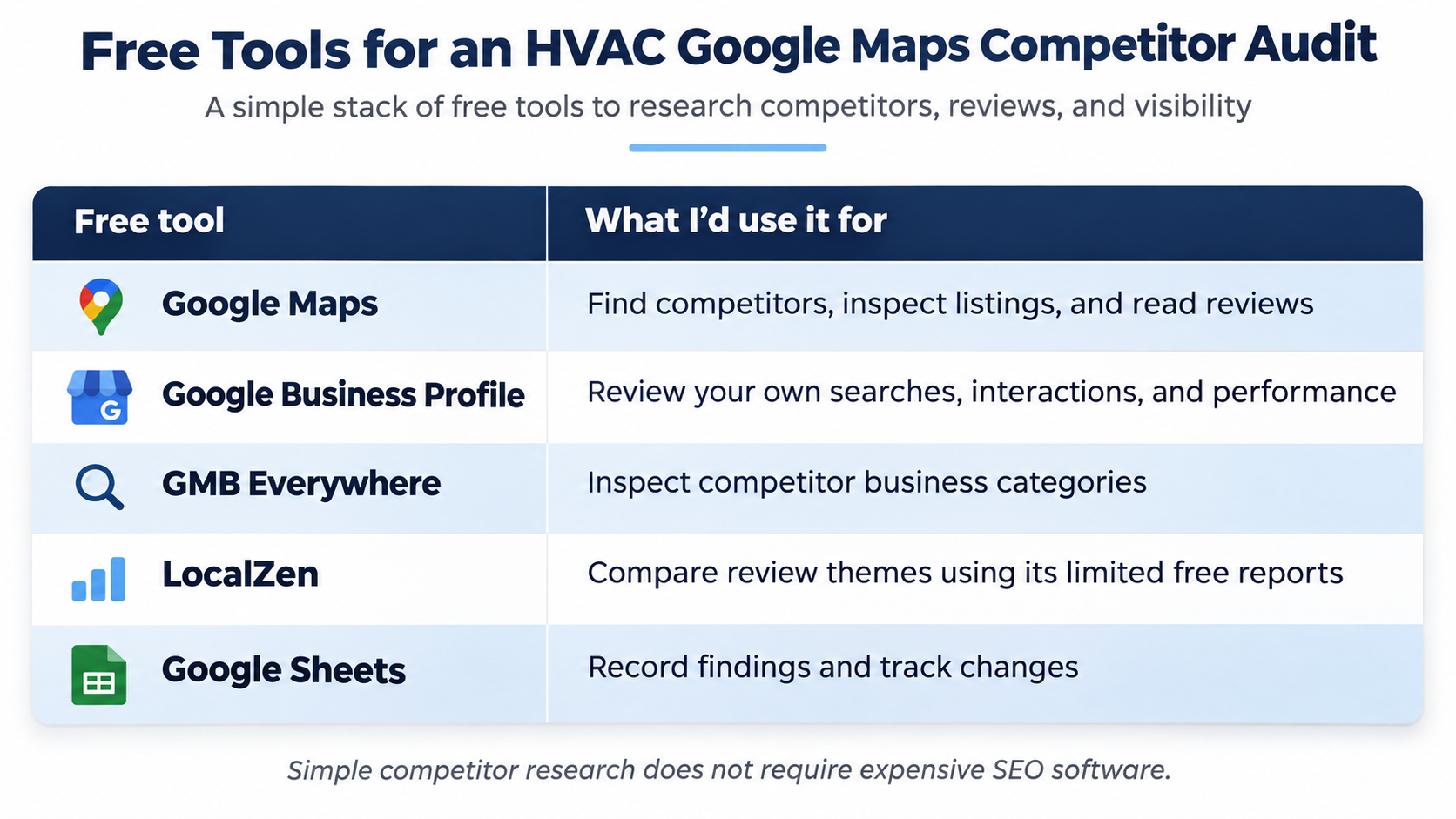
Some third-party tools have usage limits or paid upgrades, but the basic audit is possible without them.
Don't Confuse Visibility With Results
I've reviewed Google Business Profile reports for Denver-area HVAC businesses where searches for the company's name appeared alongside searches for services like furnace repair.
That distinction matters. Someone searching for your business by name probably already knows about you. Someone searching for "furnace repair near me" could be discovering you for the first time.
I'd want to know whether our visibility for relevant nonbranded searches is improving.
And I wouldn't stop at profile views. I'd want to connect those interactions to qualified calls and booked jobs.
That's where HVAC marketing attribution becomes important.
Step 7: Turn Your Competitor Audit Into an Action Plan
A competitor audit is only useful if you do something with the information. After completing the research, I'd identify the three most important opportunities.
For example:
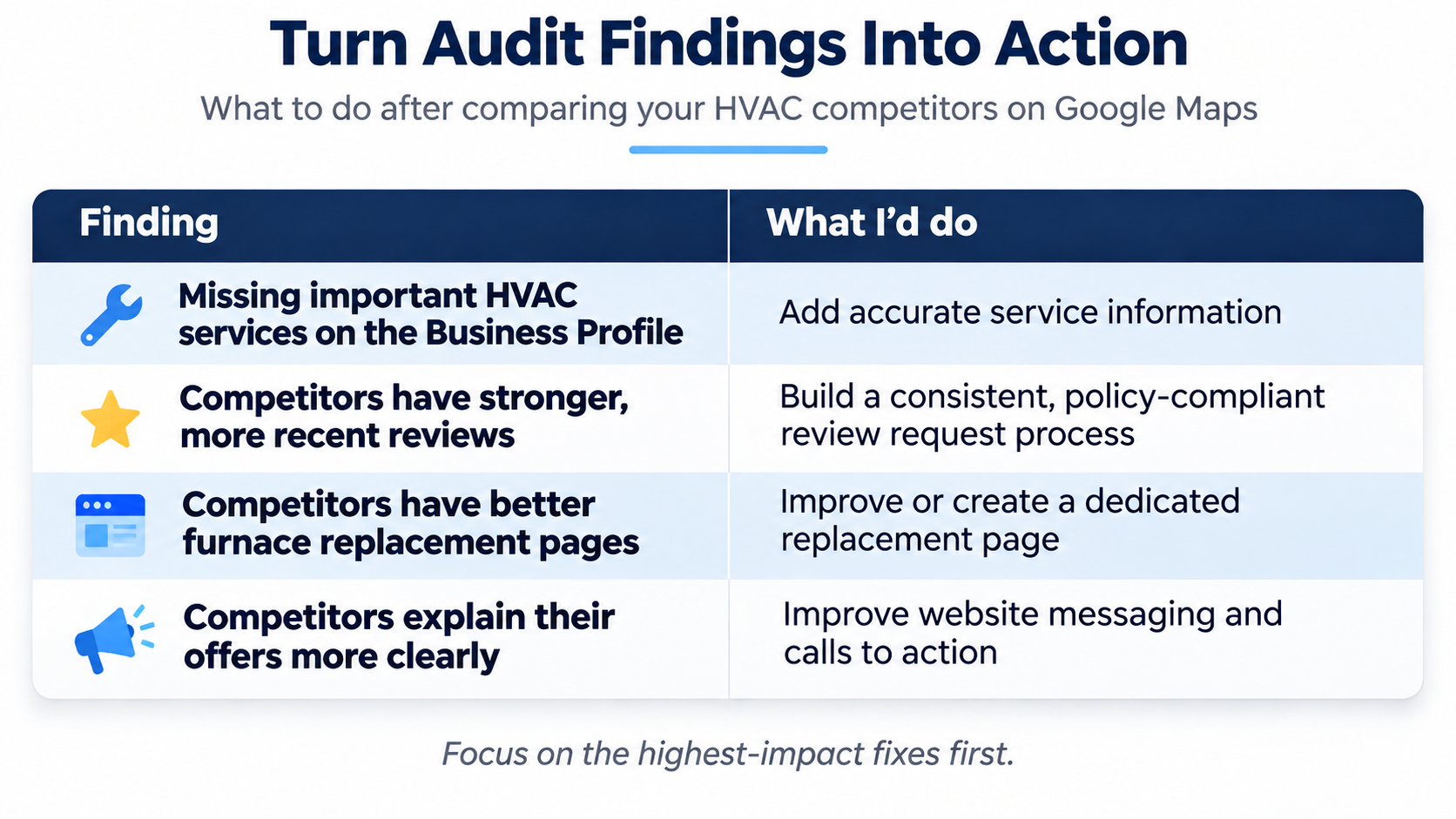
I'd prioritize changes based on potential impact, difficulty, and the profitability of the services we're trying to grow.
Then I'd monitor visibility for priority searches, Google Business Profile interactions, and actual customer results.
If the profile is getting more calls but fewer of those calls become appointments, I'd examine the HVAC call booking rate before assuming more SEO is the answer.
And when deciding how much to invest, I'd want to understand HVAC customer acquisition cost.
Because rankings don't pay your bills. Customers do.
Free HVAC Google Maps Competitor Audit Checklist
Here's the scorecard I'd use to compare your business against three competitors.
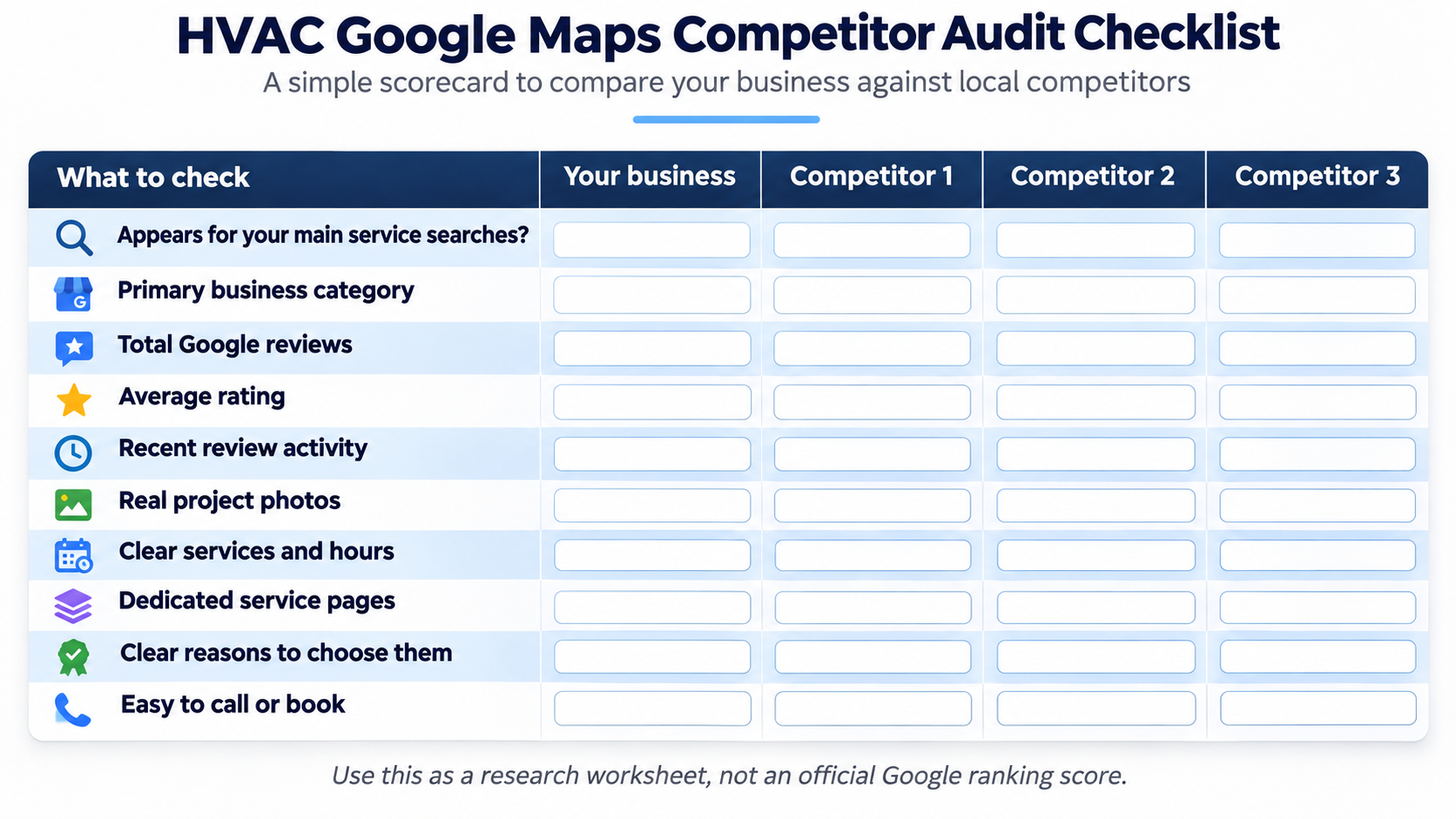
Use this as a research worksheet, not an official Google ranking score.
Mistakes to Avoid When Auditing HVAC Competitors
Before making changes, remember:
More reviews don't guarantee higher rankings. They're important, but distance and relevance also matter.
Adding more cities to your service area won't automatically make you rank there. Keep your service area accurate rather than treating it like a keyword list.
Don't copy questionable competitor tactics. Keyword-stuffed business names, fake reviews, and misleading addresses can violate Google's policies.
Don't obsess over rankings that don't produce customers. I'd rather see an HVAC company become more visible for five profitable service searches than chase dozens of irrelevant keywords.
Once you understand the gaps, the next step is knowing how to rank your HVAC company on Google Maps through legitimate, sustainable improvements.
The Bottom Line: Find the Gaps, Then Fix What Matters
You don't need expensive tools to start auditing your HVAC competitors on Google Maps.
You need to know which companies you're competing against, what they're doing differently, and where your business has opportunities to improve.
Start with your most profitable services. Compare the businesses appearing for those searches. Look at their Google Business Profiles, reviews, websites, and customer experience.
Then identify three improvements worth making.
The goal isn't to outrank every HVAC company for every keyword. It's to make your business easier to find and easier to choose for the jobs you actually want.
If you want help identifying the opportunities your HVAC company might be missing, book a consultation with Schulze Creative. We'll look at your local competition, website, and marketing priorities to figure out where your next improvements should come from.
FAQs: How to Audit Your HVAC Competitors on Google Maps
Can I audit my HVAC competitors on Google Maps for free?
Yes. Google Maps, competitor websites, public reviews, and a spreadsheet are enough for a useful initial audit. Paid tools are helpful for more detailed ranking data but aren't required to get started.
How can I see which keywords my HVAC competitors rank for on Google Maps?
Search for relevant services and locations, then record which companies appear. You can observe specific search results for free, but Google doesn't publish a complete list of every keyword a competitor ranks for.
How many Google reviews do I need to outrank competitors?
There's no universal number. Reviews and ratings influence local rankings, but Google also considers relevance, distance, and other prominence signals. Focus on genuine customer feedback rather than chasing a specific total.
Why does my HVAC company rank in one city but not another?
Distance is a major reason. Google's results are influenced by the searcher's location, so visibility can change throughout your service area.
How often should I audit my HVAC competitors?
I'd perform a full review every quarter, with shorter monthly checks on priority searches, reviews, and competitors' major website changes. That gives you useful trends without obsessing over daily fluctuations.
Can Schulze Creative audit my HVAC competitors on Google Maps?
Yes. At Schulze Creative, I help HVAC and other home service companies evaluate their Google Business Profiles, local SEO, websites, and competitive opportunities.
The goal is to identify which searches and services are worth pursuing, what might be limiting visibility, and which improvements should come first.
How is Schulze Creative's approach different?
I don't think a competitor audit should end with a list of keywords and an optimization score.
I want to understand the company's most profitable services, where it wants more customers, how its competitors position themselves, and whether its marketing is generating qualified calls and booked jobs.
That bigger-picture approach is how I evaluate what digital marketing an HVAC company needs.
