
HVAC Customer Acquisition Cost: What Should It Actually Cost to Win a Customer?
TL;DR: HVAC Customer Acquisition Cost
HVAC CAC is not the same as cost per lead. Track the full path from lead to booked job to paying customer.
There is no universal “good” CAC. A $700 CAC can be great on profitable replacement work and terrible on low-ticket service.
Use gross profit, not just revenue, when deciding what you can afford to spend to acquire a customer.
Lowering CAC does not always mean cheaper ads. Better booking rates, show rates, close rates, follow-up, and retention can lower CAC without generating another lead.
The real goal is not the lowest CAC. It is acquiring as many profitable customers as your business can successfully serve.
A $300 HVAC customer acquisition cost can be terrible.
It can also be a bargain.
That is why I do not like asking, “What is a good HVAC CAC?” without knowing what kind of customer you are talking about.
A $300 customer who buys a $149 tune-up and disappears is one thing. A $700 customer who turns into a $12,000 replacement, joins a maintenance plan, and refers a neighbor is something completely different.
Current industry benchmarks often put blended HVAC customer acquisition cost somewhere around the $250 to $400 range, but that number by itself is not enough to run your business.
You need to know what is underneath it.
How much did the lead cost?
How many leads actually booked?
How many appointments ran?
How many jobs sold?
What was the gross profit?
And how much future value does that customer have?
That is where CAC becomes useful.
I would not use it as a marketing vanity metric. I would use it as a way to diagnose the entire acquisition system, from the ad or Google search all the way to the sold job.
In this guide, I am going to show you how to calculate HVAC customer acquisition cost correctly, what you should actually be willing to pay, how CAC changes by service type, and where I would look first if your number is too high.
Because sometimes the answer is cheaper leads.
But a lot of the time, the real problem is what happens after the phone rings.
Quick Answer: What Is a Good HVAC Customer Acquisition Cost?
Current industry benchmarks often put blended HVAC customer acquisition cost somewhere around $250 to $400 per new customer.
That is useful context.
It is not a target.
A $300 CAC might be terrible for one company and fantastic for another.
It depends on:
What service the customer bought
Gross profit on that job
Whether they become a maintenance customer
Whether they buy again
Whether they refer someone
How fast you earn the acquisition cost back
Whether your team has enough capacity to serve more customers
The right CAC is not the lowest number you can possibly achieve.
The right CAC is the highest amount you can consistently spend while still acquiring customers profitably.
That is a very different way to think about growth.
What HVAC Customer Acquisition Cost Actually Means
The basic formula is:
Total customer acquisition costs ÷ New paying customers = CAC
If you spend $10,000 acquiring customers and create 25 new paying customers:
$10,000 ÷ 25 = $400 CAC
Simple.
The problem is that most HVAC companies do not include all the costs required to acquire those customers.
What Should Be Included in HVAC CAC?
For a useful, fully loaded CAC, I would include the costs directly tied to customer acquisition:
HVAC Google Ads spend
Local Services Ads spend
HVAC SEO or agency fees
Lead marketplaces
Landing page software
Call tracking
Marketing payroll
Relevant sales payroll
Relevant CSR labor
Promotions used specifically to acquire new customers
Other tools directly tied to generating and converting new business
That does not mean you need an accounting department to calculate this perfectly.
Start simple.
If you currently only track ad spend divided by customers, calculate that first. Then gradually add the other costs.
The important thing is that everyone knows which version of CAC you are talking about.
Because $300 advertising CAC and $300 fully loaded CAC are not the same thing.
Cost Per Lead Is Not Customer Acquisition Cost
This is probably the most common mistake I see.
A marketing report says:
50 leads at $120 per lead.
Great. But that tells me almost nothing about whether the campaign is profitable. You need to follow the customer farther.
Cost Per Lead
How much did it cost to generate an inquiry?
Cost Per Booked Appointment
How much did it cost to put an appointment on the schedule?
Cost Per Completed Appointment
How much did it cost to actually get someone in front of a technician or salesperson?
Customer Acquisition Cost
How much did it cost to create a new paying customer?
Those numbers can be dramatically different.
For example:
Ad Spend: $6,000 Leads: 50 Booked: 30 Appointments Ran: 24 Customers: 15
That means:
CPL = $120
Cost per booking = $200
Cost per completed appointment = $250
CAC = $400
The ad platform did not suddenly become more expensive.
You simply followed the money all the way through.
That is why Google Ads metrics for HVAC companies should never stop at clicks and calls.
The HVAC Customer Acquisition Funnel
I would look at HVAC acquisition like this:
Spend → Lead → Qualified Lead → Booked → Appointment Ran → Sold → New Customer → Gross Profit
Every step matters. And every drop tells you something.
If lead quality is bad
You probably have a targeting, keyword, offer, or channel problem.
If leads are good but not booking
You may have a phone problem.
If bookings are high but appointments are not running
You may have a confirmation, scheduling, or wait-time problem.
If appointments run but few buy
You may have a sales problem.
If customers buy but CAC still feels too high
You may have a job-mix, pricing, margin, or retention problem.
That is why I think HVAC companies make a mistake when they hand CAC entirely to the marketing department.
CAC belongs to the whole company.
Marketing creates the opportunity.
Operations and sales determine how efficiently that opportunity becomes money.
How Booking Rate Changes HVAC CAC
This is where small improvements can become extremely valuable.
Assume you generate:
100 leads at $100 each
Your spend is $10,000.
Scenario A
50% book
80% run
40% close
That creates:
16 customers
Your CAC:
$625
Scenario B
Same leads. Same ad spend.
But:
65% book
85% run
45% close
Now you create about:
25 customers
Your CAC:
$400
You lowered CAC by 36% without making your ads one dollar cheaper.
That is the kind of leverage HVAC owners should look for.
Sometimes you do not need more leads. You need to stop wasting the ones you already bought.
2026 HVAC Customer Acquisition Cost Benchmarks
Benchmarks are useful when they are treated correctly.
One 2026 dataset analyzed nearly $14.9 million in Google Ads spend across hundreds of HVAC and plumbing contractors.
Their reported numbers were approximately:
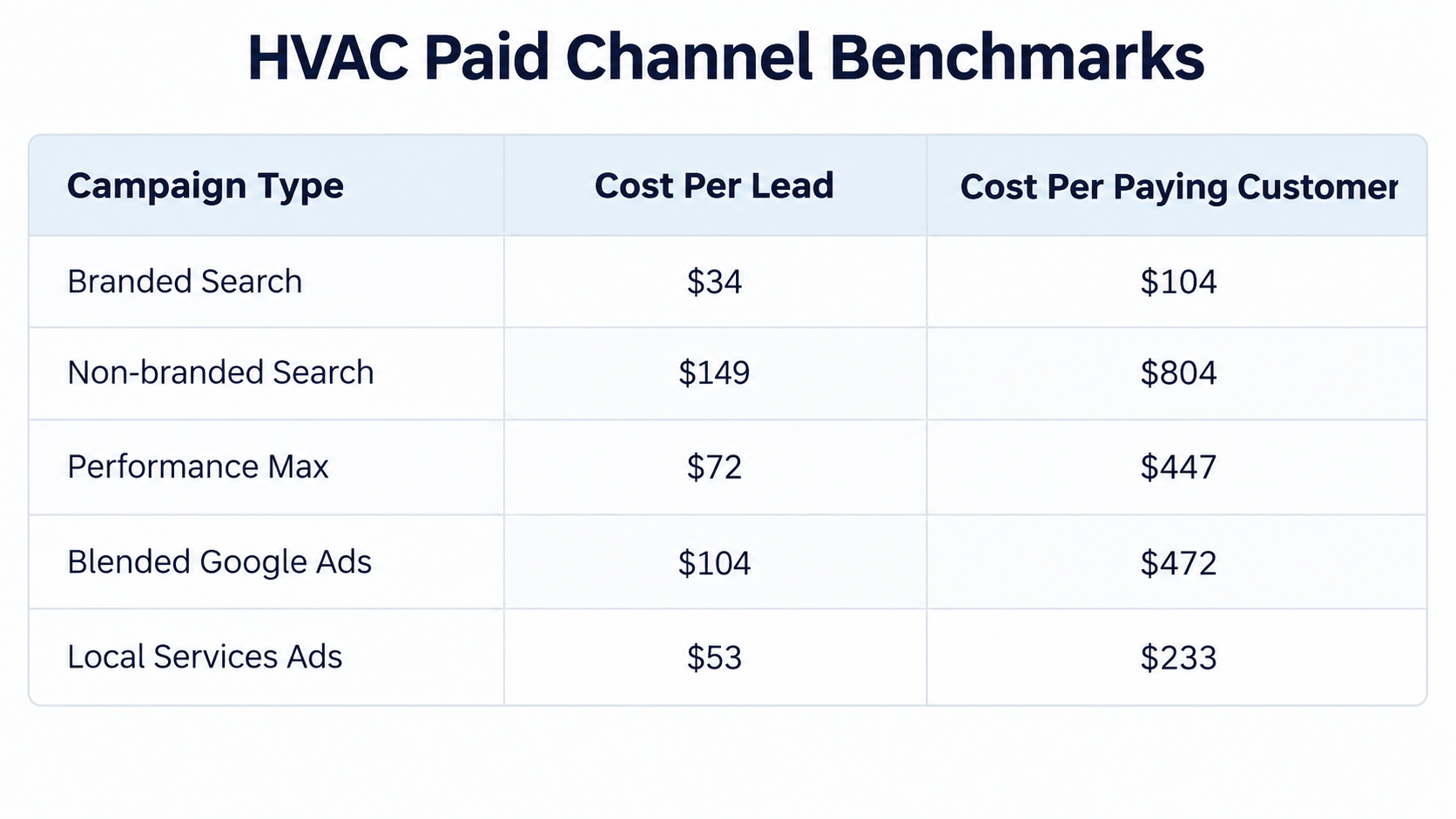
Do not look at that table and immediately decide:
LSA good. Search bad.
That would miss the point. Different channels produce different kinds of customers.
Branded Search is often capturing someone who already knows your company.
Non-branded Search may be introducing you to someone for the first time.
LSA might produce cheaper service calls.
Search might produce fewer but larger replacement opportunities.
The number only becomes useful when you connect it to:
Job type + close rate + gross profit + customer value
That is why Google LSA vs Google Search Ads for HVAC businesses should be evaluated on more than cost per lead.
What Should Your HVAC Company Actually Pay to Acquire a Customer?
This is the question that matters.
And I would not answer it using the industry average. I would work backward from your own economics.
Step 1: Start With Gross Profit
Suppose you sell a replacement for:
$12,000
That does not mean the customer is worth $12,000.
Maybe after equipment and direct labor, you produce:
$4,800 gross profit
That is the number I care about when thinking about acquisition.
You still need gross profit to cover:
Office payroll
Trucks
Rent
Insurance
Software
Management
Callbacks
Financing costs
Net profit
So you obviously cannot spend all $4,800 acquiring the customer.
But now you have something real to work with.
Step 2: Decide How Much Gross Profit You Are Willing to Spend
Say your target is to keep at least $3,800 of the first-job gross profit before overhead.
That leaves:
$1,000 available for acquisition
That does not mean you should immediately target a $1,000 CAC. It means you now know roughly where your ceiling starts.
That is much more useful than:
“The internet says HVAC CAC should be $300.”
Calculate Your Break-Even CAC
A simple way to think about it:
Break-even CAC = First-job gross profit minus the contribution you need to keep
Example:
Gross profit: $4,000 Minimum contribution you want left: $3,000
Break-even acquisition allowance: $1,000
Now set your actual target below that.
Maybe:
Target CAC = $500 to $700
That gives you room.
The exact number depends on your overhead, cash flow, growth goals, and how valuable the customer becomes later.
But now your CAC target came from your business. Not a benchmark article.
Different HVAC Customers Should Have Different CAC Targets
This is a big one.
I do not think most HVAC companies should have one CAC number for the entire business.
Why? Because the customers are too different.
Maintenance Customer
The first ticket might be low.
But that customer could produce:
Annual membership revenue
Repairs
IAQ upgrades
Replacement
Referrals
You may be willing to acquire them near break-even if retention is strong.
Repair Customer
You get immediate revenue.
But the bigger value may be establishing the relationship before the equipment eventually needs replacement.
Replacement Customer
Much larger first-job gross profit.
You can often afford a much higher CAC.
Commercial Customer
They may take longer and cost more to acquire.
But one commercial relationship can produce years of service revenue.
Stop asking, “What is our CAC?”
Ask:
“What is our CAC for each type of customer?”
That is a much more useful number.
Customer Lifetime Value Changes the Acquisition Math
The first invoice does not tell you what a customer is worth.
An HVAC customer can move through:
Repair → Maintenance → More Repairs → IAQ → Replacement → Referral
That means a $400 acquisition cost might look bad against a $250 first service call.
But if that customer later generates $8,000 of gross profit over several years, the original acquisition looks very different.
There is one important distinction though.
Use lifetime gross profit whenever possible, not lifetime revenue.
A customer producing $15,000 in revenue is not worth $15,000 to the company.
You still have to perform the work.
Gross profit gives you a much more realistic picture.
Track CAC Payback Period
There is another number I think HVAC owners should know:
How long does it take to earn the CAC back?
Suppose:
CAC = $400
First-job gross profit = $600
Your acquisition cost is paid back immediately. Great.
Now imagine:
CAC = $600
First-year gross profit = $200
You may need several years of maintenance and future repairs before you recover that money.
That could still be a good business model. But it creates a much bigger cash-flow requirement.
This is why two companies with the same LTV:CAC ratio can still have very different financial risk.
Cash timing matters.
Stop Paying to Reacquire Customers You Already Won
This is an underrated acquisition problem.
Imagine:
You repair someone's furnace. They pay you. Then you disappear for two years.
No maintenance reminder.
No email.
No membership.
No follow-up.
No useful communication.
Two winters later, something breaks.
They search:
HVAC repair near me.
They click your ad.
You pay $100 for the click and another several hundred dollars to reacquire someone who was already your customer.
That is waste.
Once someone becomes a customer, your goal should be to keep them inside your ecosystem.
Use:
Maintenance memberships
Seasonal reminders
Email
Text
Review requests
Service history
Replacement reminders
Referral campaigns
You already paid to earn the relationship.
Do not keep paying to restart it.
How to Lower HVAC Customer Acquisition Cost Without Getting More Leads
This is where I would look before increasing ad spend.
1. Answer More Calls
If 20% of paid calls go unanswered, part of your marketing budget is being thrown away.
2. Respond Faster
A homeowner with no AC in July is not waiting six hours.
They are calling someone else.
3. Improve Booking Rate
Your CSR should understand:
Why people are calling
How to handle price questions
How to handle “I’m calling around”
How to book confidently
How to avoid giving callers easy reasons to leave
4. Reduce Cancellations
Use confirmation texts.
Set expectations.
Do not book appointments five days out if the homeowner needs help today.
5. Improve Close Rate
If your comfort advisor closes 25% and another closes 50%, their effective CAC is completely different.
6. Follow Up Unsold Estimates
You already paid to create the opportunity.
One estimate is not always enough.
7. Increase Average Ticket
Better job mix and better sales make the same acquisition spend more profitable.
8. Attach Maintenance Agreements
Acquisition becomes easier to justify when customers stay.
9. Generate Referrals
Referrals increase the value of the original customer and reduce future acquisition pressure.
When Higher HVAC CAC Is Actually Good
This sounds wrong at first.
Imagine:
Company A
50 customers $250 CAC $12,500 acquisition spend $100,000 gross profit
Company B
150 customers $350 CAC $52,500 acquisition spend $300,000 gross profit
Company B has a worse CAC.
It also makes dramatically more money.
That is why sophisticated operators do not obsess over minimizing CAC forever. As you scale, you usually exhaust the cheapest acquisition channels first. The next customer often costs more. That is okay.
The real question is:
Is the next customer still profitable?
This is called thinking about marginal CAC.
In plain words:
What does the next customer cost me?
Your first 20 customers might cost $200 each.
The next 50 might cost $350.
The next 100 might cost $500.
If $500 still works economically, keep going.
Do not stop profitable growth just because the average CAC increased.
Capacity Changes the CAC Decision
There is another piece marketing reports rarely include.
Can you actually serve more customers?
If your schedule is booked two weeks out, spending another $20,000 on demand might:
Increase wait times
Hurt booking rates
Create cancellations
Burn out technicians
Lower customer experience
Raise CAC
Sometimes the best growth investment is not more marketing.
It is:
Another technician
Another CSR
Better dispatch
Better scheduling
More sales capacity
CAC should influence your operations planning, not just ad budgets.
How to Track HVAC CAC Correctly
At minimum, your monthly dashboard should show:
Marketing spend
Leads
Qualified leads
Booked appointments
Completed appointments
New customers
Sold revenue
Gross profit
CPL
Cost per booking
CAC
Average ticket
Booking rate
Close rate
Then split those numbers by:
Channel
Google Ads
LSA
SEO
GBP
Referral
Direct mail
Other
Service Type
Repair
Maintenance
Replacement
IAQ
Commercial
That is where the interesting information appears.
You might find:
LSA CAC: $220 Average gross profit: $350
Versus:
Search CAC: $700 Average gross profit: $3,200
LSA looks cheaper. Search makes you more money.
Now you can actually make a decision.
A Simple HVAC CAC Operating Review
I would review these numbers every month.
Ask five questions:
1. Did our CAC go up or down?
Then ask why.
2. Which funnel number changed?
Lead cost?
Booking rate?
Show rate?
Close rate?
Average ticket?
3. Which channel produced the most gross profit?
Not the most calls.
4. Which service type had the strongest economics?
Repairs?
Replacements?
Maintenance?
5. Where should the next dollar go?
More ads?
Better phones?
Another salesperson?
Retention?
SEO?
That turns CAC into an operating tool instead of a marketing report.
Five HVAC CAC Mistakes I See Constantly
1. Calling CPL Your CAC
A lead is not a customer.
2. Counting Only Ad Spend
Your real acquisition cost is usually higher.
3. Mixing New and Existing Customers
Returning customers should not inflate your “new customer” numbers.
4. Comparing CAC to Revenue
Compare it to gross profit whenever possible.
5. Cutting a Channel Because CAC Increased
Ask whether total gross profit also increased.
Sometimes paying more per customer is exactly what scaling looks like.
HVAC Customer Acquisition Cost: What the Number Should Actually Tell You
HVAC customer acquisition cost is not just a marketing number.
It tells you how efficiently your entire company turns demand into profitable customers.
That includes your ads and SEO, but it also includes your phones, booking process, scheduling, sales, pricing, follow-up, maintenance plans, retention, and referrals.
That is why I would never judge an HVAC business by CPL alone. A lead is only the start.
The real path is:
Lead → Qualified Lead → Booked Appointment → Completed Appointment → Sold Job → Gross Profit
Once you track that full chain, you can actually diagnose the problem.
If leads are expensive, look at the HVAC Digital Marketing. If good leads are not booking, look at the phones. If appointments run but do not close, look at sales. If customers buy but the numbers still do not work, look at pricing, job mix, margin, and retention. And if a higher CAC is still creating more total gross profit, it may not be a problem at all.
That is the part most HVAC marketing reports miss.
The goal is not to get your CAC as low as humanly possible.
The goal is to know what you can profitably afford to pay for a customer, then acquire as many of those customers as your business can successfully handle.
At Schulze Creative, I help HVAC and other home service businesses connect SEO, Google Business Profile, websites, Google Ads, LSA, call tracking, and reporting back to actual business results.
If you want to know whether your marketing is producing profitable customers or just producing activity, contact Schulze Creative and we can look at the numbers together.
FAQs: HVAC Customer Acquisition Cost
What is the average HVAC customer acquisition cost?
Current published estimates commonly put blended HVAC CAC somewhere around $250 to $400, but channel, market, service mix, close rate, and accounting method can move that number significantly.
What is a good HVAC customer acquisition cost?
A good CAC is one that produces enough gross profit, pays back within an acceptable timeframe, and can be repeated at scale. There is no universal number.
How do you calculate HVAC CAC?
Divide the costs associated with acquiring new customers by the number of new paying customers acquired during the same period.
What is the difference between HVAC CPL and CAC?
CPL tells you what it costs to generate an inquiry. CAC tells you what it costs to create a paying customer.
Should I include my agency fee in CAC?
For a fully loaded CAC, yes. If the agency fee is part of generating and converting new customers, include the relevant cost.
Should repairs and replacements have the same CAC target?
Usually not. Their first-job value, gross profit, close rate, and lifetime value can be very different.
How can I lower HVAC CAC quickly?
Start with the conversion side of the business. Improve call answer rate, speed to lead, booking rate, appointment completion, close rate, and estimate follow-up before assuming you simply need cheaper leads.
Is LSA cheaper than Google Search Ads?
It can be on a per-lead and per-customer basis, but that does not automatically make it more profitable. Compare the job type, average ticket, gross profit, and customer quality produced by each channel.
Can a higher CAC be good?
Yes. If the additional customers remain profitable, accepting a higher CAC can create significantly more total gross profit.
How often should an HVAC company track CAC?
I would review it monthly and watch the major funnel numbers weekly if you are spending heavily on paid acquisition.
How can Schulze Creative help improve HVAC customer acquisition cost?
At Schulze Creative, I help HVAC and other home service companies connect SEO, Google Business Profile, websites, Search Ads, LSA, branding, call tracking, and reporting back to actual business results.
The goal is not simply cheaper leads.
It is to understand:
Where customers come from.
What they cost.
Which ones become profitable jobs.
Where opportunities are being lost.
And ultimately:
Where the next marketing dollar will create the most profit.
