
TL;DR: HVAC Marketing Attribution
Track where every lead comes from. Use call tracking, form tracking, and CRM data to identify whether customers found you through Google Ads, Local Services Ads, SEO, Google Business Profile, or another source.
Follow leads beyond the first phone call. Track how many leads are qualified, book appointments, receive estimates, and become completed jobs.
Connect marketing to actual revenue. Link customer records to completed jobs, invoices, and payments so you know how much revenue each marketing channel generates.
Measure profitability, not just lead volume. Compare cost per booked job, customer acquisition cost, collected revenue, and gross profit to understand which channels deserve more investment.
Find and fix the gaps. Review your last 10 paying customers and trace each one back to its original marketing source. If you can't connect the dots, that's where your tracking needs work.
Thirty leads generated $14,000 in revenue. Another 20 leads generated $38,000.
Those are hypothetical numbers, but they illustrate a problem I see with how HVAC companies measure their marketing. The campaign generating the most leads isn't always the one making you the most money.
And that's a pretty important distinction!
I've worked with HVAC companies to increase inbound calls through Google Ads and SEO. Getting more calls is great, but I've always believed there's a bigger question business owners should be asking: How many of those leads actually turned into paying customers?
Think about it. You could be spending thousands every month on Google Ads, generating plenty of phone calls, and still have no idea which campaigns are producing your most profitable jobs. Without that information, you're making budget decisions based on incomplete data.
That's where HVAC marketing attribution comes in.
Before increasing your marketing budget, I'd recommend looking at your last 10 completed, paid jobs. Can you identify exactly where each customer came from, how much you spent to acquire them, and how much revenue their job generated?
If not, there's work to do.
In this guide, I'll walk you through how to track HVAC leads from their first interaction with your business all the way to completed jobs and collected revenue, so you can confidently invest in the marketing that's actually growing your business.
What Is HVAC Marketing Attribution?
Marketing attribution is the process of identifying which marketing sources contributed to a customer and the revenue that followed. Instead of reporting only that Google Ads generated a call, you connect that call to the customer record, job, invoice, and payment.
Lead tracking shows where an inquiry came from. Attribution assigns credit for the resulting business. Neither is perfect.
I think a useful marketing report should answer three questions: Where did the customer come from? What happened after they contacted us? Was acquiring that work profitable?
If you're still focused on clicks and conversions, start with the HVAC marketing KPIs owners should actually track. The next step is connecting those numbers to actual customers.
What Tracking an HVAC Lead All the Way to Revenue Looks Like
Here is the customer journey I want to see:
Marketing source → Lead → Qualified opportunity → Booked appointment → Appointment ran → Job sold → Job completed → Invoice → Payment → Gross profit
Example: One Furnace Replacement From Google Ads
Imagine a homeowner searches for furnace replacement and clicks a Google Search ad. They call the number on the landing page. Your tracking system records the campaign and creates call ID 1042.
Your CSR books an appointment under customer ID 208. A technician visits, quotes an $8,000 replacement, and the homeowner approves it. The installation gets job ID 671, the final invoice is $7,800, and the customer pays $7,800. The direct job costs are $4,900, leaving $2,900 in gross profit before marketing and overhead.
These are hypothetical numbers, but the principle is real: the original source, customer, job, and invoice need to remain connected. Otherwise, your ad dashboard sees a phone call while your accounting system sees $7,800, with no reliable link between them.
Step 1: Capture Where Every HVAC Lead Comes From
Start with a consistent source list: Google Search Ads, Local Services Ads, organic search, Google Business Profile, referrals, repeat customers, and any other channel you use.
Track Calls, Forms, and Online Bookings
For phone calls, a call-tracking platform can assign numbers to different campaigns. Dynamic number insertion changes the displayed number on your website based on how someone arrived, while forwarding calls to your regular business phone.
For forms and bookings, capture the page, source, campaign, time, and lead ID. UTM parameters label campaigns. For Google Ads, preserve the identifiers or permitted first-party data used in offline-conversion matching.
Don't assume clicking a phone button means a call was completed. And don't assume all website visits are leads. If you're wondering why your HVAC website isn't getting calls, you need to measure what happens when visitors reach its buttons and forms.
Treat Google Maps as Its Own Source
If a homeowner calls straight from your Google Business Profile, they might never visit your website. Record those calls separately where possible, and use clear source questions when technical tracking is limited.
Learning how to rank your HVAC company on Google Maps matters, but the jobs generated from that visibility are what complete the picture.
Step 2: Find Out Which Leads Were Actually Qualified
A ringing phone isn't automatically an opportunity. You might get spam, vendors, existing customers, out-of-area callers, or requests for work you don't offer.
I'd classify calls as qualified, unqualified, or existing-customer service, and record whether each new opportunity was answered, booked, or lost.
Then separate two problems:
Poor lead quality: Your targeting or marketing message may be attracting the wrong people.
Good leads that don't book: Your phones, scheduling, pricing, or follow-up may need work.
That's why I pay attention to HVAC call booking rate. Track both bookings divided by all leads and bookings divided by genuinely bookable opportunities. They answer different questions.
Before spending more, listen to a sample of the calls that didn't book. You may find that the best way to get more HVAC leads without increasing ad spend is actually to stop losing the leads you already paid for.
Step 3: Connect the Lead to Your CRM and Every Job
Your call-tracking tool and your field-service software need a common way to identify the same customer. At minimum, keep the lead ID, phone number, source, campaign, first contact date, customer ID, appointment ID, and job ID together.
When a CSR books an appointment, don't overwrite the original source with "phone call." That is the contact method, not necessarily the discovery source. Keep later touchpoints separately.
ServiceTitan offers marketing reporting for leads, jobs, and campaign revenue. Features depend on your setup. If you use another system, the principle stays the same. You can even begin with a well-maintained spreadsheet and a weekly export.
Google Analytics 4 supports lead-stage events such as generate_lead, qualify_lead, and close_convert_lead. You still need to send data from your website or CRM.
Step 4: Follow the Job Through to Collected Revenue
Here's where a lot of reports stop too early.
A booked appointment can cancel. An estimate can be declined. A sold installation can change in price. An invoice can remain unpaid.
I want four separate amounts when they're relevant:
Sold value: What the customer approved.
Invoiced revenue: What you ultimately billed.
Collected revenue: What you've actually received, accounting for refunds.
Gross profit: Revenue minus the direct costs of doing the job.
For replacements, keep the lead date alongside sale and payment dates. A campaign may look weak because its jobs haven't been installed yet. A repair customer may also return years later for a replacement, which is why HVAC customer lifetime value matters too.
You can send qualified or sale outcomes back through Google Ads enhanced conversions for leads, following current data and consent requirements.
First-Touch vs. Last-Touch HVAC Marketing Attribution
Suppose a homeowner first discovers you through an organic furnace article. Two weeks later they search your brand, click an ad, and call.
First-touch attribution credits organic search for the initial discovery. Last-touch attribution credits the ad interaction immediately before the conversion. A multi-touch approach can recognize both.
This matters when you're investing in HVAC Google Ads and SEO at the same time. Different platforms can take credit for the same customer. Don't add together their reported revenue as if every claim represents a separate job.
I prefer reviewing first and last touch side by side, then checking the actual customer record. Attribution is a way to make better decisions, not proof that one channel single-handedly caused the purchase.
The HVAC Marketing Attribution Numbers I Would Track
You don't need a dashboard with 40 charts. You need a few numbers tied to clear definitions:
Cost per qualified lead: Channel spending ÷ qualified new leads.
Cost per booked appointment: Channel spending ÷ appointments booked from that channel.
Booking rate: Booked appointments ÷ leads, with the denominator clearly labeled.
Customer acquisition cost: Relevant acquisition costs ÷ new paying customers.
ROAS: Attributed revenue ÷ ad spend.
Marketing contribution: Attributed gross profit minus relevant marketing costs.
I go deeper into HVAC customer acquisition cost because cheap leads can become expensive customers. And when you're comparing channels, HVAC marketing ROI needs to account for profitability, not just sales volume.
Example: An HVAC Attribution Dashboard That Changes Decisions
Here's a hypothetical 90-day dashboard for two paid channels. Gross profit is shown before marketing costs.
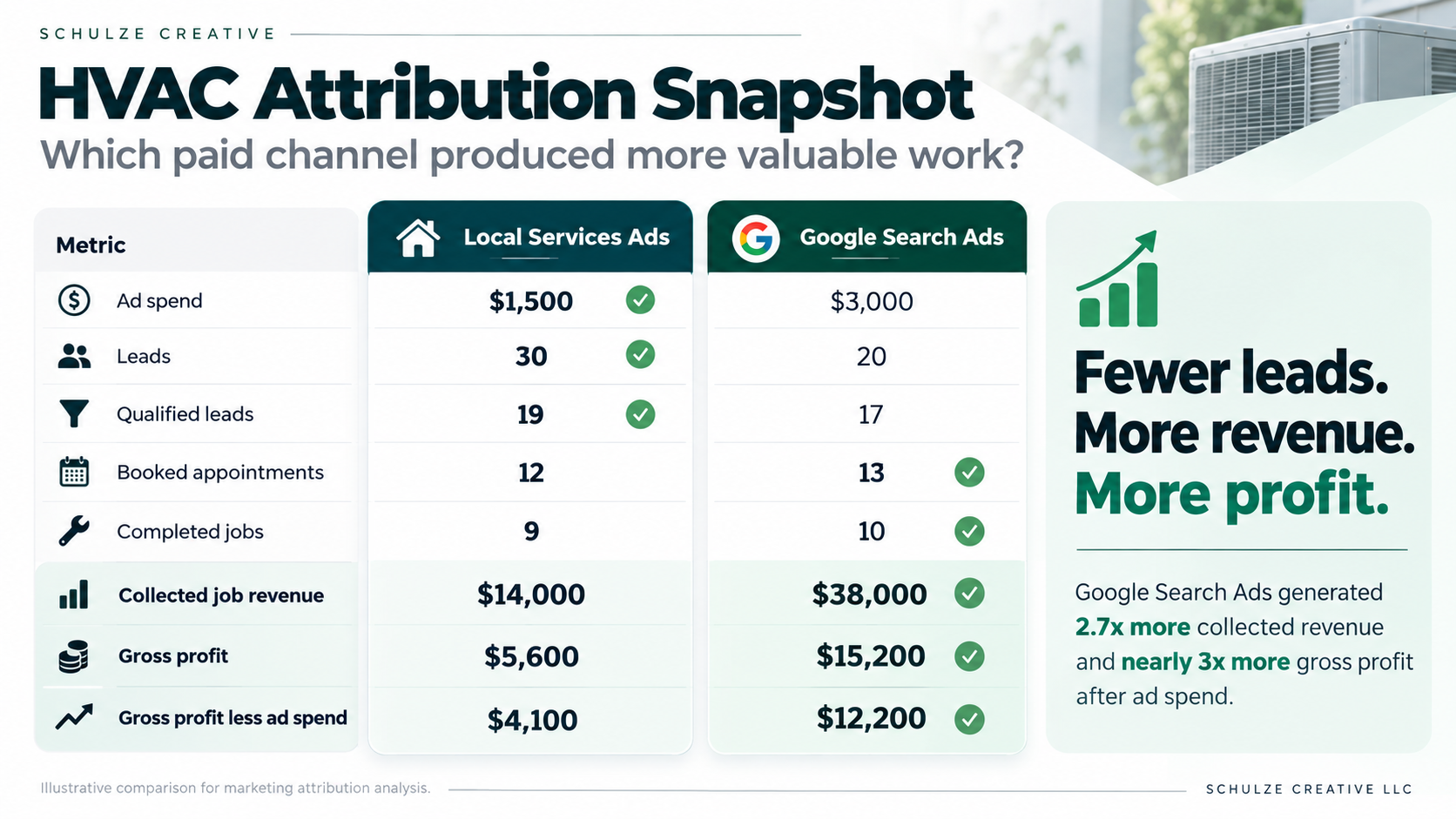
Local Services Ads wins on cost per lead: $50 versus $150. But Search produces more completed jobs and nearly three times the gross profit remaining after ad spend.
Would I automatically triple the Search budget? No. I'd check whether those jobs are repeatable, whether the team has capacity, and whether agency fees and other acquisition costs change the economics. I'd also break results down by repairs versus replacements. One expensive installation can distort a small sample.
That's the difference between a useful dashboard and a pretty one. The useful version tells you what to investigate next. It's also why cost per booked job deserves more attention than CPL alone.
Common HVAC Attribution Mistakes
Watch for these common mistakes:
Counting every call, repeat caller, and form submission as a new lead.
Losing the source when a CSR creates a customer record.
Judging ads before installations are finished and payments arrive.
Counting the same customer twice across ad platforms or multiple appointments.
Reporting revenue without job costs, marketing fees, or returns.
Start by auditing ten recent jobs. Can you trace each one backward from payment to invoice, job, customer, original call or form, and marketing source? Any broken link shows you exactly what to fix first.
HVAC Marketing Attribution Helps You Grow With More Confidence
HVAC marketing attribution is really about one thing: connecting your marketing to real business results. Not just leads. Not just calls. Not just booked appointments. Real revenue.
When you can track a lead from the first click or phone call all the way to the completed job and collected payment, your marketing gets a lot easier to manage. You can see which channels are bringing in the best customers, where leads are getting lost, and what is actually making you money.
That means better decisions across the board. You can stop guessing which campaigns are working, stop overvaluing cheap leads that never turn into jobs, and stop blaming marketing for problems that are really happening in call handling, booking, or follow-up.
In my opinion, this is where a lot of HVAC companies get stuck. They look at clicks, impressions, and raw lead volume, but they never build the system that ties those numbers back to revenue. Once you do, everything gets clearer. You know what to scale, what to fix, and what to cut.
If you want help building a better HVAC marketing attribution system and getting a clearer picture of which channels are actually driving booked jobs and revenue, book a free discovery call with Schulze Creative.
FAQs: HVAC Marketing Attribution
What is the best way to track HVAC marketing ROI?
Match calls and forms to CRM records, jobs, payments, and direct costs. Compare profit contribution against acquisition costs.
Can I track which Google Ads calls became paying customers?
Yes, with the right lead identifiers, CRM connections, call tracking, and offline conversion setup.
Do I need ServiceTitan for HVAC revenue attribution?
No. ServiceTitan can help, but any reliable system that joins source, customer, job, and payment records can work. Start with consistent data before investing in advanced software.
How do I track leads from Google Business Profile?
Use available platform reporting and source-specific call tracking where appropriate. Train your team to ask how new customers found you, while recognizing that self-reported answers aren't always exact.
Does Schulze Creative help HVAC companies track booked jobs and revenue?
At Schulze Creative, we build marketing around measurable leads, call tracking, and conversion performance. We also help businesses evaluate what happens after the lead comes in. Connecting attribution all the way to invoiced or collected revenue requires access to the company's CRM and job data, so the exact setup depends on the systems in place.
How often should an HVAC company review attribution?
Check booking issues weekly. Review revenue and profitability monthly, allowing time for estimates and installations to close.
