
TL;DR: HVAC Marketing ROI: How to Know Which Channels Are Actually Making Money
Do not judge HVAC digital marketing by CPL alone. Follow the full path from lead to booked job, sold customer, revenue, and gross profit.
ROAS and ROI are different. ROAS measures revenue against ad spend. HVAC marketing ROI should tell you how much profit the marketing actually created.
Break results down by channel and service. A $50 repair lead and a $150 replacement lead can have completely different economics.
If good leads are not booking or closing, buying more leads may make the problem worse. Sometimes the highest-ROI move is fixing phones, sales, pricing, or capacity.
The question I care about most is: For every dollar we put into this channel, how much gross profit did it create, and can we profitably buy more?
Recent HVAC benchmarks put Local Services Ads around $51 per lead, while non-branded Google Search can run closer to $149 per lead.
So LSA is obviously the better investment, right? Not necessarily.
I have seen HVAC companies get way too focused on lowering cost per lead when the much bigger question is what happens after the lead comes in.
A $50 lead that never books is expensive.
A $150 lead that turns into a $12,000 replacement can be a bargain.
That is why I do not like judging HVAC marketing ROI from clicks, leads, or even attributed revenue alone. I want to follow the money all the way through:
Spend → Qualified Lead → Answered → Booked → Ran → Sold → Revenue → Gross Profit
That one change in how you measure marketing can completely change which channels you think are working.
I have seen this firsthand with HVAC clients. One company went from roughly 6 to 10 inbound leads per month to around 30 to 35 after improving SEO, Google Search, the website, and high-intent service targeting.
That was a strong acquisition result.
But I still would not call it true ROI until I know how many leads booked, how many jobs sold, what those customers bought, and how much gross profit the work created.
That is the point of this article.
I am going to show you how to calculate HVAC marketing ROI, compare LSA, Google Ads, SEO, and other channels properly, and figure out whether your problem is actually marketing or something farther down the funnel.
Because sometimes you do not need more leads.
You need to make more money from the opportunities you already have.
What Is HVAC Marketing ROI?
At the simplest level, HVAC marketing ROI should answer:
Did the money we spent acquiring customers create enough profit to make the investment worthwhile?
The first mistake is confusing ROI with ROAS.
ROAS
Attributed Revenue ÷ Ad Spend
Spend $10,000.
Generate $50,000 in attributed revenue.
That is:
5x ROAS
Useful.
But you did not make $40,000.
HVAC Marketing ROI
For owner-level decisions, I prefer something closer to:
(Attributed Gross Profit − Total Marketing Cost) ÷ Total Marketing Cost
Say that $50,000 in revenue produces $20,000 in gross profit.
You spent $10,000 acquiring it.
Your marketing created $10,000 of gross profit after marketing cost.
That is a 100% marketing ROI, even though the ad platform may show 5x ROAS.
That distinction matters.
Digital Success's HVAC ROI calculator does something I like by moving beyond CPL and comparing channels using booked jobs and revenue. Their calculator uses spend, leads, close rate, average ticket, cost per booked job, and revenue.
I would simply carry the calculation one step farther.
Add gross profit.
Revenue tells you what sold.
Gross profit tells you what those sales were worth.
The HVAC Marketing Funnel I Actually Track
Before trying to decide whether LSA, Google Ads, SEO, or anything else has the best ROI, you need to know where the money goes.
I use:
Spend → Qualified Lead → Answered → Booked → Ran → Sold → Revenue → Gross Profit
Each number diagnoses something different.
Qualified Leads
Did the marketing attract homeowners you can actually serve?
Answer Rate
Did somebody pick up the phone?
Booking Rate
Did legitimate opportunities make it onto the schedule?
Run Rate
Did those appointments actually happen?
Close Rate
Did the opportunity become a paying customer?
Customer Acquisition Cost
What did it cost to acquire that customer?
Gross Profit
What did you actually create after the direct cost of doing the work?
This is why I care so much about HVAC Call Booking Rate: The Number Between Your Leads and Your Revenue.
Marketing can produce a perfectly good call and still look terrible if nobody answers it or the CSR cannot book it.
And if you want to understand the acquisition economics farther down the funnel, HVAC Customer Acquisition Cost: What Should It Actually Cost to Win a Customer goes deeper into what a customer can actually be worth.
A Real Example of Why I Do Not Call Leads ROI
One Denver HVAC company I have worked with was getting roughly 6 to 10 inbound leads per month before we started.
After improving HVAC SEO, Google Search, the website, and how the company showed up for high-intent services, that increased to roughly 30 to 35 inbound leads per month.
That is a strong acquisition result.
But I would not automatically call that a 300% increase in ROI.
Why?
Because I still want to know:
How many booked?
How many ran?
How many sold?
What did they buy?
What gross profit did those jobs create?
There is an important difference between lead-generation performance and true business ROI.
I think marketers lose credibility when they blur the two.
Current HVAC Paid Marketing Benchmarks
Current benchmarks are helpful, as long as you use them as reference points rather than goals.
Recent 2026 data puts the paid funnel roughly like this:
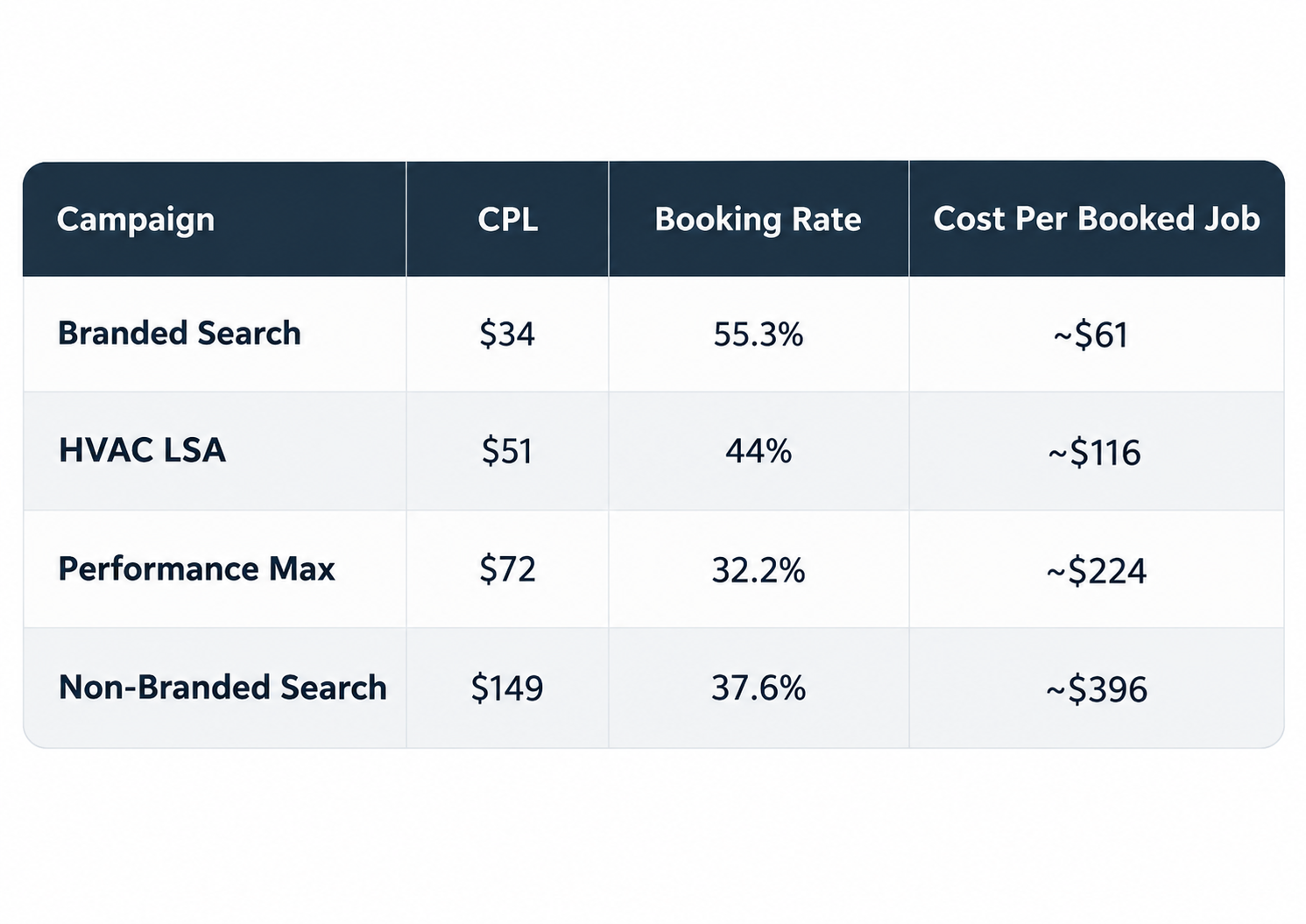
Those figures are based on different periods and are useful for planning, but they still stop before the sold job and gross profit.
That is the important part.
A $149 Search lead is not automatically worse than a $51 LSA lead.
Maybe Search generates more replacements.
Maybe LSA generates more repairs.
Maybe one has a higher close rate.
Maybe one generates customers who stay with you for ten years.
This is why comparing Google LSA vs Google Search Ads for HVAC Businesses only by CPL misses part of the story.
And if you are running paid search, Google Ads Metrics for HVAC Companies in Denver explains why I would watch cost per booked appointment in addition to CPC and CPL.
HVAC Marketing ROI Changes by Service
This is one of the biggest mistakes I see in reporting.
Companies blend everything together.
A $300 repair.
A $900 repair.
A $12,000 replacement.
A $20,000 system.
Then they ask:
"What is our Google Ads ROI?"
I would rather know:
What is our Google Ads ROI for furnace repair?
What is our CAC for replacement customers?
What is our gross profit per lead for AC installs?
We’ve seen just how different paid results can be between HVAC services. Heating repair, AC repair, installation, and IAQ campaigns can produce very different lead costs and returns.
Your allowable acquisition cost should change with the job.
That is also why I would never decide whether Google Ads Cost for HVAC Businesses in 2026 is "too expensive" without knowing what those customers are buying.
Seasonality Can Make a Good Campaign Look Bad
HVAC is one of the worst industries for judging performance from one month in isolation.
I have seen this directly in seasonal swamp-cooler advertising.
Over one March through July period, the campaign generated 24 conversions at roughly $233 per conversion. After changes to budget and bidding, July improved significantly.
Then August looked completely different. Click costs increased, conversions dropped, and cost per conversion climbed above $500.
Same business.
Same general service.
Different point in the season.
That does not mean you ignore deteriorating performance.
It means you ask why before shutting something off.
Did demand fall?
Did competitors increase spend?
Did homeowner urgency change?
Did the service become less relevant?
This is also why the seasonal budgeting ideas in 2026 Google Ads Statistics for HVAC Businesses matter more than trying to hold one CPL target all year.
Which HVAC Marketing Channel Has the Best ROI?
I do not think there is one universal winner.
The channels do different jobs.
Local Services Ads
LSA is strong at capturing immediate local intent.
I would measure:
Lead Cost → Booking → Sold Customer → Gross Profit
Google Search Ads
Google Search Ads for HVAC companies gives you more control over:
Service
Keyword
Geography
Offer
Landing page
Budget
That makes it useful when you specifically want more replacements, repairs, water heaters, or another profitable service.
SEO and Google Business Profile
SEO is a longer-term investment.
I would calculate:
Cumulative SEO Investment ÷ Cumulative Customers Acquired
and then:
Cumulative Gross Profit ÷ Cumulative SEO Investment
Do not call organic leads free.
You still paid to build the asset.
Local SEO and GBP build longer-term visibility, paid search creates demand faster, and email can monetize people you already acquired. The channels work differently and should not be forced into one simplistic ranking.
That is the same reason I recommend thinking about HVAC Marketing Strategies for Small Businesses in 2026 as one connected system rather than a collection of random tactics.
The Cheapest HVAC Lead Can Produce the Worst ROI
Imagine two channels.
Channel A
$50 CPL
25% booking rate
40% close rate
Mostly $600 repairs
Channel B
$175 CPL
65% booking rate
50% close rate
More replacement opportunities
Which lead is cheaper?
You cannot answer from CPL.
That is exactly why we argue for cost per sale rather than simply cost per lead.
Lead price is an input. Profit is the outcome.
Sometimes the Highest ROI Fix Is Not More Marketing
This is a big one.
If marketing produces good leads but nobody answers them, I do not want to buy more leads yet.
If 100 qualified opportunities come in but the office books 40, improving booking might create more revenue than adding another $5,000 to Google Ads.
The same goes for:
Missed calls
Slow callbacks
Weak sales
Poor estimate follow-up
Bad pricing
Low margins
No capacity
That is why learning How to Get More HVAC Leads Without Increasing Ad Spend is really about fixing what happens after demand arrives.
Fix the leak before adding more water to the bucket.
Do not pay to amplify a broken process.
How I Would Set Up HVAC Marketing Attribution
You cannot calculate ROI if you cannot connect the customer back to the source.
At minimum:
1. Track Calls and Forms
Know whether the lead came from:
Google Ads
LSA
Organic
GBP
Referral
Email
Meta
Direct mail
2. Keep the Original Source in the CRM
Do not lose it once the job gets booked.
3. Record the Sold Job and Revenue
Otherwise the report stops at lead generation.
4. Add Gross Profit When Possible
This is the final business result.
5. Feed Offline Results Back Into Google Ads
Google's enhanced conversions for leads allows advertisers to send offline outcomes back into Google so the platform can connect an online lead to a later customer conversion. Google says this improves conversion measurement and can support better bidding decisions. Google Help
That means I would rather teach Google:
"This person became a sold replacement."
than:
"Someone filled out a form."
The HVAC Marketing ROI Dashboard I Would Actually Use
You do not need 40 graphs.
Start with:
Channel - Spend - Qualified Leads - Booked - Ran - Sold - CAC - Revenue - Gross Profit
Then break it down by:
Service - City - New vs. existing customer - Month
That is enough to make a lot of good decisions.
Reviews matter here too because they influence the conversion rate of several channels at once. A better reputation can help your Maps visibility, landing-page trust, call conversion, and close rate. That is why How to Get More HVAC Reviews on Google (Fast Without Breaking Rules) should be viewed as part of the acquisition system, not just reputation management.
And if the entire system feels disconnected, What Digital Marketing Does an HVAC Company Need? shows how I think the pieces should work together.
When Should You Increase HVAC Marketing Spend?
I would want five things to be true:
Leads are qualified
Booking rate is healthy
Close rate is healthy
Gross profit works
The team has capacity
Then increase spend.
Not from $5,000 to $25,000 overnight.
Increase it and ask:
Did the additional money still create profitable customers?
That is the number that matters.
We recommend waiting for enough data before trusting channel comparisons, using roughly 30 tracked leads and 10 sold jobs per channel as a practical minimum where possible. It also makes the important point that channels like SEO, direct mail, Search, and social are measured differently, so you should not compare raw platform metrics as if they are the same thing.
The HVAC Marketing ROI Metric I Ultimately Care About
If I had to reduce the whole article to one number, it would be:
Gross Profit Created Per Marketing Dollar
Formula:
Attributed Gross Profit ÷ Total Marketing Investment
That number does not explain everything.
But it tells you the outcome.
Then:
CPL explains acquisition.
Booking explains intake.
Close rate explains sales.
CAC explains customer cost.
Average ticket explains service mix.
Gross profit explains whether the work was worth doing.
That is how I want marketing reporting to work.
Not as a report card.
As a way to figure out what to fix next.
Conclusion: HVAC Marketing ROI Is About Profit, Not Leads
The biggest mistake you can make with HVAC marketing ROI is stopping the measurement too early.
Clicks are useful.
Leads are useful.
Revenue is useful.
But none of them, by themselves, tell you whether the marketing actually made the business money.
That is why I would track:
Spend → Qualified Lead → Answered → Booked → Ran → Sold → Revenue → Gross Profit
Then break those numbers down by channel, service, season, and customer type.
You may discover that your most expensive leads are producing your best customers.
You may discover that Google Ads is fine, but your booking rate is killing the return.
You may discover that a campaign generating a lot of revenue is actually producing weak gross profit.
Or you may find a channel that is working so well that the obvious next move is to put more money into it.
That is what good marketing reporting should do.
It should not just tell you what happened.
It should tell you what to do next.
If you want help figuring out which marketing channels are actually producing profitable HVAC customers, contact Schulze Creative. I can help you connect SEO, Google Ads, LSA, call tracking, and your sales numbers into one system so you can see where your marketing dollars are really paying off.
FAQ: HVAC Marketing ROI
What Is a Good HVAC Marketing ROI?
There is no universal number because margins, service mix, market, and acquisition costs vary. I would compare your marketing investment against gross profit created, then track whether that ratio improves over time.
What Is the Difference Between HVAC ROI and ROAS?
ROAS compares revenue with ad spend.
Marketing ROI goes farther by considering profit and total marketing cost.
A campaign can have high ROAS and still have weak ROI if job margins are poor.
Which HVAC Marketing Channel Has the Best ROI?
There is no universal winner. LSA, Search, SEO, GBP, email, and referrals can all work well for different reasons. Compare them using sold customers and gross profit rather than raw lead volume.
Should HVAC Companies Track Revenue or Gross Profit?
Both, but I would use gross profit for the final ROI decision whenever reliable job-cost data is available.
How Does Schulze Creative Measure HVAC Marketing ROI?
At Schulze Creative, I try to connect the original marketing source as far through the business as the available data allows:
Spend → Qualified Lead → Booked → Ran → Sold → Revenue → Gross Profit
That is the same philosophy behind Google Ads Metrics for HVAC Companies in Denver.
How Does Schulze Creative Decide Which HVAC Channel to Scale?
I look at lead quality, booking rate, close rate, CAC, customer value, gross profit, and capacity.
If those numbers work, the next question is simple:
Can we spend another dollar here and still acquire a profitable customer?
That is when I want to scale.
