
The HVAC Marketing KPIs Owners Should Actually Track
TL;DR: The HVAC Marketing KPIs Owners Should Actually Track
The best HVAC marketing KPIs follow the customer all the way from spend to gross profit, not just clicks and leads.
Track qualified leads, answer rate, booking rate, run rate, close rate, CAC, average ticket, revenue, and gross profit.
Break the important numbers down by channel, service, geography, and new vs. existing customers so blended averages do not hide the real problem.
Use CPC, CTR, impressions, traffic, and rankings to diagnose marketing. Use customers, revenue, and gross profit to make business decisions.
Every KPI should answer a practical question: What is working, where are we losing money, and what should we fix next?
A marketing report can tell you that you generated 50 HVAC leads at $100 each and still tell you almost nothing about whether the marketing worked.
What happened to those 50 leads?
Did 45 actually need HVAC service, or were 15 junk? How many calls got answered? How many booked? How many appointments actually ran? How many customers bought?
And after labor, equipment, materials, and the cost of acquiring those customers, how much gross profit was left?
That is where I think most HVAC marketing monthly reporting stops too early.
It spends a lot of time telling you what happened inside HVAC Google Ads, your website, or your CRM and not enough time answering the question the owner actually cares about:
Did this digital marketing for our HVAC company make us money?
I like to look at the entire chain:
Spend → Qualified Lead → Answered → Booked → Ran → Sold → Revenue → Gross Profit
That gives every number context.
If 100 leads become 70 booked appointments, you have a very different business than a company where 100 leads become 25 appointments.
Same number of leads.
Completely different outcome.
It is also why I separate marketing metrics from business KPIs.
A metric is simply something you can measure. A KPI is important enough that when it changes, you should probably make a decision.
If CPC goes from $10 to $12, I want to know why. Someone managing HVAC Google Ads costs should absolutely watch CPC, CTR, search terms, conversion rate, and bidding.
But if customer acquisition cost drops from $700 to $450 while gross profit per customer goes up?
That can change how much money I am willing to spend.
The first number helps diagnose the marketing.
The second helps run the business.
The same applies to HVAC call booking rate. Generating the lead is only one step. If good leads are coming in and nobody books them, buying more traffic does not solve the real problem.
So throughout this guide, I am going to break down the HVAC marketing KPIs owners should actually track, how to calculate them, what each one tells you, and what I would look at when the number starts moving in the wrong direction.
Because the goal is not to build a prettier dashboard.
The goal is to know what to fix next.
13 HVAC Marketing KPIs Owners Need to Pay Attention To
You do not need to track every number available in Google Ads, your CRM, or your call tracking software.
You need the handful of numbers that tell you where marketing is working, where opportunities are being lost, and whether the customers you are acquiring are actually profitable.
The 13 HVAC marketing KPIs below follow the customer from the first lead all the way through revenue, gross profit, and lifetime value. If you track these consistently, you can usually tell whether the next thing to fix is marketing, phones, scheduling, sales, pricing, or capacity.
1. Qualified Leads by Source
Do not start with:
“We got 80 leads.”
Start with:
“How many were legitimate opportunities?”
Track leads by source:
Google Search Ads
Local Services Ads
Organic search
Google Business Profile
Referrals
Direct
Other campaigns
Then classify them.
A homeowner in your service area with a failed furnace is not the same thing as:
Spam
Job seekers
Vendors
Wrong service
Wrong geography
Existing customers calling about an open job
I like:
Qualified Lead Rate = Qualified Leads ÷ Total Leads
That number helps you separate bad marketing from bad conversion.
If you generate 50 leads and 20 are junk, look at targeting.
If 45 are good and only 15 book, stop blaming the ads.
That is also why I would never choose the best way to generate HVAC leads based on volume alone.
2. Call Answer Rate
This number is painfully simple.
Answered Lead Calls ÷ Total Lead Calls
If marketing creates the call and nobody answers it, you paid to create an opportunity for the next contractor.
I have personally called home service companies while doing market research and been surprised by how many never answer or never return the call.
So track:
How many calls were answered live?
Then separately track:
How quickly were missed calls returned?
Before buying more leads, I would fix this.
That is one of the reasons getting more HVAC leads without increasing ad spend often starts with the phone rather than another campaign.
3. HVAC Booking Rate
Once the lead is legitimate and someone answers, did it become an appointment?
I prefer:
Qualified Booking Rate = Booked Appointments ÷ Qualified Opportunities
You can also track a raw booking rate using all leads, but label the two differently.
Why?
Because definitions matter.
A historical June 2022 dataset across more than 3,000 trade businesses reported a 42% overall call-booking rate, with HVAC at 38%. That is useful context, but it is not automatically your target because companies can define leads and bookings differently.
Do not compare two percentages until you know the denominator.
That applies to almost every benchmark in this article.
4. Cost Per Booked Job
This is where CPL gets more useful.
Cost Per Booked Job = Marketing Spend ÷ Booked Jobs
Imagine you spend $10,000 and generate 100 leads.
Your CPL is:
$100
Company A books 35.
$10,000 ÷ 35 = $286 per booked appointment
Company B books 55.
$10,000 ÷ 55 = $182 per booked appointment
Same marketing spend. Same leads.
Company B creates 20 more sales opportunities.
No additional advertising required.
This is exactly why I would rather improve the booking system before obsessing over shaving $10 off CPL.
5. Run Rate
Booked does not mean completed.
Track:
Run Rate = Completed Appointments ÷ Booked Appointments
A weak run rate could point to:
Long wait times
Poor scheduling
Weak confirmation
Customers finding another contractor first
Capacity problems
No-shows or cancellations
Keep this separate from close rate.
If the appointment never happens, the sales team never had a chance to close it.
6. Close Rate
Now we are actually talking about selling work.
For genuine sales opportunities:
Close Rate = Sold Jobs ÷ Completed Sales Opportunities
I would not use one close rate for the entire company if you can avoid it.
Separate:
Service/repair
from:
Replacement/install
A technician selling a $600 repair is not doing the same job as a comfort advisor presenting a $15,000 replacement.
Blending them can hide problems.
If replacement leads are strong but the replacement close rate falls, buying more replacement leads might simply make the problem more expensive.
7. Customer Acquisition Cost
This is one of the owner's most important numbers.
CAC = Customer Acquisition Cost
Simple version:
Marketing Spend ÷ New Paying Customers
Better version:
Total Acquisition Cost ÷ New Paying Customers
That second version may include:
Ad spend
Agency fees
Marketing payroll
Tracking software
Landing-page tools
Other acquisition costs
You do not need perfect accounting on day one.
Start somewhere.
But eventually I want to know the real cost of acquiring a customer, not just the cost of getting their phone number.
I go much deeper into that in HVAC Customer Acquisition Cost: What Should It Actually Cost to Win a Customer?.
And remember:
There is no universal good CAC.
A $700 CAC on a profitable replacement customer can be fantastic.
A $300 CAC on a tiny job with no repeat value can be terrible.
8. Average Ticket by Service
Most owners know their average ticket.
I would go one step further.
Break it down.
Maintenance
Repair
Replacement
IAQ
Commercial
whatever matters to your company.
Why?
Because service mix can make the rest of the dashboard lie.
Imagine leads stay flat. Close rate stays flat. Revenue falls 25%.
The problem might not be marketing at all.
Maybe you simply sold more repairs and fewer replacements.
Without service-level numbers, you cannot see that.
9. Revenue Per Qualified Lead
I really like this metric.
Revenue Per Qualified Lead = Attributed Revenue ÷ Qualified Leads
It gives CPL context.
Consider:
Channel A
$60 CPL
but produces:
$180 revenue per qualified lead
Channel B
$130 CPL
but produces:
$750 revenue per qualified lead
Which lead is expensive now?
This is why comparing Google LSA vs. Google Search Ads for HVAC businesses solely on CPL misses the point.
Cheap leads are not the goal. Profitable customers are.
10. Revenue by Marketing Source
You should be able to answer:
How much revenue came from Google Ads?
LSA?
SEO?
Google Business Profile?
Referrals?
If the CRM cannot connect customers back to the original source, fix that.
This is one reason I consider tracking part of the actual digital marketing an HVAC company needs rather than something you bolt on later.
But revenue is still not the end.
11. Gross Profit by Marketing Source
This is where I think owners should eventually get.
Revenue can fool you.
Suppose:
Campaign A creates $100,000 revenue
Campaign B creates $75,000 revenue
Campaign A looks better.
Then you discover:
Campaign A created $25,000 gross profit
Campaign B created $35,000 gross profit
Now which campaign do you want more of?
That is why I would eventually track:
Attributed Gross Profit = Attributed Revenue − Direct Job Costs
Then:
Gross Profit After Marketing = Attributed Gross Profit − Marketing Cost
Now you are talking about actual economics.
12. ROAS vs. Marketing ROI
These are not the same.
ROAS
Attributed Revenue ÷ Ad Spend
Spend:
$10,000
Create:
$50,000 revenue
ROAS:
5x
Useful.
But that does not mean you made $40,000.
Marketing ROI
For owner-level decisions, I would move closer to:
(Attributed Gross Profit − Marketing Cost) ÷ Marketing Cost
Now margins matter.
That is a much better way to decide whether a campaign deserves another $5,000.
13. HVAC Customer Lifetime Value
The customer may continue creating value after the first invoice.
They may:
Buy another repair
Join a maintenance plan
Replace equipment
Refer neighbors
So once you have enough historical data, compare:
CAC
against:
Lifetime Gross Profit
And eventually:
CLV by acquisition source
Maybe Search Ads customers cost more initially but buy more replacements.
Maybe referral customers have exceptional retention.
Maybe one lead source creates lots of cheap one-time calls.
That is why HVAC customer lifetime value belongs in the owner's longer-term marketing scorecard.
Do Not Let Blended Averages Hide the Answer
A company-wide CPL is useful.
It can also hide a disaster.
Imagine this:
AC repair CPL: $70
Replacement CPL: $220
The blended CPL might look expensive.
But the $220 replacement leads could be creating $12,000 installs while the $70 leads generate small repairs.
You need both views.
Track by Channel
Search, LSA, organic, GBP, referrals.
Track by Service
Repair, maintenance, replacement, IAQ.
Track by Geography
One city may produce much better customers than another.
Track New vs. Existing Customers
Acquiring a stranger and reactivating someone already in your database are completely different economics.
Blended numbers tell you how the business is doing.
Segmented numbers tell you what to change.
What About CTR, CPC, Traffic, Rankings, and Impressions?
They matter. They just belong lower on the owner's scoreboard. Think of them as diagnostic numbers.
If leads suddenly fall, then I want to inspect:
Search impressions
CPC
CTR
Rankings
Website traffic
Search terms
Landing-page conversion rate
Those numbers help explain why the business KPI changed.
For example, if ads are generating traffic but the phone is quiet, the problem may be the page itself. Why Your HVAC Website Isn't Getting Calls explains how I separate traffic problems from website conversion problems.
These metrics are useful tools.
They are not the final score.
How to Diagnose Your Business From the HVAC Marketing KPIs
This is the part I would actually print out.
Not enough qualified leads?
Look at visibility, targeting, channel, geography, budget, and offer.
Lots of leads but poor quality?
Look at keywords, targeting, service area, messaging, and lead source.
Good leads but weak booking?
Listen to calls. Check answer rate, response time, CSR training, pricing questions, and availability.
Good booking but weak run rate?
Look at scheduling delay, confirmations, dispatch, and cancellations.
Appointments run but sales are weak?
Look at technician communication, sales process, options, financing, pricing, and trust.
Sales are good but average ticket is weak?
Look at service mix.
Revenue is high but gross profit is weak?
Look at pricing, labor, materials, callbacks, and job efficiency.
Everything is healthy and the team has capacity?
Buy more demand.
That is what good KPI tracking should do. It should tell you where to look next.
The HVAC Owner Dashboard I Would Build
You do not need a giant dashboard with 42 charts.
Start here:
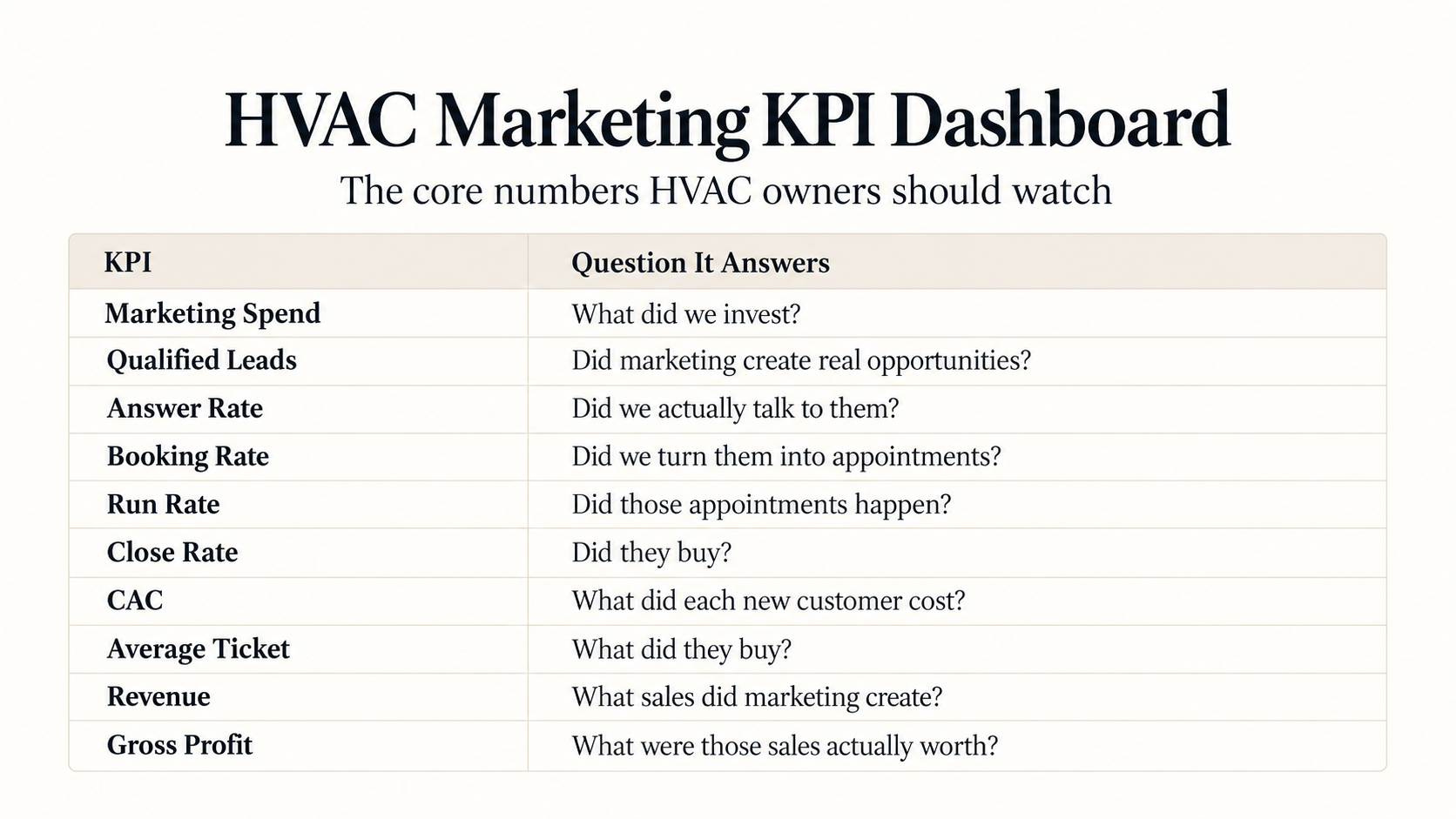
Then break the important numbers down by channel and service.
That dashboard will tell most HVAC owners more than 20 pages of marketing reports.
If you are building this yourself, the tools in my DIY HVAC Marketing Tools guide can help you start tracking calls, website behavior, and lead sources without building an expensive tech stack.
What Are Good HVAC Marketing KPI Benchmarks?
Benchmarks are useful.
But use them correctly.
In an analysis of 3,211 U.S. home-service search advertising campaigns that ran from April 2024 through March 2025, they saw a median CPLs of $127.74 for air-conditioning installation and repair and $129.02 for heating and furnace campaigns.
That does not mean:
“My CPL must be under $128.”
Different market. Different season. Different offer. Different customer. Different website. Different sales process.
Use benchmarks to identify something worth investigating.
Use your own unit economics to decide whether the number is good.
How Often Should You Review HVAC Marketing KPIs?
Not every number needs daily attention.
Daily or Near-Daily
Watch operational problems that can burn leads quickly:
Missed calls
Lead response
Ad-budget pacing
Major campaign issues
Weekly
Review the acquisition funnel:
Spend
Qualified leads
Lead quality
Booking rate
Cost per booked job
Run rate
Obvious campaign problems
Monthly
Make real budget decisions:
CAC
Revenue by channel
Gross profit by channel
Service mix
Marketing ROI
Quarterly
Look at slower-moving numbers:
Customer lifetime value
Retention
Membership performance
SEO trends
New service areas
Bigger budget shifts
Do not redesign your entire marketing strategy because Tuesday was slow.
The HVAC Marketing KPI I Ultimately Care About
If I had to reduce everything to one owner-level idea:
Gross Profit Created Per Marketing Dollar
Conceptually:
Attributed Gross Profit ÷ Total Marketing Investment
That tells you:
For every dollar we put into acquiring customers, how much gross profit did we create?
Then everything else explains why that number moved.
CPL tells me about acquisition efficiency.
Lead quality tells me whether we attracted the right people.
Booking rate tells me about the phones.
Run rate tells me about scheduling.
Close rate tells me about sales.
CAC tells me what customers cost.
Average ticket tells me what they bought.
Gross profit tells me what those sales were actually worth.
That is the point of HVAC marketing KPIs.
When a number changes, you should know where to look, what to fix, and whether the next dollar belongs in marketing, sales, phones, pricing, or capacity. That is when the dashboard becomes useful.
Conclusion: The HVAC Marketing KPIs Owners Should Actually Track
You do not need 40 numbers to understand whether your HVAC marketing is working.
You need the right numbers connected in the right order.
Start with:
Spend → Qualified Lead → Answered → Booked → Ran → Sold → Revenue → Gross Profit
Then use CPL, booking rate, run rate, close rate, CAC, average ticket, revenue per lead, and gross profit by channel to understand what is happening inside that chain.
And do not let blended averages hide the answer.
Break the important numbers down by:
Marketing channel
Service type
Geography
New vs. existing customer
That is how you find out whether a $150 lead is actually expensive, whether Google Ads deserve more budget, whether the phones are leaking opportunities, or whether the business simply needs more demand.
The question I keep coming back to is simple:
For every dollar we put into acquiring customers, how much gross profit did we create?
Everything else should help explain that number.
If you want help setting up marketing, tracking, and reporting that connects SEO, Google Ads, Local Services Ads, your website, calls, and booked jobs back to actual business results, contact Schulze Creative.
I can help you figure out which numbers matter, where the leaks are, and where the next marketing dollar has the best chance of producing profitable growth.
FAQ: HVAC Marketing KPIs
What HVAC Marketing KPIs Should Owners Track?
At minimum, I would track marketing spend, qualified leads, answer rate, booking rate, run rate, close rate, customer acquisition cost, average ticket, attributed revenue, and gross profit.
Then break the major numbers down by channel and service.
What Is the Most Important HVAC Marketing KPI?
There is no single number that diagnoses the entire system.
At the owner level, I ultimately care about gross profit created relative to marketing investment.
The other KPIs tell you why that number improved or declined.
What Is a Good HVAC Cost Per Lead?
A 2025 Search Ads dataset reported median CPLs of about $128 for air-conditioning installation/repair and $129 for heating/furnace campaigns. Those are reference points, not goals.
Your acceptable CPL depends on booking rate, close rate, job value, margins, and customer acquisition cost.
What Is a Good HVAC Booking Rate?
A June 2022 platform dataset reported a 38% booking rate for HVAC in its sample. Definitions vary significantly, so I would establish your own qualified-opportunity booking rate and improve from there rather than chasing one universal benchmark.
What Is the Difference Between HVAC CPL and CAC?
CPL tells you what it costs to generate a lead.
CAC tells you what it costs to acquire a customer.
If four $100 leads are required to create one customer, your acquisition economics are very different from a company that converts two out of four.
Should HVAC Companies Track Revenue or Gross Profit by Marketing Channel?
Both.
Revenue tells you what a channel sold.
Gross profit tells you what those sales were worth before overhead.
For budget decisions, gross profit usually gives me the better picture.
How Often Should HVAC Marketing KPIs Be Reviewed?
I would check lead-flow problems weekly, make meaningful channel and budget decisions monthly, and review longer-term numbers such as retention and CLV quarterly.
What HVAC Marketing KPIs Does Schulze Creative Track?
At Schulze Creative, I try to connect marketing as far down the funnel as the client's available data allows:
Spend → Qualified Lead → Answered → Booked → Ran → Sold → Revenue → Gross Profit
The exact setup depends on the CRM, call tracking, advertising platforms, and how consistently job outcomes are recorded.
How Does Schulze Creative Use HVAC Marketing KPIs?
The purpose is to identify the constraint.
Sometimes Google Ads need work. Sometimes the website is weak. Sometimes marketing is producing good leads and the real problem is booking. Sometimes everything is working and the answer is simply to spend more.
That is why I look at HVAC marketing as a complete system rather than a collection of isolated tactics, which is the same approach I outline in Best HVAC Marketing Strategies for Small Businesses in 2026.
A good KPI should not just tell you what happened. It should tell you where to look next.
