
TL;DR: When Should an HVAC Company NOT Spend Money on Google Ads?
Your customer acquisition costs are higher than your profits. If you're spending more to acquire customers than their jobs can reasonably support, increasing your Google Ads budget will only make the problem worse.
Your technicians are already at capacity. Don't pay for more leads you can't service. Shift your budget toward higher-profit jobs or reduce spending until capacity opens up.
You're losing the leads you already generate. If your office isn't answering calls or converting qualified leads into booked appointments, fix that before spending more.
You can't track what's actually making money. Cost per click and cost per lead don't tell the whole story. Track booked jobs, customer acquisition costs, and gross profit.
Your budget isn't focused on profitable services. Stop spreading money across every HVAC service. Prioritize the jobs with the best margins, available capacity, and strongest customer demand.
You can have a perfectly good HVAC Google Ads campaign and still lose money.
Google could send you 50 qualified leads, your office could book 30 appointments, and your technicians could close 15 jobs.
Sounds great. But what if you spent $5,000 acquiring those customers and the jobs only generated $4,000 in gross profit?
Your marketing worked. Your business lost money.
That's why I don't think every HVAC company should automatically be spending more on Google Ads.
I've managed Google Ads for HVAC companies in the Denver area, and one thing I've learned is that campaign performance doesn't exist in a vacuum. Seasonality, technician availability, booking rates, job profitability, and marketing budgets all affect whether advertising makes financial sense.
Sometimes the answer is to increase spending. Sometimes it's to fix something first. And sometimes, I'd tell an HVAC company to stop spending money on Google Ads altogether until the numbers make sense.
Here's how I'd make that decision.
Are Google Ads Worth It for Every HVAC Company?
Google Ads can be one of the best ways to generate HVAC leads because you're reaching homeowners who are already looking for your services.
Someone searching for "emergency furnace repair near me" probably has a problem they want fixed quickly.
But that doesn't automatically make the click profitable. You still have to pay for the traffic, turn the inquiry into an appointment, complete the job, and make enough money to justify acquiring that customer.
More leads only help if your business can turn them into profitable work.
That's why I look at Google Ads as one part of a larger business system.
Marketing generates demand. Your office books it. Your technicians fulfill it. And your pricing determines whether it was worth doing.
If one of those pieces isn't working, increasing advertising spend might make the problem worse.
7 Signs Your HVAC Company Shouldn't Spend More on Google Ads
1. You Don't Know What You Can Afford to Pay for a Customer
This is where I'd start.
Let's say your average furnace repair generates $400 in gross profit before marketing.
If you spend $350 acquiring that customer, you're left with $50 to contribute toward your overhead and profit.
That might not make sense.
Now compare that to a $12,000 furnace replacement generating $4,000 in gross profit.
Spending $500 to acquire that customer might be a great investment.
Same advertising platform. Completely different economics.
Before setting a budget, calculate your average gross profit by service and how much of it you're willing to spend acquiring a customer.
That's far more useful than following some generic HVAC advertising benchmark.
That is why how much Google Ads costs for HVAC businesses is only a starting point. A good acquisition cost depends on what the customer is actually worth to your business.
2. Your Technicians Are Already at Capacity
Imagine your technicians are booked solid with $99 furnace tune-ups.
Then a cold front moves through, and homeowners start calling about broken furnaces. You have demand for potentially more profitable work, but you've filled your schedule. Would I automatically shut off Google Ads?
No. I'd look at what jobs are filling the calendar.
If we have the capacity for profitable furnace replacements but not additional tune-ups, I'd stop spending money advertising tune-ups and focus on replacements.
If we're booked two weeks out and can't take another emergency repair, I'd reduce that advertising until capacity opens up.
Your marketing budget should follow your available capacity and the jobs you actually want.
Keeping technicians busy isn't the same as maximizing profitability.
3. You're Paying for Leads Your Office Doesn't Book
Let's say you're generating 50 qualified calls per month from Google Ads. But your office only books 15 appointments.
That's a 30% booking rate.
Before increasing spending, I'd want to know what happened to the other 35 opportunities.
Were calls missed? Were homeowners told the next available appointment was four days away? Did the CSR answer pricing questions without attempting to book?
Maybe your advertising isn't the problem. Maybe your office isn't converting the demand you're already paying to generate.
Improving your HVAC call booking rate could create more appointments without increasing your advertising budget.
I'd fix that before asking Google for another 50 leads.
4. Your Website Isn't Converting Relevant Traffic
Google Ads can get someone to your website. It can't force them to call.
If you're paying for furnace repair searches but sending everyone to a homepage promoting AC installations, maintenance plans, and company history, you're making people work too hard.
I'd rather have a dedicated furnace repair page that immediately answers three questions:
Can you fix my problem? Do you service my area? How do I book?
Installation traffic needs something different. Those homeowners want pricing information, financing options, warranties, and proof that you're worth hiring.
That's why knowing how to design an HVAC website around the customer's specific problem matters even more when you're paying for the traffic.
If qualified clicks aren't turning into inquiries, I'd investigate the landing page before buying more clicks.
5. You're Advertising Services That Aren't Profitable Enough
Not every service deserves the same advertising budget.
A company might generate plenty of maintenance leads at a low cost per lead but make very little money on those appointments.
Meanwhile, its replacement campaign generates fewer leads at a higher cost but produces substantially more gross profit.
Which would you rather scale? I'd look at the numbers before deciding.
There's nothing wrong with advertising low-ticket services when they create profitable relationships, maintenance agreements, or future replacement work.
But I'd want actual data supporting that strategy. I wouldn't spend $200 acquiring a $150 tune-up customer simply because I hope they'll eventually buy a new furnace.
6. You Can't Track Which Campaigns Generate Booked Jobs
If you're spending $5,000 per month and can't tell me how many jobs that money generated, I'd be hesitant to increase the budget.
You don't need a complicated reporting dashboard. You need to know which campaigns produced qualified leads, which leads booked, which jobs sold, and how much money those jobs made. Even Google emphasizes the importance of setting the right conversion goals, because the actions you choose determine what its automated bidding system tries to generate.
This is why monthly marketing reports matter: they should connect campaign spending to meaningful business outcomes, not just show clicks and impressions.
Without it, you could be increasing the budget for a campaign generating cheap but unqualified calls while cutting the campaign responsible for your best replacement jobs.
I wouldn't necessarily pause everything because tracking is incomplete. But I'd keep spending controlled until I could make informed decisions.
7. Your Budget Is Spread Too Thin
Let's say you have $500 per month for Google Ads.
You're trying to advertise AC repair, furnace repair, installations, maintenance, mini splits, and duct cleaning across an entire metropolitan area.
That's a problem. You're spreading a limited budget across too many services and search opportunities. I'd rather focus on one service, one manageable geographic area, and a group of high-intent searches.
Even then, $500 might not buy enough traffic or qualified leads to evaluate the campaign reliably in a competitive market.
Google Ads doesn't have a universal minimum budget that guarantees results. Even the ranges in 2026 Google Ads statistics for HVAC businesses are benchmarks, not a budget you should copy without checking your market.
But your budget needs to be large enough relative to your market and acquisition costs to produce useful opportunities.
If it isn't, I'd save the money, narrow the campaign, or invest in another priority first.
How to Know Whether Your HVAC Google Ads Are Actually Profitable
Here's where I'd spend the most time.
Two HVAC companies can have identical Google Ads performance and completely different financial results.
Let's look at a hypothetical example.
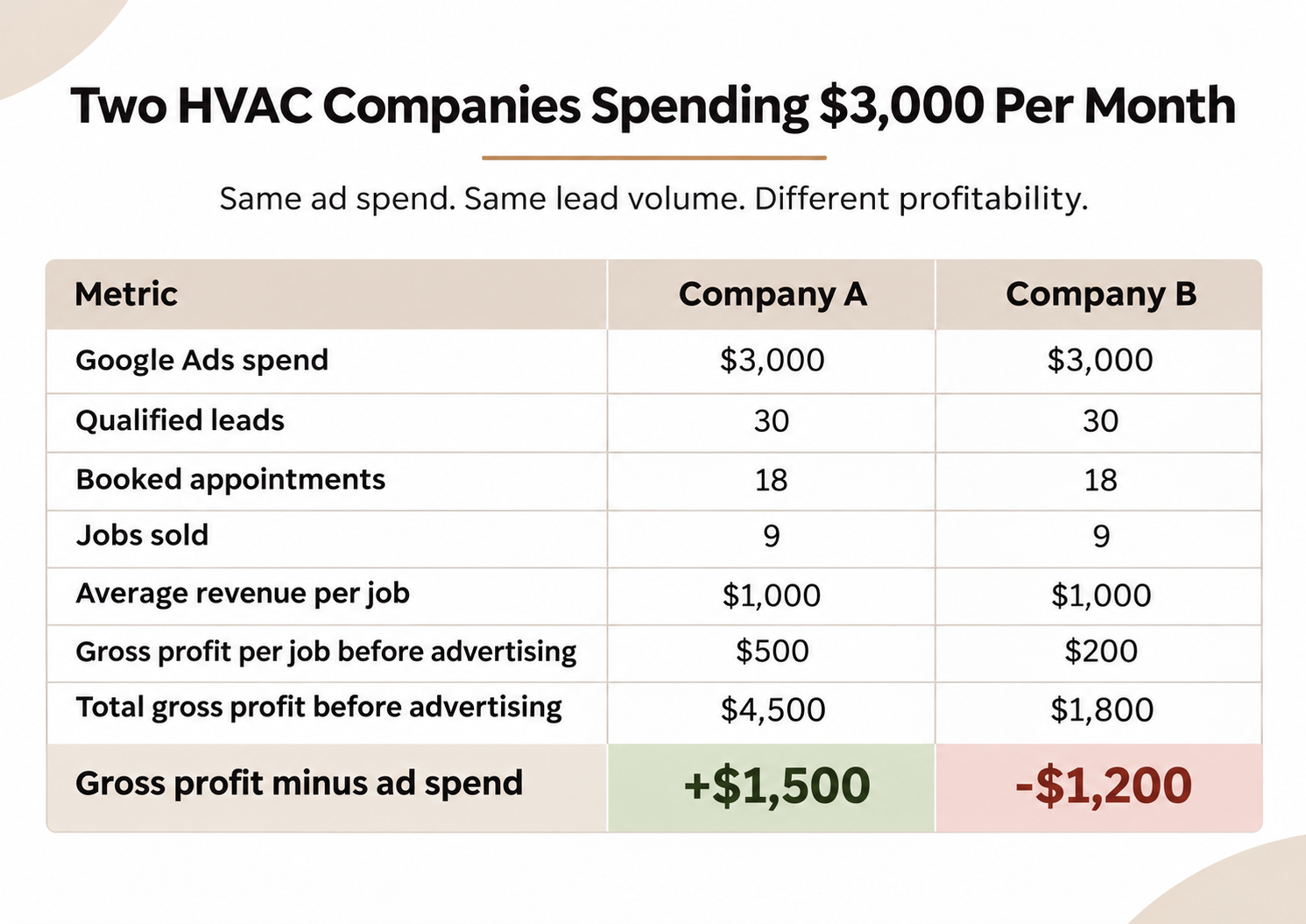
Both companies have a $100 cost per qualified lead. Both book 18 jobs. Both acquire nine paying customers at $333.33 in advertising cost per customer.
But Company A generates enough gross profit to cover its advertising expense.
Company B doesn't.
And that's before accounting for agency fees or other marketing costs.
The problem isn't necessarily the Google Ads campaign. It's how much the business makes from the customers it acquires.
Calculate Your Maximum Customer Acquisition Cost
Here's the calculation I'd use.
Start with the gross profit you make on an average job. Then subtract the amount you need to retain toward overhead and profit.
What's left is your maximum affordable acquisition cost.
For example:
Average gross profit per repair: $400
Required contribution toward overhead and profit: $250
Maximum acquisition budget: $150
Now you have an actual number to work with.
If only 20% of qualified leads become new paying customers, you'd need to acquire those leads for an average of $30 or less to stay within that $150 acquisition ceiling, assuming no other acquisition costs.
Customer lifetime value can change the calculation, but I'd only count future revenue that your business can reasonably substantiate.
It's also why, when comparing what type of digital marketing offers the best ROI for small businesses, I'd look at gross profit instead of revenue alone.
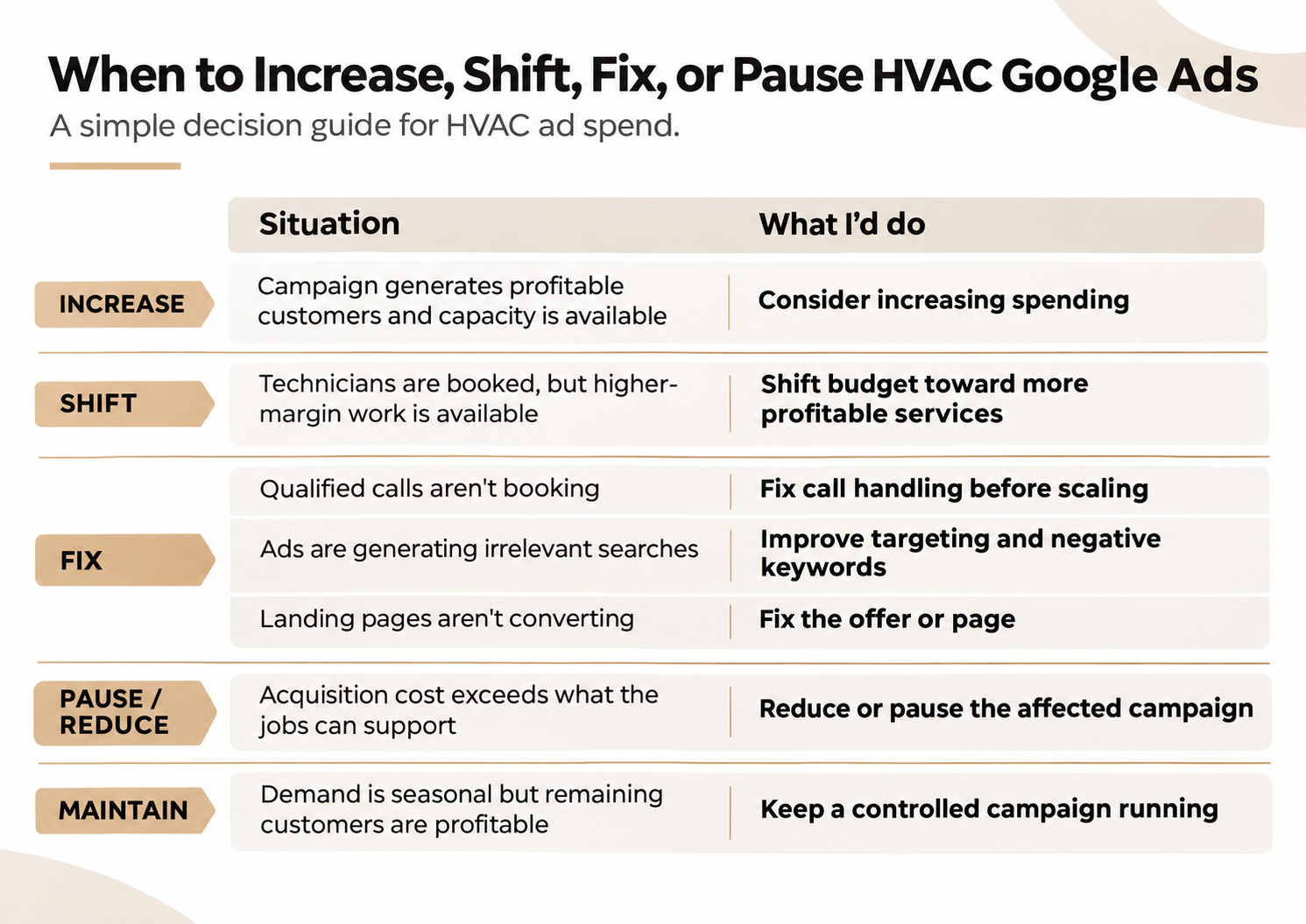
When Should You Pause, Reduce, or Keep Running Google Ads?
I don't think HVAC companies should treat Google Ads like a light switch.
You're either spending money or you're not.
There are better options.
Don't Pause Profitable Advertising Just Because You're Busy
This is something I think contractors get wrong.
If you're booked for the next two weeks, your first instinct might be to shut off your ads.
But what if most of those appointments are low-margin maintenance visits? And what if your installation crew has capacity for another replacement?
I'd rather adjust which services we're advertising than turn everything off.
Don't Keep Spending Just Because Google Reports Conversions
I've worked on seasonal HVAC campaigns, including swamp cooler repair and installation, where performance changed as budgets and seasonal demand shifted.
I've seen how quickly cost per conversion can move when the market changes. But that doesn't automatically mean the campaign should be shut off.
I'd look at whether relevant searches still exist, whether calls are qualified, what those calls book, and whether the jobs are profitable.
A rising CPA is a reason to investigate. Many of the problems covered in what can go wrong with Google Ads, like poor targeting or broken conversion tracking, are things I'd try to diagnose before giving up on the channel.
It's not automatically a reason to quit.
Where I'd Spend Money Before Google Ads
If a company isn't ready to increase advertising, that doesn't mean it should stop investing in marketing altogether.
I'd figure out what's preventing the current demand from turning into profitable jobs.
Fix Your Offer and Website
If customers can't understand why they should choose you, spending more to send them to your website won't help much.
Clearly communicate your services, availability, warranties, financing when offered, and the actual reasons homeowners should hire your company. That's the point of a unique selling proposition (USP): give people a reason to choose you beyond price.
Improve Call Handling
If you're paying for qualified calls but losing them before they become appointments, I'd improve that process before spending more.
Listen to actual calls. Identify objections. Train your CSRs. Measure booking performance.
Invest in Google Business Profile and Local SEO
Google Ads isn't the only way homeowners find contractors.
Building your Google Business Profile, service pages, customer reviews, and organic visibility can help you generate demand without paying for every individual click. Learning how to rank your HVAC company on Google Maps is a practical place to start.
Unlike advertising, SEO usually takes time to develop. But a plan to promote your business locally and get consistent leads is worth investing in when you need a stronger long-term acquisition system.
Improve Your Targeting
Sometimes the money is being wasted because you're paying for people who were never going to become customers.
I'd review the actual search terms and exclude irrelevant traffic.
For example, an HVAC company advertising furnace repairs shouldn't be paying for searches about HVAC jobs, certification programs, or wholesale parts.
But I'd be careful about excluding searches containing words like "cost" or "estimate."
Those can be homeowners preparing to hire.
That's why Google Ads negative keywords for HVAC companies should be selected based on actual intent, not copied from a generic list.
How Much Should an HVAC Company Spend on Google Ads?
I wouldn't tell an HVAC company to spend 10% of revenue on marketing without knowing anything else about the business.
Revenue alone doesn't tell me enough.
A $1 million company with strong margins, six available technicians, and a goal of reaching $3 million needs a different strategy from a $1 million company struggling to make payroll.
I'd start with the company's goals, gross margins, acquisition costs, and available capacity.
Then I'd work backward to a budget.
What About Google Local Services Ads?
If the company has a small advertising budget, Local Services Ads might be worth testing.
LSAs generally charge per lead rather than per click.
That can make them appealing for companies trying to generate local service calls without managing traditional keyword campaigns.
But cheaper leads aren't automatically better leads.
I'd still compare cost per booked job and the gross profit those jobs generate.
The differences between Google LSA vs. Google Search Ads for HVAC businesses matter when deciding where limited advertising dollars should go.
When Google Ads DO Make Sense for an HVAC Company
Here's when I'd be comfortable recommending more spending.
The company knows which services are profitable. It has available capacity. Its phones are being answered, qualified calls are getting booked, and the office can track those opportunities through completed jobs.
Most importantly, the company knows approximately what it can afford to spend acquiring a customer.
That doesn't mean every campaign will immediately be profitable. There still needs to be room for testing, adjustments, and seasonal changes.
But at least we're making decisions based on the economics of the business rather than blindly hoping more advertising will produce more revenue.
The HVAC Google Ads Readiness Checklist
Before increasing your Google Ads budget, I'd answer these five questions:
Do we know our gross profit by service? Not just revenue or average ticket.
Do we know our cost per booked job and acquired customer? Can we connect spending to the actual jobs?
Do we have room for more work? Which technicians, schedules, and services have available capacity?
Are we converting the leads we already generate? What's our answer rate, booking rate, and close rate?
Do we know where the next dollar should go? Which campaign and service create the best opportunity for profitable growth?
If you can't answer most of those questions, I'd address that before substantially increasing spending.
When Should an HVAC Company NOT Spend Money on Google Ads? The Bottom Line
I don't think the question should be, "Can we afford to run Google Ads?"
It should be, "Can we profitably acquire more customers, and do we have the capacity to serve them?"
If your company is generating good leads, converting them into appointments, and making money on the completed jobs, Google Ads can be a great investment.
But if your margins don't support your acquisition costs, your phones aren't converting leads, or your schedule is full of the wrong jobs, more advertising probably isn't the answer.
Fix the actual problem first. Then use your marketing budget to acquire the customers and jobs your business can profitably handle.
At Schulze Creative, that's how I approach marketing for home service companies. The goal isn't to get you spending more money on ads. It's to figure out where your next marketing dollar can make the biggest difference.
Not sure whether your HVAC company should increase, reduce, or stop spending on Google Ads? Book a consultation with Schulze Creative, and let's look at your current marketing, booked jobs, and growth goals before deciding where the budget should go.
FAQ: HVAC Google Ads
Should a New HVAC Company Start With Google Ads?
It can make sense if the company has an offer, enough cash flow to test advertising, and the capacity to handle additional customers. I'd start with a focused campaign rather than advertising every possible service.
Are Google Ads Worth It for Small HVAC Companies?
Yes, if the company can acquire customers profitably. A smaller business doesn't automatically need a smaller acquisition cost. It needs a budget and strategy appropriate for its market and margins.
Should I Pause Google Ads When We're Fully Booked?
Not automatically. I'd review the profitability of the scheduled work and whether capacity exists for higher-value jobs. Reducing certain campaigns may make more sense than shutting everything off.
Should HVAC Companies Advertise During the Off-Season?
Sometimes. I'd look at actual demand and the available services. An off-season campaign may still make sense for replacements, maintenance, or other profitable work, but the strategy should reflect current conditions.
How Do I Know If My HVAC Google Ads Are Losing Money?
Calculate advertising cost per acquired customer, compare it with gross profit, and include relevant management and acquisition expenses. Tracking leads alone won't tell you whether the campaign is profitable.
Is SEO Better Than Google Ads for HVAC Companies?
They solve different problems. Google Ads can capture existing demand quickly, while SEO builds organic visibility over time. I'd prioritize based on what the company needs right now, rather than automatically choosing one.
Can Schulze Creative Tell Me If Google Ads Are Worth Running?
Yes. At Schulze Creative, I work with HVAC and other home service businesses on Google Ads, SEO, Google Business Profile, landing pages, and performance tracking.
My approach is to understand the company's goals, services, margins, and existing marketing results before recommending where to spend.
Sometimes that means increasing advertising. Sometimes it means fixing the website, improving lead tracking, or adjusting the services being promoted. And sometimes the best recommendation is to hold off on spending more until the business is ready.
