
TL;DR: Google Ads Negative Keywords for HVAC Companies
Block searches that won't turn into customers. HVAC jobs, apprenticeships, DIY tutorials, wholesale parts, and services you don't offer are good places to start.
Don't block keywords just because they sound informational. Searches containing “cost,” “price,” “free estimate,” or equipment brands can come from homeowners ready to hire.
Understand negative keyword match types. Broad, phrase, and exact negatives exclude different searches. One overly broad exclusion can cost you valuable leads.
Build negative keyword lists around your services. AC repair, furnace installation, maintenance, and swamp cooler campaigns shouldn't automatically use identical exclusions.
Measure booked jobs, not just wasted clicks. Review your Search Terms report regularly and compare exclusions against qualified calls, booked appointments, and revenue.
A homeowner searching for “furnace repair near me” and a student searching for “HVAC repair training” could both click your Google Ads.
One might turn into a $1,000 repair job. The other is just costing you money.
And Google will happily charge you for both!
That's why Google Ads negative keywords for HVAC companies are so important. They help prevent your ads from showing for searches that have little or no chance of becoming paying customers.
But there's a catch.
Block the wrong keywords, and you could eliminate the exact homeowners you're trying to reach.
I've seen how much search intent matters while managing Google Ads for HVAC companies in the Denver area. Someone searching for an AC replacement cost might just be researching, or they might be comparing contractors before spending thousands of dollars on a new system.
You don't want to exclude that person automatically.
In this guide, I'll show you which negative keywords HVAC companies should consider blocking, which ones you should be careful with, and how to use your actual search data to stop wasting money without sacrificing qualified calls.
What Are Negative Keywords in Google Ads?
Negative keywords tell Google when not to show your ad. Positive keywords help your ad enter relevant searches. Negatives prevent it from appearing for certain terms.
Suppose you target “furnace repair near me,” but show for “furnace repair training course.” You pay for a click that won't become a service call.
This becomes especially important when you're paying for urgent searches. In Google Ads for HVAC emergency calls, I explain why someone with no heat is different from someone researching how a heating system works.
How Negative Keyword Match Types Actually Work
Google offers three negative match types for Search campaigns. They don't behave like positive keywords:
Negative broad match: hvac jobs blocks searches containing both words, in any order. A search with only jobs isn't necessarily blocked by that two-word negative.
Negative phrase match: "hvac jobs" blocks that phrase in that order, even with words before or after it.
Negative exact match: [hvac jobs] blocks that specific search without automatically blocking longer searches such as “hvac jobs near me.”
Negative keywords don't automatically cover synonyms or singular and plural variations. They do account for capitalization and misspellings. Google's negative keyword documentation explains the matching rules.
My rule: use the narrowest exclusion that solves the problem. A single-word negative such as parts can block far more than you intended.
HVAC Negative Keywords List: What Should You Block?
Start with the searches that clearly don't describe a customer you can serve. These are candidates to review, not a list I'd paste blindly into every account.
1. HVAC Jobs, Careers, and Training
If you're selling repair and installation services, searches about employment generally don't belong in your customer acquisition campaigns.
Potential negatives include jobs, careers, salary, apprenticeship, hvac school, and certification course.
Use "hvac training" rather than blocking every search containing training.
2. DIY Tutorials and Research-Only Searches
Consider queries such as "how to replace ac capacitor", "furnace wiring diagram", or "hvac repair tutorial".
Don't automatically block how to. “How to get my AC fixed today” may still be commercial.
3. Parts, Wholesale Supplies, and Equipment Shopping
If you don't sell standalone parts, review searches such as "wholesale hvac parts", "capacitor for sale", and "used furnace parts".
Don't automatically add capacitor, thermostat, or compressor as single-word negatives. “AC capacitor replacement near me” might be exactly the repair call you want.
4. Services, Equipment, and Customers You Don't Serve
A residential-only contractor might exclude "commercial hvac maintenance". A company that doesn't touch vehicle systems might exclude "car ac repair".
But a business offering commercial contracts shouldn't use that residential-only list. The same applies to heat pumps, mini splits, boilers, swamp coolers, and window units.
My swamp cooler campaigns reinforced the need for separate service intent. One contractor's irrelevant query is another's core business.
5. Locations Outside Your Service Area
Review searches containing cities you don't serve, but fix your campaign's location settings first. Location targeting and location exclusions do more of this work than an enormous city-name negative list.
Target areas based on actual service capacity and profitable jobs.
HVAC Keywords You Should NOT Automatically Block
This is where a lot of free negative keyword lists go wrong.
Cost, Price, and Estimate
“Furnace replacement cost” can be a strong lead. So can “AC repair price near me.” People often research price immediately before contacting contractors.
If price searches don't book, review the queries and calls before excluding cost.
Free and Cheap
“Free AC estimate” is valuable if you offer one. “Cheap furnace repair” may still produce jobs.
I'd compare booking rates and job value before making that decision. As I explain in how much Google Ads cost for HVAC businesses, a costly click can still be worthwhile when it produces a profitable job.
Equipment Brands and Problem Descriptions
“Carrier air conditioner” may be product research. “Carrier AC not cooling” could be a homeowner who needs a repair. Excluding Carrier blocks both.
Protect service-related problem searches unless you can't handle that work.
Real HVAC Searches: Block, Keep, or Investigate?
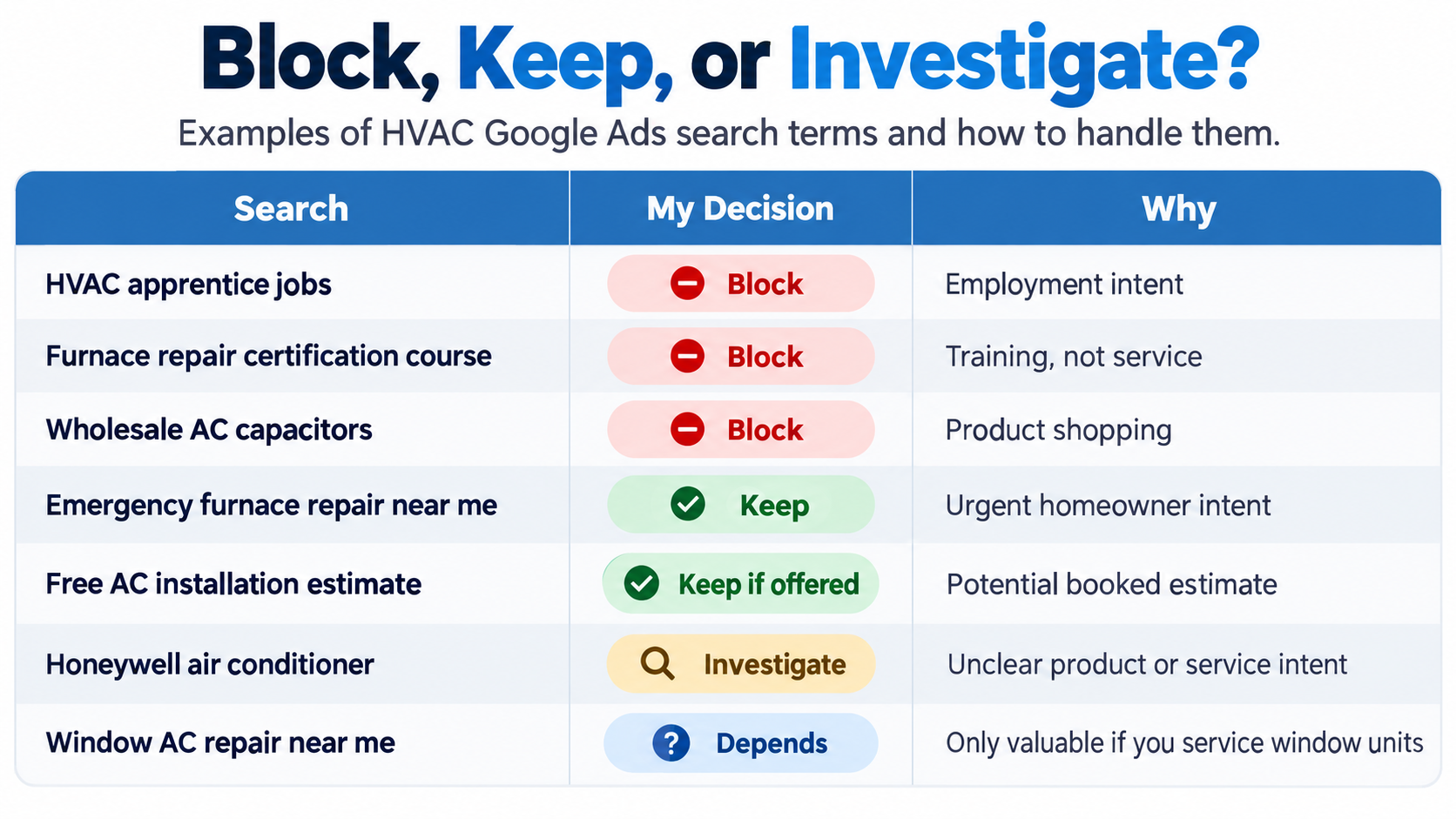
For ambiguous terms, check the landing page and lead outcome before excluding.
Build Separate Negative Lists for Different HVAC Campaigns
I wouldn't use one universal list for AC repair, furnace replacement, maintenance, and swamp cooler installation.
For example, an AC replacement campaign might exclude "ac repair diy" and product-only searches, while a repair campaign should protect phrases like “AC not cooling.” If you sell mini split installations, don't block mini split just because your central AC repair campaign doesn't need it.
Use three levels of control:
Account-level negatives for terms irrelevant across all eligible campaigns, such as obvious employment searches when you're not advertising careers.
Campaign-level negatives for traffic a particular service campaign shouldn't receive.
Ad-group negatives for more precise separation when closely related services share a campaign.
Shared negative keyword lists can make ongoing exclusions easier to maintain across chosen campaigns. But double-check which campaigns each list is applied to. A bad AC repair query could be a good installation lead.
What About Performance Max?
Performance Max supports campaign-level and account-level negative keywords for its Search and Shopping inventory. Google's Performance Max negative keyword instructions explain the process.
Compare the different channels in Google LSA vs Google Search Ads for HVAC businesses.
How to Find and Add Negative Keywords in Google Ads
Here's the process I'd use during a weekly campaign review.
Step 1: Open the Search Terms Report
In Google Ads, go to Campaigns → Insights and reports → Search terms. Adjust the date range and review actual queries that triggered ads. Not every low-volume query appears in the report, so don't assume it's a complete record of every search.
Step 2: Look for Wasted Spend and Weak Intent
Sort by cost and clicks, then read the actual queries.
For expensive terms, ask: Does this person need a service we offer? Are they in our service area? Would our team have a reason to book them?
Step 3: Check the Lead, Not Just the Conversion
A conversion might be a short call that never books. Was the lead qualified?
That is why I distinguish HVAC marketing KPIs from vanity numbers in an ads dashboard.
Step 4: Choose the Match Type and Scope
Block a single irrelevant query with negative exact when appropriate. Use phrase or broad only when you genuinely want to exclude that wider set of searches. Then add it at the ad group, campaign, shared-list, or account level that makes sense.
Check for conflicts with positive keywords before saving.
Step 5: Review the Impact
Compare search terms and booked appointments over time, accounting for seasonality.
I wouldn't claim success just because spend fell. Spending less while losing profitable replacement calls isn't an improvement.
How Do You Know Your Negative Keywords Are Working?
Here's a hypothetical example.
Say an HVAC campaign spends $2,000 and gets 20 inquiries. Five are people looking for training or parts, and 15 are potential customers. Ten of those book appointments.
After excluding clearly irrelevant searches, suppose the next comparable period spends $1,900 and generates 11 booked appointments. That's encouraging, but weather, competition, or call handling could explain the change too.
I'd track:
Irrelevant search spend and qualified lead rate
Answered calls and HVAC call booking rate
Sold jobs, revenue, and HVAC marketing ROI
And if relevant search terms aren't generating calls, I'd check the offer, the Google Ads metrics for HVAC companies, and why your HVAC website isn't getting calls.
Common HVAC Negative Keyword Mistakes
The biggest mistakes are copying a generic list, blocking one-word terms without checking context, placing campaign-specific negatives at the account level, and never reviewing the results.
Another is blaming Google Ads for every unbooked lead. An inquiry isn't a booked appointment.
Good HVAC marketing attribution connects the original search to a qualified call, booked job, and eventually revenue. Without that connection, you're optimizing toward guesses.
Google Ads Negative Keywords for HVAC Companies: Stop Wasting Money Without Losing Good Leads
A good negative keyword strategy isn't about blocking as many searches as possible. It's about making sure your advertising dollars reach homeowners who actually need the services you provide.
Start by excluding obvious mismatches like job seekers, training programs, DIY-only searches, and equipment you don't service. Then review your Search Terms report to find where your budget is going.
But be careful.
Someone searching for “AC repair cost” or “furnace replacement estimate” could be one phone call away from booking a job. Blocking those searches without looking at the results could cost you more than it saves.
My approach is simple: Stop paying for irrelevant searches, protect high-intent traffic, and measure success by qualified calls and booked jobs rather than clicks alone.
At Schulze Creative, we help HVAC companies do exactly that through strategic Google Ads management, better targeting, and conversion tracking that connects marketing spend to actual business results.
Want to know whether your HVAC Google Ads are wasting money on the wrong searches? Contact Schulze Creative to discuss your campaigns and identify opportunities to generate more qualified calls from your existing advertising budget.
FAQ: Google Ads Negative Keywords for HVAC Companies
How Many Negative Keywords Should an HVAC Company Have?
There's no magic number. Start with obvious irrelevant intent, then build the list from your own search terms. A short, accurate list can beat a huge one that blocks legitimate customers.
Should I Block Competitor HVAC Company Names?
Not automatically. Competitor searches are often expensive or less likely to convert, but they can also have commercial intent. Review the results and your strategy before excluding competitor brands.
Do Negative Keywords Work With Broad Match?
Yes. Even when your positive keyword is broad match, negatives can exclude defined searches. But negative matching follows its own rules, so check singular/plural terms and meaning-related searches separately.
How Often Should I Review HVAC Search Terms?
Weekly is a good starting point for active campaigns, especially during seasonal spikes. Increase or decrease that frequency based on spending and query volume.
Can Too Many Negative Keywords Hurt Performance?
Absolutely. You can block good repair, maintenance, or installation searches without realizing it, especially if you use broad single-word negatives everywhere.
Does Schulze Creative Help HVAC Companies Manage Negative Keywords?
Yes. At Schulze Creative, we manage Google Ads for home service companies, including HVAC businesses. That means reviewing search intent, keyword exclusions, geographic targeting, landing pages, and actual lead quality, not just adding a long list once and walking away.
How Does Schulze Creative Decide Which HVAC Searches to Exclude?
I start with what the company sells, where it works, and which jobs are profitable. Then I review real search terms alongside calls and booking outcomes. An exclusion should protect the budget without cutting off the next good customer.
