
Google Ads Metrics for HVAC Companies in Denver
TL;DR: Google Ads Metrics for HVAC Companies in Denver
Don't focus on clicks and impressions. The most important Google Ads metrics for HVAC companies are conversion rate, cost per lead, cost per booked appointment, and return on ad spend (ROAS).
Denver is a competitive HVAC market. Most companies see cost per clicks between $8-$25, conversion rates between 8%-15%, and cost per leads between $75-$200 depending on the service and season.
Cost Per Booked Appointment is often the most valuable metric. Leads don't generate revenue. Booked appointments do.
Small improvements can dramatically improve results. Better ad copy, stronger landing pages, negative keywords, and faster call handling can lower costs and increase revenue.
The goal isn't cheaper leads. The goal is generating more profitable HVAC jobs and maximizing the return on your advertising investment.
If you're running Google Ads for your HVAC company in Denver, chances are you've logged into your account and seen dozens of metrics staring back at you.
Clicks.
Impressions.
Cost per click.
Conversion rate.
Cost per lead.
Return on ad spend.
The problem is that most HVAC business owners don't know which numbers actually matter.
And honestly, that's not your fault.
Google Ads gives you more data than almost any other marketing platform. But most of that data doesn't tell you whether your advertising is making you money.
That's why understanding the right Google Ads metrics is so important.
The HVAC companies that consistently grow in Denver aren't necessarily spending the most money on advertising. They're tracking the right numbers, making smarter decisions, and optimizing for revenue instead of vanity metrics.
In this guide, we'll break down the most important Google Ads metrics for HVAC companies in Denver, explain what good performance looks like, and show you how to use those metrics to generate more calls, more booked jobs, and more revenue.
Why Google Ads Metrics Matter for HVAC Companies
Google Ads can be one of the fastest ways to generate HVAC leads.
When a homeowner searches:
AC repair near me
Furnace repair Denver
HVAC contractor in Denver
Air conditioning replacement
Your company has the opportunity to appear at the exact moment they need help.
That's powerful.
But simply showing up isn't enough.
The real question is:
Are your ads generating profitable jobs?
Many HVAC companies focus on surface-level metrics because they're easy to understand.
More clicks must be good.
More traffic must be good.
More impressions must be good.
Not necessarily.
A campaign can generate hundreds of clicks and still lose money.
Another campaign can generate fewer leads while producing significantly more revenue.
The difference comes down to understanding which metrics actually impact your bottom line.
How Denver's HVAC Market Impacts Google Ads Performance
Denver is one of the most competitive HVAC markets in Colorado.
Homeowners have plenty of options when they search online, and many companies are bidding on the exact same keywords.
That competition affects your advertising costs and performance.
For example, emergency service keywords often cost significantly more than maintenance-related searches because homeowners are ready to make a decision immediately.
Seasonality also plays a major role.
During summer heat waves and winter cold snaps, search volume increases dramatically.
As more HVAC companies compete for those searches, costs typically rise.
This means Denver HVAC companies often experience:
Higher cost per click during peak seasons
Increased competition for emergency service keywords
Greater importance placed on positive google reviews and trust signals
More pressure to convert leads efficiently
Understanding your metrics helps you navigate these market conditions more effectively.
The 8 Most Important Google Ads Metrics for HVAC Companies
Click-Through Rate (CTR)
Click-through rate measures how often people click on your ad after seeing it.
The formula is simple:
CTR = Clicks ÷ Impressions × 100
Let's say your ad appears 1,000 times and receives 60 clicks.
Your CTR would be 6%.
For HVAC companies, CTR helps answer one important question:
Do homeowners find your ad relevant enough to click?
Generally speaking:
Below 4% may indicate weak ad copy
5% to 8% is often considered healthy
Above 8% is typically strong performance
A higher CTR often means your messaging aligns with what homeowners are searching for.
Cost Per Click (CPC)
Cost per click tells you how much you pay every time someone clicks your ad.
For HVAC companies in competitive markets like Denver, CPCs are often higher than many other industries.
Many HVAC advertisers see CPCs ranging between $8 and $25 depending on:
Keyword competitiveness
Service type
Seasonality
Geographic targeting
Emergency service keywords often command some of the highest CPCs because the buying intent is extremely strong.
Here's the important thing to remember:
The cheapest click isn't always the best click.
A $20 click that generates a $15,000 system replacement is far more valuable than a $5 click that never becomes a customer. Manual Cost Per Click for Google Ads is another thing entirely.
Conversion Rate
Conversion rate measures how many people take action after clicking your ad.
That action may include:
Calling your business
Filling out a contact form
Scheduling an appointment
Requesting an estimate
For example:
100 visitors click your ad
12 contact your company
Your conversion rate is 12%.
For HVAC companies, conversion rates often fall between 8% and 15%.
Top-performing campaigns frequently exceed those numbers because they combine strong ads with highly optimized landing pages.
Cost Per Lead (CPL)
Cost per lead measures how much advertising spend is required to generate a lead.
Formula:
Cost Per Lead = Ad Spend ÷ Leads
Example:
$2,000 ad spend
25 leads
Cost Per Lead = $80
Many HVAC companies in Denver see CPLs ranging from $75 to $200 depending on:
Service category
Market competition
Lead quality
Seasonal demand
Emergency repair leads typically cost more than maintenance-related leads.
Cost Per Booked Appointment
This may be the most important metric that many agencies never discuss.
Why?
Because leads don't create revenue.
Booked appointments do.
Let's look at two campaigns.
Campaign A:
40 leads
12 booked appointments
Campaign B:
25 leads
20 booked appointments
Most agencies would celebrate Campaign A because it generated more leads.
A business owner should prefer Campaign B because it generated more actual opportunities.
Formula:
Cost Per Booked Appointment = Ad Spend ÷ Booked Appointments
Tracking this metric helps connect marketing performance to real business outcomes.
Return on Ad Spend (ROAS)
ROAS measures how much revenue your advertising generates.
Formula:
ROAS = Revenue ÷ Ad Spend
Example:
$5,000 ad spend
$25,000 revenue generated
ROAS = 5X
That means every dollar invested produced five dollars in revenue.
Many HVAC companies aim for a minimum ROAS of 4X, though profitable campaigns vary based on margins, overhead, and service mix.
Impression Share
Impression share measures how often your ads appear compared to how often they could appear.
If your impression share is low, it may indicate:
Budget limitations
Strong competition
Poor ad rankings
This metric helps identify whether you're missing opportunities in the market.
Search Terms Report
The Search Terms Report shows the exact searches people typed before clicking your ads.
This report is one of the most powerful optimization tools available.
It helps identify:
Wasted ad spend
Negative keyword opportunities
New service opportunities
High-converting search phrases
Many HVAC companies dramatically improve campaign performance simply by reviewing this report regularly.
Which Google Ads Metrics for HVAC Companies Actually Matter Most?
Not every metric deserves the same level of attention.
Some metrics help you understand visibility.
Others help you understand profitability.
Vanity Metrics
These numbers can look impressive but don't necessarily generate revenue:
Impressions
Clicks
Website visits
Average position
Revenue Metrics
These metrics directly impact business growth:
Conversion Rate
Cost Per Lead
Cost Per Booked Appointment
Revenue Generated
ROAS
If you only review one category every week, focus on revenue metrics.
Those numbers tell you whether your advertising is helping grow your business.
HVAC Google Ads Benchmarks for Denver
Benchmarks provide useful context, but they should never become your goal.
Every HVAC company has different pricing, different close rates, different service offerings, and different operational efficiency.
Still, understanding average performance can help you identify areas for improvement.
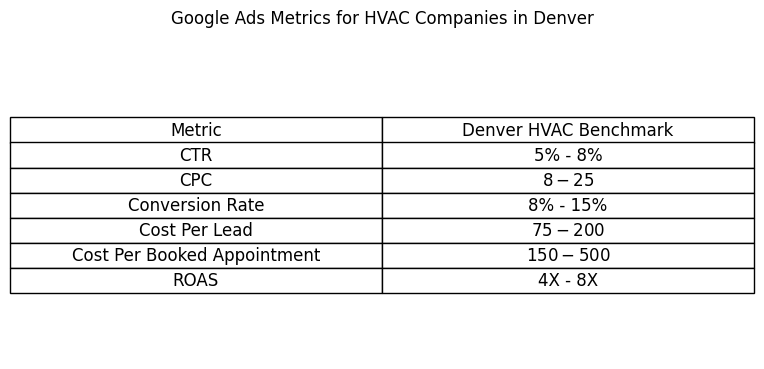
Remember:
A company focused on system replacements may willingly pay much higher lead costs because the revenue generated from each customer is significantly greater.
Context matters.
How Denver HVAC Companies Can Improve Their Google Ads Metrics
Improve Ad Relevance
The closer your ad matches a homeowner's search, the better your performance tends to be.
Create separate campaigns for:
AC repair
Furnace repair
HVAC installation
Heat pumps
Indoor air quality
More specific campaigns typically produce stronger results.
Improve Landing Pages
Many HVAC companies spend thousands on advertising while sending traffic to generic website pages.
A strong landing page should include:
Clear headline
Reviews
Trust badges
Financing information
Service guarantees
Click-to-call buttons
Even small improvements can significantly increase conversion rates.
Improve Lead Quality
Not every lead is worth pursuing.
Use:
Service-specific pages
Geographic targeting
Audience exclusions
These adjustments often reduce wasted spend and improve lead quality.
Improve Call Handling
Your marketing can generate the lead.
Your team determines whether it becomes a customer.
Review:
Missed calls
Response times
Booking rates
Call recordings
Sometimes improving call handling creates more growth than increasing ad spend.
The One Google Ads Metric Every HVAC Owner Should Track Weekly
If you only track one number, make it:
Cost Per Booked Appointment
Here's why.
Clicks don't create revenue.
Leads don't create revenue.
Booked appointments create revenue.
When you know how much it costs to generate a booked opportunity, you gain a much clearer understanding of whether your marketing is actually working.
This metric connects advertising spend directly to business growth.
And that's ultimately what matters.
Are Your HVAC Google Ads Actually Working?
The most successful HVAC companies in Denver don't make decisions based on clicks or impressions.
They understand the numbers that drive revenue.
They track conversion rates.
They monitor lead quality.
They optimize for booked appointments.
And they focus on profitability instead of vanity metrics.
When you understand the right Google Ads metrics, you can make smarter marketing decisions, reduce wasted ad spend, and generate more profitable jobs.
If you're not sure whether your campaigns are performing as well as they should, a Google Ads Expert can often uncover opportunities hiding in plain sight.
FAQs: Google Ads Metrics for HVAC Companies in Denver
What is a good conversion rate for HVAC Google Ads?
Most HVAC campaigns see conversion rates between 8% and 15%. Top-performing campaigns can exceed 20% when they combine strong targeting, compelling offers, and optimized landing pages.
What is a good cost per lead for HVAC companies in Denver?
Many HVAC companies in Denver see cost per lead figures between $75 and $200, though emergency service and replacement campaigns often exceed those numbers.
What is a good ROAS for HVAC Google Ads?
Many HVAC companies target a minimum ROAS of 4X. Higher-ticket services like system replacements can often generate significantly higher returns.
Should HVAC companies focus on clicks or leads?
Neither should be the primary focus.
Booked appointments and revenue are much better indicators of advertising success.
Does Schulze Creative manage Google Ads for HVAC companies?
Yes. We at Schulze Creative help HVAC companies improve visibility, generate qualified leads, and track the metrics that actually impact revenue growth.
How does Schulze Creative measure Google Ads success?
We focus on business outcomes rather than vanity metrics. That includes conversion rates, lead quality, booked appointments, cost per acquisition, and return on ad spend.
