
Should I Set a Manual Cost Per Click (CPC) in Google Ads?
TL;DR: Should I Set a Manual Cost Per Click (CPC) in Google Ads?
Manual Cost Per Click (CPC) in Google Ads lets you control how much you pay for each click in Google Ads by setting your own maximum bids.
It works best for new campaigns, small budgets, and keyword testing because it gives you tighter control over spending.
As campaigns generate more conversions, automated bidding strategies often outperform Manual CPC because they use real time signals like device, location, and search behavior.
We follow a simple strategy: start with Manual CPC, gather data, then switch to automated bidding once the campaign has enough conversion history.
The goal is not choosing one strategy forever. It is using the right bidding strategy at the right stage of your campaign.
Most businesses waste money on their first Google Ads campaigns. Not because the platform does not work. Because the bidding strategy is wrong.
One of the first choices you make when setting up a campaign is how you want to bid. Google gives you a long list of options. Maximize clicks. Target CPA. Smart bidding. It can feel like you are choosing between tools you barely understand. But there is one option that still sparks debate among advertisers.
Manual Cost Per Click.
Some marketers say it is outdated. Others still rely on it every day. And the difference between those two opinions can mean thousands of dollars in ad spend.
I have seen businesses launch campaigns where automated bidding drives CPCs through the roof in the first week. I have also seen accounts where smart bidding doubles conversions once the data is there. The trick is knowing when Manual CPC actually makes sense and when it does not.
In this guide, we will break it down with practical insights you can apply to your own campaigns. You will learn when Manual CPC gives you an advantage, when automated bidding usually wins, and how to set your first bids so you are not guessing. If you run search ads and want better control over your results, this is where to start.
What Is Manual Cost Per Click (CPC) in Google Ads?
Manual Cost Per Click is a bidding strategy in Google Ads where you choose the maximum amount you are willing to pay for a click on your ad.
Instead of letting Google adjust bids automatically, you set them yourself.
For example:
If you set a max CPC of $3.00, you are telling Google:
I am willing to pay up to $3 for a click on this keyword.
You usually end up paying less than your maximum bid because the actual price depends on the auction.
Your real CPC is determined by a combination of factors like:
Your bid
Your Quality Score
The competition in the auction
This means that even if your max bid is $3, you might only pay $1.90 depending on the competition.
Manual CPC gives you direct control over how much you are willing to pay for traffic.
How Manual CPC Works in the Google Ads Auction
Every time someone searches on Google, an ad auction happens instantly.
The auction determines:
Which ads appear
Where they appear
How much each advertiser pays
Google calculates something called Ad Rank.
Ad Rank is based on:
Your bid
Your ad quality
Expected click through rate
Landing page experience
If your ad has a strong Quality Score, you may rank higher than competitors even with a lower bid.
This is why improving your ad relevance and landing page experience is just as important as your CPC bid.
When Manual CPC Actually Makes Sense
Manual Cost Per Click is not the best choice for every campaign. But there are several situations where it can be very effective.
Many experienced advertisers still use Manual CPC in certain scenarios.
Launching a New Campaign
When you start a new campaign, Google has very little data.
Automated bidding strategies rely on conversion data to work well. Without that data, automation can struggle.
Manual CPC gives you control while you gather early data.
We recommend running manual bids until you reach 10 to 30 conversions.
Once enough data exists, automation usually performs better.
Very Small Budgets
If your monthly ad budget is small, automation can sometimes spend money inefficiently early on.
Manual CPC allows you to control bids carefully.
This helps prevent situations where automated bidding drives CPCs higher than you are comfortable with.
Testing New Keywords
Manual CPC is also useful when you are experimenting with keywords.
You can:
Start with low bids
Monitor performance
Increase bids on keywords that generate leads
This method helps identify the most profitable search terms before scaling.
Brand Campaigns
Brand campaigns target searches for your own company name.
Example:
"Schulze Creative digital marketing agency"
These keywords usually have:
Low competition
Low CPC
High conversion rates
Manual CPC works well here because bids are predictable and easy to manage.
When You Should NOT Use Manual CPC
Manual CPC has benefits, but it also has limitations.
Many modern campaigns perform better with automated bidding.
Large Campaigns
If your campaign contains hundreds of keywords, managing bids manually becomes extremely time consuming.
Automation can adjust bids in real time across large keyword sets.
Campaigns With Conversion Data
When campaigns generate regular conversions, automated bidding strategies often outperform manual bidding.
Google's algorithms analyze signals like:
location
device
time of day
browser
search intent
Manual bidding cannot react to these signals in real time.
Scaling Ecommerce Campaigns
Ecommerce accounts often rely on strategies like:
Target ROAS
Maximize Conversion Value
These strategies require machine learning to optimize profit.
Manual CPC usually struggles in large ecommerce accounts.
Manual CPC vs Automated Bidding
There are several automated bidding strategies available in Google Ads.
These include:
Maximize Conversions
Target CPA
Target ROAS
Maximize Clicks
Each uses machine learning to adjust bids during the auction.
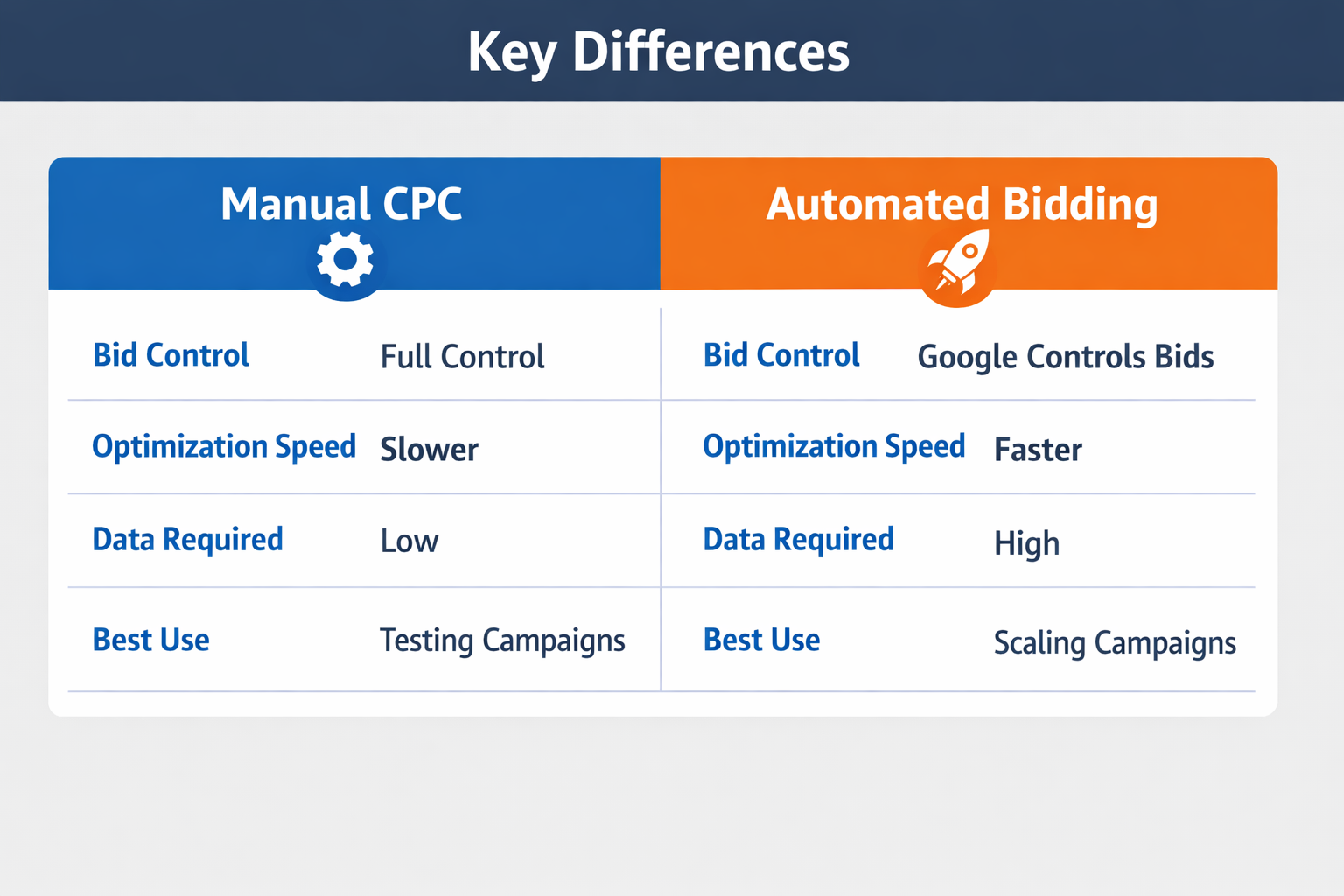
Many advertisers begin with manual bidding and later transition to automation.
Manual CPC vs Maximize Clicks
One automated strategy that often gets confused with Manual CPC is Maximize Clicks.
The difference is simple.
Manual CPCYou choose the bid.
Maximize ClicksGoogle chooses bids to generate the most clicks possible within your budget.
Maximize Clicks can work well for traffic campaigns but it does not focus on conversions.
Manual CPC often provides better control when testing keywords.
Manual CPC vs Smart Bidding
Smart Bidding refers to automated strategies that optimize for conversions.
Examples include:
Target CPA
Target ROAS
Maximize Conversions
These strategies use machine learning to evaluate many signals during each auction.
Signals include:
user location
device type
time of day
language
past search behavior
Manual CPC does not adjust bids using these signals.
That is why automated bidding often wins once campaigns generate enough conversion data.
A Common Strategy: Start Manual Then Switch to Automation
We follow a simple progression when launching campaigns.
Step 1Start with Manual CPC to control costs.
Step 2Gather data and conversions.
Step 3Switch to Maximize Conversions.
Step 4Eventually move to Target CPA or Target ROAS.
This approach combines control in the early stages with automation later.
It allows Google’s algorithm to work effectively once it has enough data.
How to Set Your First Manual CPC Bid
If you decide to use Manual Cost Per Click, here is a simple process to start.
Step 1: Use Keyword Research Tools
Tools like the Keyword Planner inside Google Ads show estimated CPC ranges.
Look at:
top of page bids
competition levels
search volume
Step 2: Start Slightly Below Average
If the estimated CPC is $4.50, start around $3 to $4.
This lets you gather data without overspending.
Step 3: Monitor Performance Weekly
Watch for:
click through rate
conversion rate
cost per conversion
Increase bids on high performing keywords.
Reduce bids on poor performers.
Step 4: Improve Quality Score
Better ads and landing pages can lower CPC.
Focus on:
relevant ad copy
strong calls to action
fast landing pages
Common Manual CPC Mistakes
Many people struggle with Manual CPC because they make a few common mistakes.
Setting Bids Too Low
If your bids are too low, your ads will rarely appear.
Always compare bids to estimated keyword ranges.
Ignoring Quality Score
A higher Quality Score can significantly lower CPC.
Improve ad relevance and landing pages.
Not Adjusting Bids Often Enough
Manual CPC requires ongoing optimization.
Review bids weekly.
Using Manual CPC for Too Long
Once campaigns generate consistent conversions, automation often performs better.
Do not stay manual forever if data supports smart bidding.
So Should You Use Manual Cost Per Click (CPC)?
The answer depends on your campaign stage.
Manual CPC works best when:
campaigns are new
conversion data is limited
budgets are small
you are testing keywords
Automated bidding works best when:
campaigns have consistent conversions
you want faster optimization
accounts are large and complex
In many cases the best approach is to start with manual bidding and transition to automation later.
This allows you to control early spending while still benefiting from machine learning once enough data exists.
Final Thoughts: Should I Set a Manual Cost Per Click (CPC) in Google Ads
Manual Cost Per Click is not outdated. It is simply a tool that works best in the right situation.
If you are launching a new campaign in Google Ads, Manual CPC can give you something incredibly valuable early on. Control. You decide how much you are willing to pay for each click. You can test keywords carefully, protect a small budget, and gather real data without letting automation run wild.
But as your campaign grows, the role of Manual CPC usually changes.
Once you start generating consistent conversions, automated bidding strategies often become more effective. Google’s algorithms can analyze thousands of signals in real time, adjusting bids based on factors that would be impossible to manage manually. That is why we follow a simple path. Start with Manual CPC. Collect data. Then transition to smart bidding once the campaign has enough information to optimize properly.
The key takeaway is this. Manual CPC is not a long term growth strategy for most campaigns. It is a smart starting point.
When used strategically, it can help you find profitable keywords, control early spending, and build a strong foundation for future optimization. And when paired with strong messaging, relevant ads, and high quality landing pages, it becomes part of a much larger system that turns clicks into real customers.
If you want your Google Ads campaigns to succeed, the bidding strategy matters. But the real advantage comes from understanding when to use each strategy and why. If you are confused by this article and just want someone to run Google Ads for you, book a call with us.
FAQs: Manual Cost Per Click (CPC) in Google Ads
What is Manual Cost Per Click (CPC)?
Manual Cost Per Click is a bidding strategy in Google Ads where advertisers set the maximum amount they are willing to pay for a click on their ad.
Is Manual CPC better than automated bidding?
Manual CPC is better for early campaign stages or small budgets. Automated bidding often performs better once campaigns generate enough conversions.
Is Manual CPC outdated?
No. Manual CPC is still useful for testing campaigns, controlling budgets, and managing small accounts. However many large campaigns now use automated bidding.
How much should my Manual CPC bid be?
Start by checking the estimated CPC in Keyword Planner. Begin slightly below the average bid and adjust based on performance.
What does Schulze Creative do with Google Ads campaigns?
We at Schulze Creative help businesses create personalized Google Ads strategies that generate leads and real customers instead of just clicks.
This includes:
campaign setup
bid strategy optimization
landing page improvements
performance tracking
Does Schulze Creative use Manual CPC?
Yes. We sometimes start campaigns with Manual CPC to gather data and control costs. Once enough conversions exist, campaigns often transition to automated bidding strategies.
Can Schulze Creative help lower my Google Ads cost per click?
Yes. We improve CPC by focusing on:
better keyword targeting
stronger ad copy
improved landing pages
higher Quality Scores
These improvements often reduce the cost per click while increasing conversions.
How long does it take to see results from Google Ads?
Most campaigns begin generating data within the first few weeks. Many businesses start seeing meaningful lead flow within 30 days of campaign launch when campaigns are properly optimized.
