
TL;DR: Customer Acquisition Cost for Home Service Businesses
Cost per lead is not customer acquisition cost. A $100 lead can easily turn into a $400 or $800 customer once booking and close rates are factored in.
Track the full path: Spend → Lead → Qualified → Booked → Ran → Sold → Gross Profit.
There is no universal “good CAC.” A $600 CAC can be terrible for a small repair and great for a high-margin replacement.
Compare CAC to gross profit and lifetime gross profit, not just revenue.
You can lower CAC without getting cheaper leads by improving booking, follow-up, close rate, website conversion, and retention.
A home service company can brag about a $75 cost per lead and still have terrible marketing economics.
Here’s why.
If you spend $6,000 and generate 80 leads, your CPL is $75. Looks good!
But if only 20 of those leads actually become paying customers, your real customer acquisition cost is $300.
That is the number I care about a lot more.
Because home service businesses do not make money from leads. They make money from customers. And even CAC by itself is not enough.
If you spend $600 to acquire a customer who buys a $350 repair, that probably looks awful.
If you spend the same $600 to acquire a customer who buys a profitable $12,000 replacement, joins a maintenance plan, and calls you again later, that could be a great investment.
So when I look at customer acquisition cost for home service businesses, I do not stop at:
Spend → Lead
I want to see:
Spend → Lead → Qualified → Answered → Booked → Ran → Sold → Gross Profit
That is where the useful decisions start.
In this guide, I’ll show you how to calculate CAC properly, what costs to include, how to compare CAC across services and marketing channels, and how to figure out what you can actually afford to pay for a customer.
Because the goal is not to acquire the cheapest customer.
The goal is to acquire profitable customers at a cost you can repeat.
What Is Customer Acquisition Cost for Home Service Businesses?
The basic formula is simple:
Customer Acquisition Cost = Acquisition Spend ÷ New Paying Customers
If you spend $10,000 acquiring new customers and 25 people actually hire you:
$10,000 ÷ 25 = $400 CAC
The key words are paying customers.
Not leads. Not phone calls. Not estimates. Not appointments. Customers.
This is the same distinction I make when looking at HVAC Customer Acquisition Cost: What Should It Actually Cost to Win a Customer?.
Marketing CAC vs Fully Loaded CAC
I actually like tracking two versions.
Marketing CAC:
Marketing spend ÷ new customers
Then a more complete number:
Fully Loaded CAC:
Marketing + sales acquisition costs ÷ new customers
That second number might include:
Ad spend
LSA spend
SEO
Agency fees
Call tracking
CRM or lead software
Sales commissions
Marketing payroll
Other costs directly tied to acquiring customers
If you only include media spend, you can make your CAC look artificially good because you are ignoring the people, tools, and systems required to actually produce the customer.
I would not make the formula so complicated that nobody uses it. Just be consistent.
Cost Per Lead vs Customer Acquisition Cost
This is where a lot of owners get fooled.
Imagine your Google Ads CPL is:
$100
And 25% of those leads become customers.
Your actual CAC is:
$400
A useful shortcut is:
CAC = CPL ÷ Lead-to-Customer Conversion Rate
That is why I care so much more about what happens after the lead.
Current 2026 home-service data makes this gap obvious.
LSA benchmark reported roughly $53 per lead but $233 per paying customer.
Blended Google Ads data showed roughly $104 per lead and $472 per paying customer.
Non-branded Search was even wider at $149 per lead and $804 per paying customer.
The lead cost is only the beginning.
Your Phone Process Can Cut CAC Without Making Leads Cheaper
This is one of my biggest opinions on CAC. Owners assume that if acquisition cost is too high, marketing needs cheaper leads. Not always.
Two companies could each spend:
$10,000
and each generate:
100 leads
Same CPL.
But Company A converts 20 of them into customers:
$500 CAC
Company B converts 40:
$250 CAC
Company B did not get cheaper leads.
They simply did a better job with them.
That is why I treat HVAC Call Booking Rate: The Number Between Your Leads and Your Revenue as part of marketing economics, not just an office metric.
If your booking rate goes from 35% to 55%, you can dramatically lower customer acquisition cost without increasing traffic by one person.
The same idea is behind How to Get More HVAC Leads Without Increasing Ad Spend.
Sometimes you do not need another lead. You need to stop wasting the ones you already paid for.
What Is a Good Customer Acquisition Cost for a Home Service Business?
There is no universal number.
I know that answer is less satisfying than saying "$300 is good," but it is the truth.
A $300 CAC for a $350 repair is probably awful.
A $700 CAC for a profitable $12,000 replacement could be fantastic.
That is why the better question is:
How much gross profit does this type of customer create?
I use the same logic when helping electricians think about Electrician Marketing Budget: How Much Should You Actually Spend?.
You should not have the same allowable CAC for:
A $300 repair
A $1,500 EV charger
A $4,000 panel upgrade
A $10,000 generator
A $15,000 rewire
The economics are completely different.
Stop Comparing CAC to Revenue
This is another mistake I see all the time.
Say two customers each generate:
$5,000 in revenue
Customer A produces:
$2,500 gross profit
Customer B produces:
$1,000 gross profit
Both cost $600 to acquire.
Those are not equally valuable customers.
I would eventually measure:
CAC ÷ First-Job Gross Profit
and:
Lifetime Gross Profit ÷ CAC
That is also why the final numbers in The HVAC Marketing KPIs Owners Should Actually Track are revenue and gross profit, not clicks and impressions.
Revenue tells you how much sold.
Gross profit tells you what the sale was actually worth.
Customer Lifetime Value Changes What You Can Afford to Spend
The first invoice is not always the whole customer.
An HVAC customer might start with a repair, join a maintenance plan, need another repair, and eventually replace their system.
A plumbing customer might start with a clogged drain and eventually buy a water heater.
A pest-control customer could stay on recurring service for years.
Many think roughly 3:1 to 5:1 LTV:CAC as a useful service-business range, while also pointing out that an extremely high ratio could mean a company is actually underinvesting in growth.
I like the concept, but I would make one adjustment for home services:
Use lifetime gross profit whenever you can, not just lifetime revenue.
An online example estimates roughly $1,040 in lifetime gross profit for a customer retained 5.5 years, but only about $660 when that lifespan falls to 3.5 years. Same acquisition cost. Much worse economics.
Retention changes what you can afford to pay upfront.
How Much Can You Afford to Pay for a Customer?
Here is the way I would work backward.
Step 1: Find the Gross Profit
Suppose the average customer you want more of creates:
$2,000 first-job gross profit
Step 2: Set an Allowable Acquisition Cost
Maybe you are comfortable spending 25% of that gross profit acquiring the customer.
That gives you:
$500 allowable CAC
Step 3: Account for Lifetime Value
If that customer regularly buys again, joins a membership, or generates referrals, you may eventually decide you can spend more.
But I would be careful here.
Do not use a theoretical replacement 12 years from now to justify terrible economics today.
Lifetime value should make good acquisition better. It should not be an excuse for bad acquisition.
Step 4: Build Your Marketing Budget
If you want 20 additional customers and can profitably spend $500 acquiring each:
20 × $500 = $10,000 potential acquisition budget
That is a much better way to think about marketing budgets than picking a random number.
Stop Using One CAC for the Whole Company
This is where CAC becomes really useful.
Do not stop at:
Google Ads CAC = $450
Break it down.
Google Search → Furnace Replacement → $650 CAC
LSA → Furnace Repair → $240 CAC
SEO → AC Replacement → $300 CAC
Now you can make decisions.
This is one reason I prefer building service-specific campaigns in Google Ads for Home Service Businesses: Performance Max vs Search Campaigns.
Search gives you the ability to intentionally go after the services you want more of.
And if you are comparing paid channels, Google LSA vs Google Search Ads for HVAC Businesses explains why the cheapest lead does not automatically mean the cheapest or best customer.
Customer Acquisition Cost by Marketing Channel
Different channels need to be measured differently.
Google Search Ads
Search is expensive, but I like the control.
You can control keywords, services, geography, messaging, landing pages, negatives, offers, and budget.
That is why I often prefer Search when we know exactly what type of job we want.
The latest home-service benchmark data also shows why tracking beyond CPL matters. LSA averaged $233 per paying customer in a dataset compared with $472 for blended Google Ads, while non-branded Search averaged $804.
Local Services Ads
I like LSA running in the background for a lot of home-service companies.
It is pay per lead.
If it sends 10 good opportunities this month, great. If it sends two next month, you did not burn the same amount of budget buying clicks. Volume can be inconsistent, though, so I usually would not want the entire acquisition system dependent on it.
SEO
SEO CAC needs to be measured over a longer period.
I would use:
Cumulative SEO Investment ÷ Cumulative New Organic Customers
Organic customers are not free.
You paid to build the asset.
That is why SEO for HVAC: How to Grow Your Business with Schulze Creative focuses on searches that can actually produce calls and booked jobs, not simply ranking for more keywords.
Shared Lead Platforms
This is where owners really need to calculate CAC.
Paying $50 for a lead sounds cheap.
But if five contractors got the same lead and only 10% turn into customers:
Your customer acquisition cost can get ugly fast.
That is why I prefer building lead sources you actually control, which is also a major theme in How to Get More Customers as an Electrician Without Buying Junk Leads.
How to Lower CAC Without Finding Cheaper Leads
If CAC is too high, I would inspect the entire funnel:
Lead → Qualified → Answered → Booked → Ran → Sold
Then find the first big leak.
Bad leads?
Fix targeting, messaging, keywords, service areas, or the offer.
Good traffic but low conversion?
Look at the website. Contractor Website Design: What Actually Turns Visitors Into Calls covers the clarity, trust, proof, and calls-to-action I look for.
Good leads but weak booking?
Listen to calls.
Good appointments but weak closing?
Look at sales, financing, pricing, and how options are presented.
Good customers but poor lifetime value?
Look at retention, follow-up, maintenance plans, and referrals.
Sometimes the cheapest way to lower CAC is simply getting better at converting the demand you already bought.
The CAC Dashboard I Would Actually Track
You do not need 50 KPIs.
Start here:
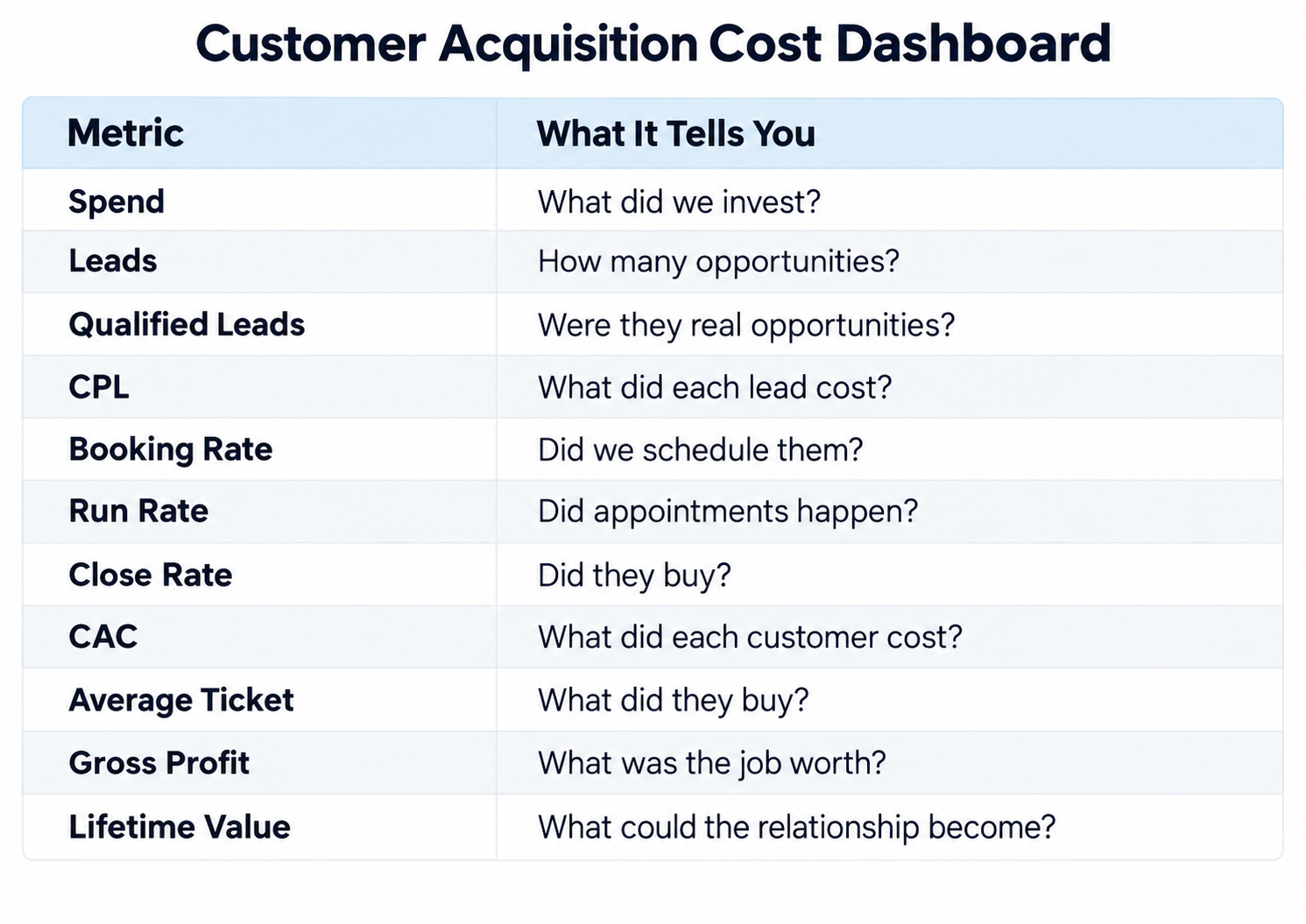
Then segment it by:
Channel + Service
That is when CAC becomes useful instead of just another number in a report.
A complete acquisition system is also why I like thinking about What Digital Marketing Does an HVAC Company Need? as multiple pieces working together rather than one magic channel.
Conclusion: Customer Acquisition Cost for Home Service Businesses Is About Buying Profitable Customers
The biggest mistake with customer acquisition cost for home service businesses is treating CAC like a number that should always be as low as possible.
That is not the goal.
A $200 customer can be expensive if they only buy a $250 service call.
A $700 customer can be cheap if they generate thousands in gross profit and stay with you for years.
That is why I would track the full chain:
Spend → Lead → Qualified → Answered → Booked → Ran → Sold → Gross Profit → Lifetime Gross Profit
Then break it down by channel and service.
That tells you which customers are actually worth acquiring.
It also tells you where to look when CAC gets too high.
Sometimes the problem is targeting. Sometimes it is lead quality. Sometimes the phones are not getting answered. Sometimes booking is weak. Sometimes the techs are not closing. And sometimes the customer simply is not worth what you are paying to acquire them.
Once you know the math, the question changes from:
“How do I get cheaper leads?”
to:
“How much can I profitably spend to acquire this customer, and can I buy more of them?”
That is a much better way to run marketing.
If you want help figuring out your real CAC, which channels are producing profitable customers, and where your next marketing dollar should go, contact Schulze Creative.
FAQ: Customer Acquisition Cost for Home Service Businesses
What is customer acquisition cost for a home service business?
CAC is the total cost required to acquire a new paying customer. At its simplest, divide acquisition spend by new customers acquired.
What is the difference between CPL and CAC?
CPL measures what it costs to generate a lead. CAC measures what it costs to turn those leads into paying customers.
What is a good customer acquisition cost for contractors?
There is no universal number. Your acceptable CAC depends on gross profit, service type, close rate, repeat business, lifetime value, cash flow, and capacity.
Should agency fees be included in CAC?
For fully loaded CAC, yes. I would include costs directly tied to customer acquisition, such as ad spend, agency fees, tracking software, and relevant sales expenses.
Should I compare CAC to revenue or gross profit?
I prefer gross profit. Revenue can make an expensive customer look better than they really are because it ignores the direct cost of delivering the job.
Can improving booking rate lower CAC?
Absolutely. If the same number of leads produces more paying customers, your CAC falls without changing your CPL.
How does Schulze Creative track customer acquisition cost?
At Schulze Creative, I try to connect Home Service Digital Marketing all the way through:
Spend → Qualified Lead → Booked → Ran → Sold → Revenue → Gross Profit
The farther we can follow the customer, the better decisions we can make.
How does Schulze Creative decide when to increase marketing spend?
I want to know the customer is profitable, CAC is sustainable, the funnel is converting well, and the business has capacity.
Then the real question becomes:
Can we spend the next dollar and still acquire a profitable customer?
