
Electrician Marketing Budget: How Much Should You Actually Spend?
TL;DR: Electrician Marketing Budget: How Much Should You Actually Spend?
5% to 10% of revenue is a useful benchmark, not a rule. Your actual electrician marketing budget should come from your growth goal, job mix, margins, and capacity.
Work backward from the customer: Revenue Goal → Customers Needed → Leads Needed → Expected Lead Cost → Total Marketing Budget.
Do not optimize around cost per lead alone. Track Spend → Lead → Booked → Ran → Sold → Revenue → Gross Profit.
Your acceptable customer acquisition cost should change by service. A panel upgrade, generator, rewire, and small repair should not all have the same CAC target.
Increase digital marketing budget when customer acquisition is profitable and you still have capacity. Cut or reallocate when the next dollar stops producing acceptable returns.
A $5,000 monthly marketing budget can be a terrible decision for one electrical contractor and a great decision for another.
That is why I do not think “spend 5% to 10% of revenue” is a complete answer. It is a decent benchmark. But it tells you almost nothing about what you should actually spend.
A residential electrician doing mostly $300 service calls should not build a budget the same way as a company trying to add $500,000 in panel upgrades, generators, EV chargers, and rewires.
The math is different. The risk is different. The upside is different.
I would start with this question:
How much can you afford to spend to acquire a profitable customer?
Then work backward.
If you want another $250,000 in revenue, figure out how many customers that requires. Then determine how many leads you need to create those customers, what those leads should cost, and whether the gross profit from the work supports the acquisition cost.
That is the part most marketing budget advice skips.
You also need to know where the budget stops making sense.
If your next $1,000 produces profitable customers, keep going.
If the next $1,000 produces low-margin jobs, bad leads, or work your team cannot handle, stop or move the money somewhere else.
That is how I would build an electrician marketing budget.
Not from a percentage, but from the actual economics of the business.
How Much Should an Electrician Spend on Marketing?
As a rough benchmark:
4% to 6% of revenue: maintaining an established business
6% to 10%: consistent growth
10% to 15%+: aggressive growth, expansion, or entering a competitive market
Those numbers are useful for checking whether your budget is reasonable.
But I would not start there.
If your company does $1 million a year, a 7% budget equals:
$70,000 per year
or about:
$5,833 per month
That still does not tell you whether $5,833 is the right number.
I would rather know:
How much new revenue do you want?
Which electrical services should create it?
What is the gross profit on those jobs?
How many customers do you need?
How many leads does it take to produce those customers?
What will those leads cost?
Can your team actually handle the extra work?
Use percentage of revenue as a guardrail after you do the math, not as the math itself.
If you are still deciding where to invest, 9 Electrician Marketing Ideas That Actually Generate Calls covers the channels I would consider first.
What Should Be Included in an Electrician Marketing Budget?
Contractors often use “marketing budget” to mean different things.
One company might say it spends $4,000 per month on Google when the real breakdown is:
$2,500 Google Ads spend
$1,000 agency fee
$300 tracking software
$200 website work
That is $2,500 in media spend and $4,000 in total marketing investment.
I would separate the budget into four categories.
Advertising Spend
Money paid directly to generate attention or leads:
Direct mail
Lead platforms
Sponsorships
Marketing Management
The people running the marketing:
Agency fees
PPC management
Freelancers
Internal marketing employees
Keep this separate from ad spend so you know how much money is actually reaching the platform.
Owned Marketing Assets
Things the business builds and keeps:
These can become increasingly valuable over time because you are not paying for every single click.
For SEO, the starting point should be the actual work you want more of. Electrical Contractor Keywords for SEO: What to Target First explains how I would prioritize service, local, emergency, and high-value searches.
Tracking and Software
This can include:
Call tracking
CRM
Analytics
Reporting
Email tools
Lead attribution
If you are spending tens of thousands of dollars a year on marketing, you need to know what is creating customers.
Your Electrician Marketing Budget Has Three Limits
There are three ceilings I would think about.
1. Cash
How much can you safely invest without creating a cash flow problem?
A campaign can be profitable on paper and still hurt the business if you need to spend the money today but do not get paid for the work for another 60 days.
2. Profitability
How much can you pay to acquire a customer while still making enough money on the job?
This should be based on gross profit, not just revenue.
3. Capacity
How many additional customers can the company actually serve?
If your schedule is already full three weeks out, another $10,000 in advertising may create more missed calls, longer wait times, and unhappy customers instead of more profit.
Your actual marketing budget has to stay under all three ceilings.
How to Calculate Your Electrician Marketing Budget
I would work backward from the growth goal.
Step 1: Set the Revenue Target
Say your electrical company currently does:
$750,000 per year
Your goal is:
$1,000,000
You need:
$250,000 in additional revenue
Now we have a real target.
Step 2: Decide What Kind of Work You Want
Do not just say you need another $250,000 in “electrical work.”
Be specific.
Maybe you want more:
Panel upgrades
EV charger installations
Generator installations
Rewires
Commercial projects
Residential service work
The marketing should match the jobs you want.
If panel upgrades are a priority, they should not be buried inside one generic electrical services page. The same principle applies to how you structure an electrician website that converts.
Step 3: Calculate the Customers You Need
Suppose your targeted job mix averages:
$2,500 in first-job revenue per customer
To add $250,000:
$250,000 ÷ $2,500 = 100 new customers
Now the goal is clear.
You need roughly 100 new customers.
Step 4: Work Backward Through the Funnel
Leads are not customers.
Say your numbers look like:
65% of leads book
90% of booked appointments actually run
55% of completed appointments close
Your overall lead-to-customer rate is:
65% × 90% × 55% = 32.2%
To get 100 customers:
100 ÷ 32.2% = about 311 leads
Now you know the marketing system needs to create roughly 311 leads.
Step 5: Estimate Lead Cost
Suppose your blended paid lead cost is:
$80
311 leads × $80 = about:
$24,880 in media spend
That gives you a starting point for paid acquisition.
Then add any management, SEO, website, and tracking costs to get the actual marketing investment.
Step 6: Check the Gross Profit
Suppose that $250,000 in new revenue produces a 45% gross margin.
That is:
$112,500 in gross profit
If the total additional marketing cost is $40,000:
$112,500 gross profit
− $40,000 marketing
= $72,500 remaining before overhead
Now you can actually judge whether the plan makes sense.
Customer Acquisition Cost Matters More Than Cost Per Lead
This is one of the biggest mistakes I see in home service marketing.
Everyone wants cheaper leads.
But cheap leads can produce expensive customers.
The basic formula is:
Customer Acquisition Cost = Total acquisition spend ÷ new customers
You can also estimate CAC using your funnel:
CPL ÷ (Booking Rate × Run Rate × Close Rate)
Say your leads cost:
$90 each
Your funnel is:
60% booking rate
90% run rate
50% close rate
Your CAC is approximately:
$333
That number is much more useful than the $90 cost per lead.
You are not really trying to buy leads. You are trying to buy profitable customers.
Your Acceptable CAC Should Change by Service
An electrical company can sell jobs ranging from a few hundred dollars to tens of thousands.
Those customers should not all have the same acquisition target.
For example:
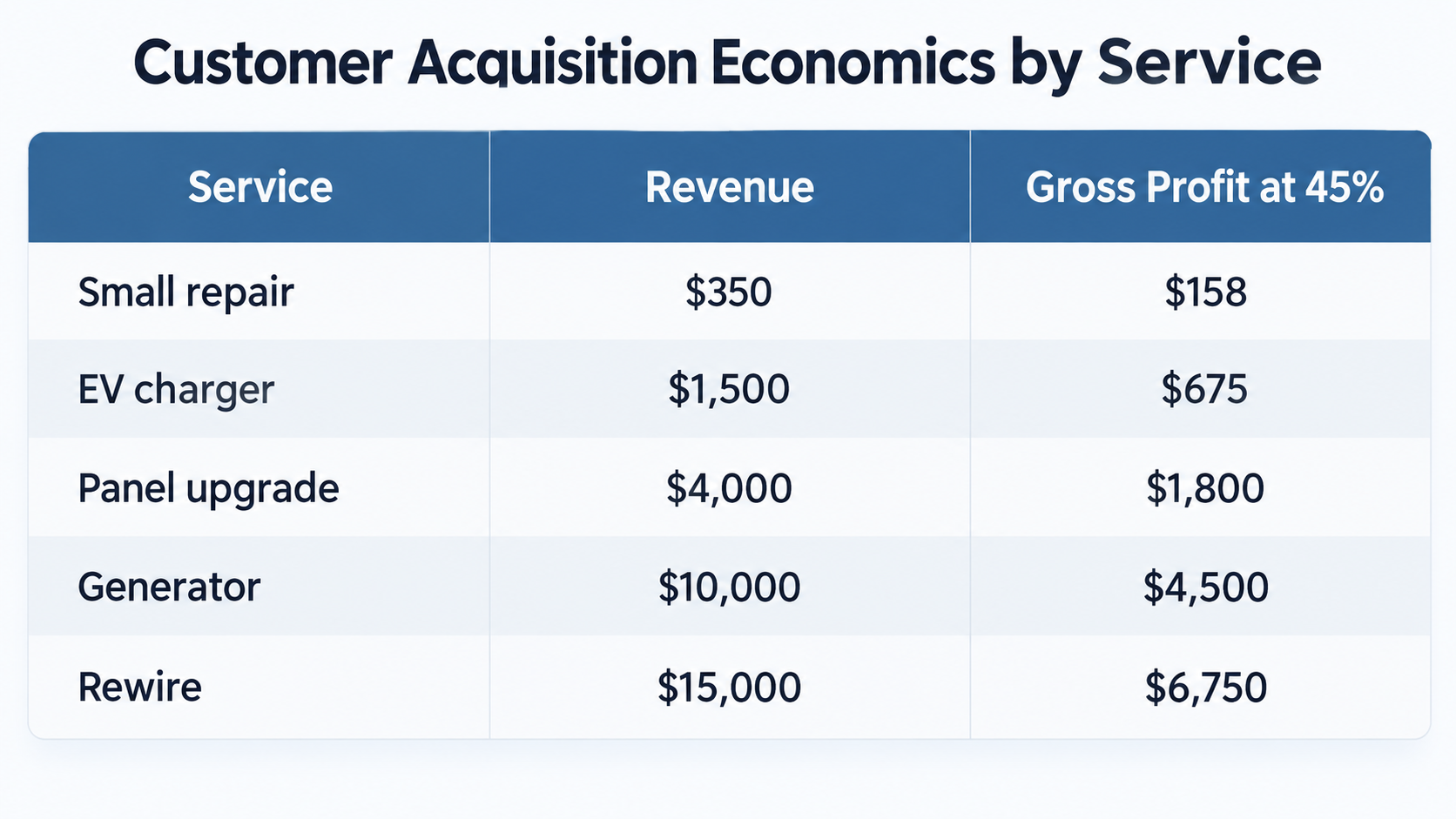
A $300 customer acquisition cost on a $350 repair may be terrible.
A $300 CAC on a profitable $4,000 panel upgrade could be excellent.
An $800 CAC on a $15,000 rewire may also work very well.
That is why one company-wide “good CPL” or “good CAC” number can be misleading.
The better question is:
What can I afford to pay to acquire this type of customer?
How to Set Your Maximum Customer Acquisition Cost
Start with gross profit.
Say a panel upgrade sells for:
$4,000
At a 45% gross margin:
$1,800 gross profit
Suppose you want at least $1,200 remaining before overhead.
That leaves:
$600
as the maximum acquisition allowance.
I would probably set the target lower to leave room for mistakes.
For example:
Target CAC: $350 to $450
Hard ceiling: $600
Now you have a number you can use.
If panel customers consistently cost $300 to acquire, you may have room to increase the budget.
If they start costing $700, you need to fix something.
First-Job Value vs. Customer Lifetime Value
Some electrical customers will hire you more than once.
A homeowner who calls today for a breaker issue might later need:
Panel work
EV charger installation
Generator installation
Lighting
Remodeling work
Another repair
They may also refer other customers.
That makes customer lifetime value important.
But I would be conservative.
Do not lose money on every first job and justify it with:
“They could be worth $10,000 eventually.”
If your actual customer data shows strong repeat business, use it.
If not, make sure the first-job economics are healthy first.
What Do Electrician Leads Cost?
Benchmarks can help you check your assumptions.
Electrical leads can be $39 per lead in one large dataset, with a booking rate around 43%.
Google Search tends to cost more. Recent home service search benchmarks have put electrician Google Ads leads around $90 to $100 on average.
Your actual numbers can be much higher or lower depending on:
Location
Competition
Reviews
Services
Search terms
Website
Campaign setup
Time of year
The platform matters too.
LSA may generate cheaper leads, while Search gives you more control over what type of work you target.
You might be happy paying $150 for someone searching for a 200 amp panel upgrade while being unhappy paying $50 for a lead looking to replace one outlet.
That is why Google Ads for home service businesses should be evaluated based on the customer produced, not simply the click.
Paid Marketing and Owned Marketing Should Both Be in the Budget
I would not build an electrician marketing budget entirely around paid advertising.
Paid channels buy speed.
That includes:
Google Search Ads
Local Services Ads
Meta Ads
Owned marketing builds long-term visibility.
That includes:
SEO
Google Business Profile
Reviews
Website content
Email list
Customer database
The ideal marketing system usually has both.
Paid acquisition helps create leads now.
Owned marketing reduces how dependent you are on buying every opportunity later.
That is why I think digital marketing for home service businesses should be treated as one system instead of a collection of unrelated services.
What If Your Budget Is Only $2,000 Per Month?
Do not try to do everything.
A common mistake is spreading a small budget across too many channels:
$300 Google Ads
$300 Facebook
$300 SEO
$300 lead platforms
$300 social media
Then nothing gets enough money or attention to work properly.
With a small budget, concentration matters more than variety.
I would first make sure the basics are solid:
Google Business Profile
Reviews
Clear website
Call tracking
Then choose the strongest acquisition channel available.
That could be LSA.
It could be tightly targeted Google Search.
It could be SEO if immediate lead volume is not the priority.
Give one strategy enough time and money to prove itself before adding five more.
What Changes at $5,000 or $10,000 Per Month?
With more budget, you can start combining immediate acquisition with longer-term marketing.
A $5,000 budget might include:
Paid lead generation
SEO and content
GBP work
Tracking
Management
Landing page improvements
The exact percentages should depend on the company.
At $10,000+, I would start segmenting more aggressively.
Instead of one giant electrician campaign, you might have separate strategies for:
Emergency service
Panels
EV chargers
Generators
Rewires
Commercial work
Each one can have its own:
Budget
Landing page
CAC target
Lead quality standard
Revenue
Gross profit
That is when marketing starts getting much easier to manage.
The Next Dollar Matters More Than the Average Dollar
This is important once you begin scaling.
Say your first $3,000 in ad spend produces customers at:
$250 CAC
You increase to $6,000 and your blended CAC becomes:
$300
Still profitable.
But the next $3,000 might produce customers at $500.
The next $5,000 might produce them at $700.
As you spend more, you often reach lower-intent or more expensive demand.
That means you should not only ask:
"What is our average CAC?"
Ask:
What did the additional money we spent produce?
If the next customer remains profitable, keep scaling.
If the economics start breaking, slow down or move the money somewhere else.
Capacity Can Be More Important Than Budget
Suppose your marketing can profitably generate 100 more customers.
Can the business actually serve them?
If your current team only has room for 20 more jobs per month, you should not blindly buy 50.
Look at:
Technician capacity
Phone answer rate
Booking rate
Days until the next available appointment
Sales capacity
Service area
Hiring pipeline
More leads are not automatically more growth.
Sometimes the highest-return use of your money is hiring another electrician, improving dispatch, or getting more calls booked.
ROAS Is Not the Same as Profit
Marketing reports often make this confusing.
Say you spend:
$10,000
and generate:
$40,000 in revenue
That is:
4x ROAS
But you did not make $30,000.
If those jobs produced:
$18,000 gross profit
and you also spent another:
$2,000 on marketing management
your total marketing cost is $12,000.
So:
$18,000 gross profit
− $12,000 marketing
= $6,000 remaining
That gives you a much better picture of what the marketing actually produced.
Gross profit after marketing is the number I would eventually want to understand by channel and service.
The Electrician Marketing Scorecard I Would Use
You do not need a 40-tab spreadsheet.
I would review:
Marketing
Total marketing spend
Media spend
Spend by channel
Leads
Total leads
Qualified leads
Cost per qualified lead
Sales
Booking rate
Appointments run
Close rate
Customers acquired
Economics
Cost per booked appointment
Customer acquisition cost
Average ticket
Revenue
Gross profit
Gross profit after marketing
Then break the important numbers down by channel and service.
For example:
Google Ads + panel upgrades
LSA + service calls
SEO + EV chargers
That tells you where the next dollar should go.
When Should an Electrician Increase Marketing Spend?
I would increase the budget when:
Customer acquisition is profitable.
Good leads are getting booked and sold.
The company has capacity.
Cash flow can support more spending.
The next dollar still produces acceptable returns.
If those are all true, I would not panic because marketing is 11% of revenue instead of 8%.
The business math matters more than an arbitrary percentage.
When Should You Reduce or Move the Budget?
I would consider changing the budget when:
Lead quality stays poor
CAC moves above your target
Calls consistently go unanswered
The schedule is already full
A service has poor margins
You cannot tell which channels produce jobs
Another channel produces better economics
You are attracting work you do not want
Notice the goal is not always to cut marketing.
Sometimes the answer is to move money.
Maybe broad Search is weak but panel campaigns work.
Maybe LSA is stronger than Meta.
Maybe the website is the bottleneck.
Maybe SEO deserves more investment.
Your contractor website, reviews, brand, and call handling all affect what your paid traffic can produce.
The Biggest Electrician Marketing Budget Mistakes
Using a Revenue Percentage as the Entire Strategy
5% to 10% is a benchmark.
Do the actual math.
Spreading a Small Budget Too Thin
Get one or two channels working before adding more.
Optimizing for Cheap Leads
Cheap leads mean nothing if they do not become profitable customers.
Using One CAC Target for Every Service
A service call and a rewire have completely different economics.
Measuring Revenue Without Gross Profit
A high-revenue channel can still produce weak profits.
Ignoring Booking and Close Rates
Marketing does not end when the phone rings.
Spending Beyond Capacity
Do not pay for demand the company cannot handle.
Choosing Marketing Based Only on Price
The cheapest marketing provider can become very expensive if the work produces nothing. That is one reason I think a cheap marketing agency can cost more than a $3,000 marketing agency.
Electrician Marketing Budget: How Much Should You Actually Spend?
There is no magic number.
The common 5% to 10% benchmark is useful, but it should be the final check, not the starting point.
I would build the budget in this order:
How much do you want to grow?
Which electrical services should create that growth?
How much gross profit does each customer produce?
How many customers do you need?
How many leads does that require?
What will those leads cost?
What can you afford to pay to acquire each customer?
Can your team actually handle the extra work?
Once those numbers are clear, the budget usually becomes obvious.
The biggest mistake is treating marketing like a fixed expense.
It is not.
It is an investment that should be judged by what it produces.
That means tracking the whole path:
Marketing Spend → Lead → Booked → Ran → Sold → Revenue → Gross Profit
If one channel produces cheap leads but weak customers, it may not deserve more money.
If another channel looks expensive up front but consistently produces profitable panel upgrades, generators, or rewires, it may deserve much more.
That is why I would not automatically cut marketing because the budget reaches 10% or 12% of revenue.
If the next dollar still produces profitable customers and the company has the capacity to serve them, spending more can make sense.
If the economics break, cash gets tight, or the team cannot absorb more work, pull back.
That is the real job of an electrician marketing budget.
It should help you decide where the next dollar creates the best return.
If you want help building a marketing plan around your actual job mix, margins, growth goals, and capacity, contact Schulze Creative. I can help you build a system around SEO, Google Ads, Local Services Ads, websites, Google Business Profile, tracking, and the numbers that actually connect marketing to profitable customers.
FAQ: Electrician Marketing Budgets
What Percentage of Revenue Should an Electrician Spend on Marketing?
Around 5% to 10% of revenue is a useful planning range. Established companies focused on maintenance may spend less, while contractors pursuing aggressive growth may spend 10% to 15% or more.
Use the percentage to check your budget after working backward from your actual growth goal.
How Much Should a Small Electrical Company Spend on Marketing?
There is no universal minimum.
A solo electrician may only have $1,000 to $2,000 available, while a multi-truck company may profitably spend tens of thousands each month.
With a smaller budget, concentrate the money into fewer channels instead of trying to do everything.
How Much Should an Electrician Spend on Google Ads?
Start with how many customers you want, how many leads that requires, and your expected cost per lead.
If you need 50 leads and expect them to cost $100 each, you need roughly $5,000 in ad spend before management and other marketing expenses.
What Is a Good Cost Per Lead for Electricians?
Current benchmarks vary widely by platform and market. Recent electrical LSA data has shown leads around $40, while Google Search benchmarks are closer to $90 to $100.
The more important number is what those leads cost after they become customers.
What Is a Good Customer Acquisition Cost for an Electrician?
It depends on the service.
A $500 CAC could be terrible for small repairs and excellent for a profitable panel upgrade, generator, or rewire.
Base your CAC target on gross profit, not a universal industry number.
Should Electricians Invest in SEO or Google Ads First?
If you need leads quickly, Google Ads or LSA may make sense.
If you want to build a lead source that compounds over time, SEO matters.
Most established contractors benefit from using paid acquisition for speed while building owned organic visibility.
Does an Electrician Marketing Budget Include Agency Fees?
I would include agency fees in your total marketing investment, but track them separately from media spend.
That way you know how much went to Google, how much went to management, and what the total acquisition system actually cost.
Can Schulze Creative Help Build an Electrician Marketing Budget?
Yes.
At Schulze Creative, I would start by looking at the services you want more of, current lead sources, job values, service area, website, Google presence, growth goal, and capacity.
Then we can build the marketing budget around the economics of the business instead of forcing the business into an arbitrary monthly package.
How Does Schulze Creative Measure Electrician Marketing?
As far down the funnel as the available data allows:
Spend → Lead → Qualified Lead → Booked Appointment → Completed Appointment → Sold Job → Revenue → Gross Profit
Because the goal is not the cheapest clicks or the most leads.
The goal is more profitable customers.
