
TL;DR: Google Ads for Furnace Repair
Target high-intent keywords. Searches like "furnace repair near me" and "emergency furnace repair" usually have stronger hiring intent than general troubleshooting searches.
Block DIY searches carefully. Exclude tutorials, job seekers, and parts shoppers, but don't automatically block searches like "furnace not working" or "furnace repair cost."
Separate your services. Furnace repair, installation, and maintenance attract different customers and shouldn't all be treated the same.
Make calling easy. Send people to a dedicated furnace repair page with a visible phone number, reviews, and a clear reason to contact you.
Track booked jobs, not just clicks. A cheap lead isn't valuable if it never turns into actual revenue.
Running Google Ads for furnace repair can get expensive fast.
You might be spending $1,500, $3,000, or even $5,000 a month trying to get more furnace repair calls. And Google is more than happy to spend every dollar of that budget.
The problem is that not everyone searching for furnace problems is looking to hire an HVAC company.
Some homeowners want to fix the furnace themselves. Others are looking for replacement parts, troubleshooting videos, or instructions on resetting their equipment. And if your Google Ads campaigns aren't set up correctly, you could be paying for those clicks.
Here's the frustrating part. You might have a perfectly good ad, a decent website, and a competitive budget, but still struggle to get enough qualified calls.
The problem isn't always your ads. Sometimes it's who you're paying to put those ads in front of.
At Schulze Creative, when we're working on Google Ads for HVAC companies, we're not trying to generate the most clicks. We're trying to generate the most profitable jobs for the money being spent.
In this article, I'll walk you through the furnace repair keywords worth targeting, the DIY searches I'd avoid, and how I'd structure a Google Ads campaign to get more calls without wasting your budget.
Why Furnace Repair Google Ads Attract So Many DIY Searches
Think about the last time something broke in your house. Did you immediately call someone? Or did you Google the problem first to see whether you could fix it yourself?
A lot of homeowners do the same thing when their furnace stops working.
They search things like:
Why is my furnace blowing cold air?
How to reset a furnace
Furnace ignitor replacement
Why won't my furnace turn on?
How to fix a furnace that won't heat
Some of these people will eventually hire an HVAC technician. Others have absolutely no intention of paying someone.
That's where Google Ads can get tricky.
Search Intent Matters More Than Search Volume
Let's compare two searches.
Search A: "How to replace furnace ignitor yourself"
Search B: "Emergency furnace repair near me"
Both people have furnace problems. But they're probably looking for two completely different solutions.
The first person wants instructions. The second person is looking for a professional.
If you're paying $10 or $20 per click, which one would you rather spend money on?
Exactly.
Now, this doesn't mean every informational search is worthless.
Someone searching "furnace blowing cold air" might try fixing it themselves, give up, and call a technician. That's why I wouldn't automatically exclude every problem-related keyword.
The trick is knowing which searches are worth testing and which ones are unlikely to become customers.
Why Google Shows Your Ads for Unexpected Searches
Google Ads uses keyword match types to decide which searches can trigger your ads.
There are three main positive keyword match types:
Exact match: Gives you tighter control over the meaning and intent of searches, although it can still match close variations.
Phrase match: Allows your ad to appear for searches that include the meaning of your keyword.
Broad match: Gives Google more freedom to match your ads to related searches.
Broad match isn't automatically bad. But I wouldn't start a brand-new furnace repair campaign with a bunch of broad keywords and no reliable conversion data.
That's an easy way to spend money learning what doesn't work.
Best Google Ads Keywords for Furnace Repair
When choosing keywords, I start by asking one question:
What would someone search if they needed to hire an HVAC technician today?
Those are the searches I'd prioritize.
High-Intent Furnace Repair Keywords
Here are some keywords I'd consider targeting first:
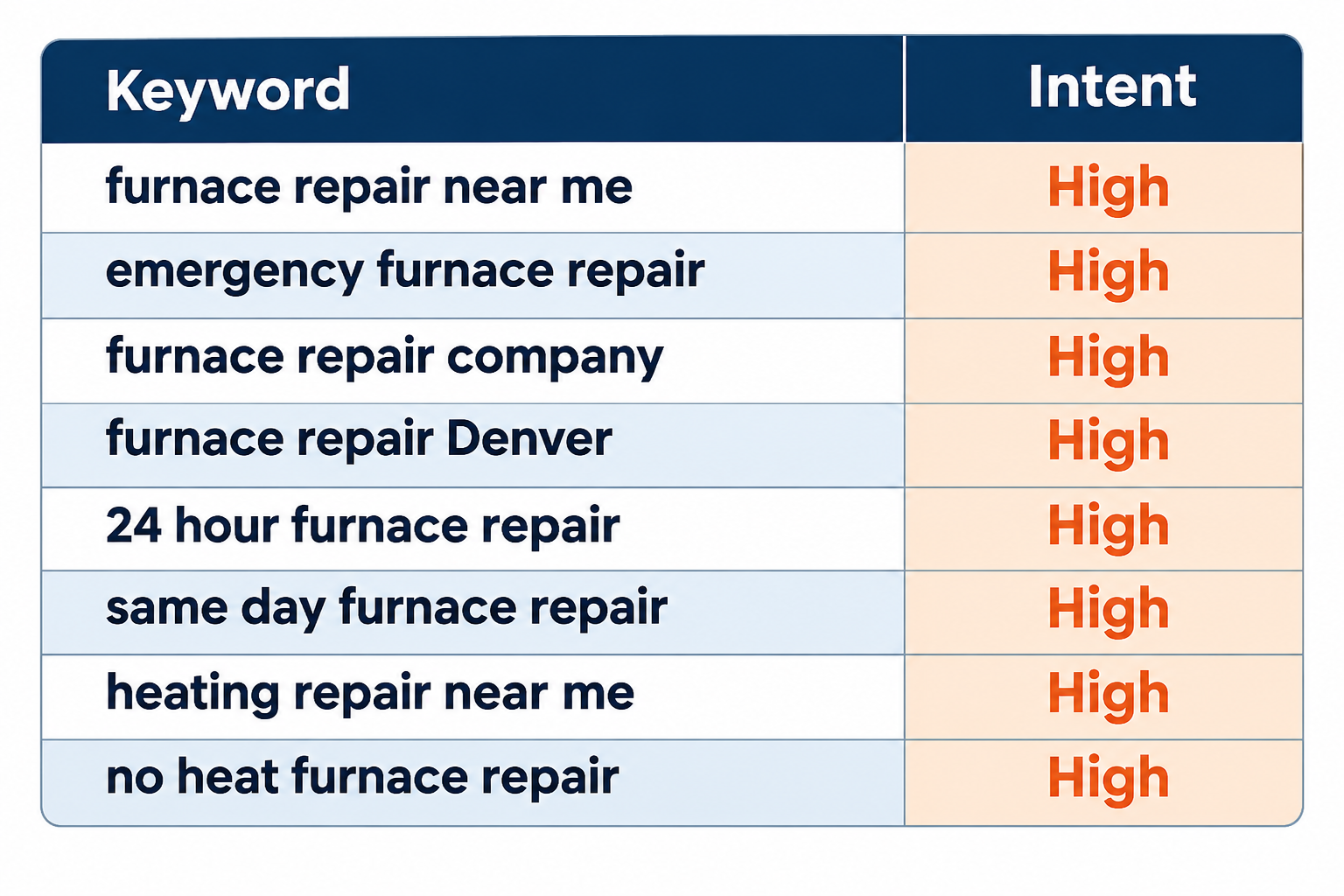
These searches suggest that someone is looking for a business, not just information.
They're also competitive because other HVAC companies want those same customers.
That's okay.
I'd rather pay more for a click from someone ready to hire than less for someone watching furnace repair tutorials.
Problem-Based Keywords Worth Testing
Now let's look at some searches that aren't quite as straightforward.
Furnace not turning on
Furnace blowing cold air
Furnace running but no heat
Furnace keeps shutting off
Furnace making loud noise
These searches could generate legitimate repair calls. But they could also attract people looking for free troubleshooting advice.
My approach would be to test them separately, monitor the actual search terms, and compare the quality of the calls they generate.
If they produce booked jobs at a profitable cost, great. Keep them.
If they consistently generate DIY traffic, reduce spending or exclude the specific searches causing the problem.
Keep Furnace Repair and Installation Keywords Separate
This is something I pay close attention to.
Someone searching for furnace repair might need a $400 repair.
Someone searching for furnace replacement might be considering a $7,000 installation.
Those customers have different needs, different buying timelines, and different values to your business.
Combining everything makes it harder to understand which services are actually producing results.
Your HVAC emergency Google Ads strategy should reflect how urgently someone needs help, not just whether the search contains the word "furnace."
Negative Keywords for Furnace Repair: What to Block and What to Keep
This is probably the most important part of this entire article.
Negative keywords tell Google which searches you don't want to pay for.
Without them, you can end up spending money on people who have no intention of hiring your company.
But there's another side to this.
Block too many keywords, and you could remove perfectly good customers from your campaigns.
Here's how I'd approach it.
DIY Furnace Repair Searches to Block
These are examples of searches I'd usually want to exclude from a furnace repair campaign:
how to replace furnace ignitor
DIY furnace repair
furnace repair tutorial
how to fix furnace yourself
furnace repair YouTube video
furnace wiring diagram
furnace repair instructions
furnace service manual PDF
These searches strongly suggest that the person is looking for instructions instead of professional service.
I'd start with targeted negative phrases, then expand the list based on the searches actually showing up in the account.
I wouldn't blindly add every word from those examples as a single-word negative.
For example, blocking "ignitor" everywhere might eliminate a homeowner searching for "furnace ignitor repair near me."
That person could be a paying customer.
Parts, Equipment, and Job Searches to Exclude
I'd also review searches involving:
Wholesale furnace parts
Furnace parts for sale
Furnace repair jobs
HVAC technician salary
Furnace repair training
HVAC apprenticeship programs
Furnace repair certification
Unless your business sells parts or offers training, these searches probably aren't worth paying for.
Furnace Keywords You Should NOT Automatically Block
Here's where I think a lot of HVAC companies make mistakes.
They see a search that sounds informational and immediately add it to their negative keyword list.
But a homeowner researching the price of furnace repair might be getting ready to call three companies.
You don't want to automatically eliminate that opportunity.
Here's how I'd classify common searches:
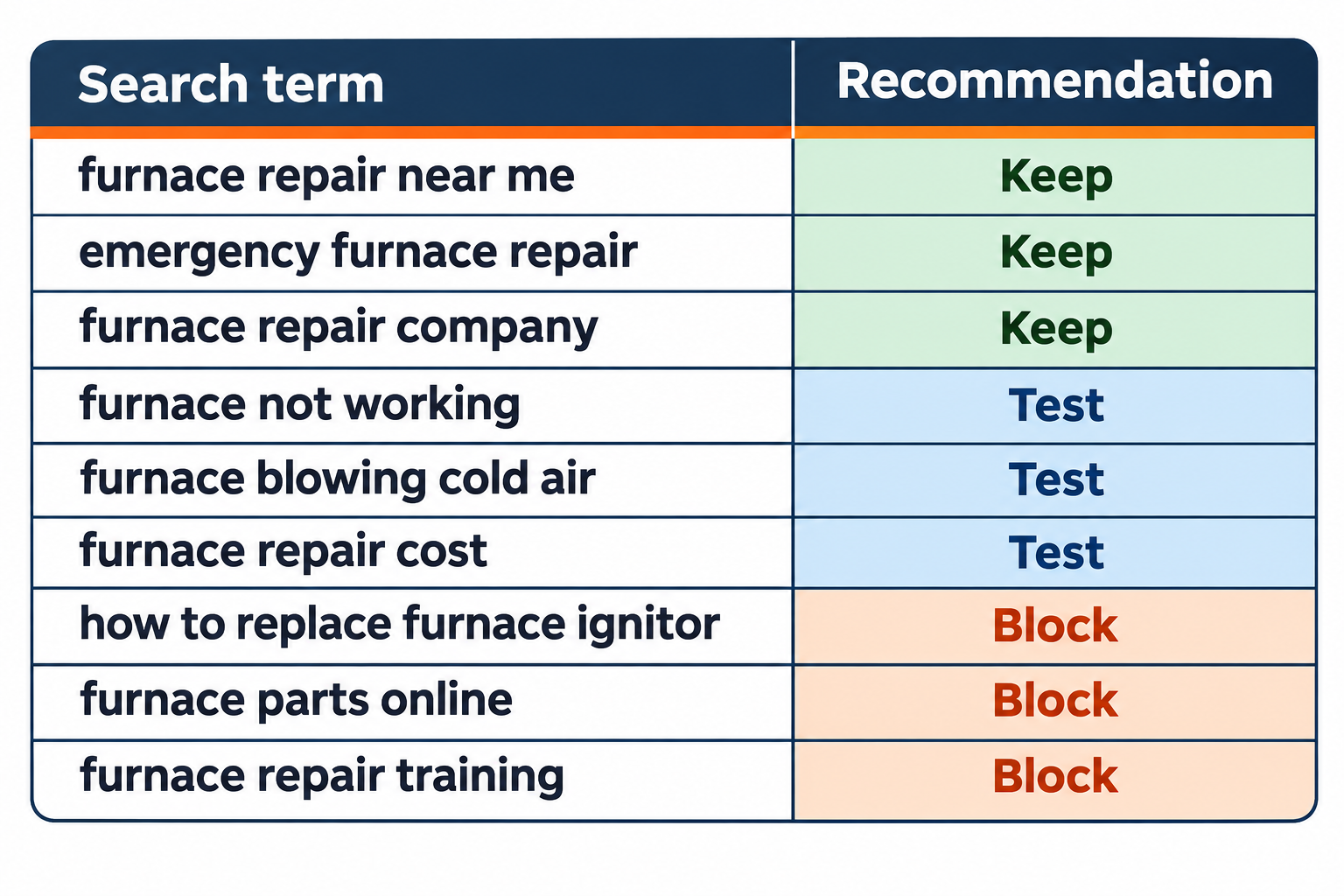
These are starting recommendations, not rules that apply to every account.
Your actual conversion data should determine what stays.
Understand Negative Keyword Match Types
Google has three negative keyword match types, and they don't work exactly like regular positive keywords.
Negative broad match: furnace repair
This can block searches containing both words, even if they're in a different order.
That means you could accidentally exclude "emergency furnace repair near me."
Negative phrase match: "how to replace furnace"
This blocks searches containing that phrase in the same order, even with additional words before or after it.
Negative exact match: [furnace repair tutorial]
This blocks that specific search without automatically excluding longer searches containing additional words.
The lesson?
Don't just download a list of 500 negative keywords and paste them into your account.
A good negative keyword list protects your budget without cutting off legitimate customers.
You can go deeper into the actual match types and exclusions in Google Ads Negative Keywords for HVAC Companies: What to Block (and What Not To).
How to Structure a Google Ads Campaign for Furnace Repair Calls
You don't need 15 different campaigns to generate furnace repair leads.
In fact, if you're working with a smaller advertising budget, I'd argue that having too many campaigns can make things harder.
You're splitting your budget and conversion data across too many places.
Instead, I'd start simple.
Start With One Focused Furnace Repair Campaign
Here's an example of how I'd organize it:
Campaign: Furnace Repair | Search
Ad Group 1: General Furnace Repair
[furnace repair near me]
"furnace repair company"
"local furnace repair"
Ad Group 2: Emergency Furnace Repair
[emergency furnace repair]
"same day furnace repair"
"no heat furnace repair"
Ad Group 3: Furnace Problems
"furnace not working"
"furnace blowing cold air"
"furnace not heating"
This structure keeps related searches together without making the account unnecessarily complicated.
If emergency repair eventually needs a different budget, bidding strategy, or schedule, we can separate it into its own campaign.
Start With Exact and Phrase Match
For a smaller account, I generally prefer starting with exact and phrase match keywords.
They give us a more controlled starting point while we collect data about which searches turn into actual calls.
As conversion data improves, we can test broader targeting.
But I wouldn't give Google more freedom until we're confident it's optimizing toward valuable leads.
The bidding strategy matters too. Max Clicks and Max Conversions serve different purposes, and the right choice depends on your existing conversion tracking and campaign data.
Stop Paying for Furnace Repair Clicks Outside Your Service Area
This is one of the simplest ways to waste money.
Imagine an HVAC company based in Denver.
They serve Denver, Arvada, Westminster, Lakewood, and a few surrounding communities.
But their Google Ads campaign targets a 50-mile radius.
Now they're paying for clicks from homeowners who might be an hour away.
Even if those people call, are the jobs worth the drive?
Maybe. Maybe not.
I'd rather focus on the areas where the company can consistently complete profitable work.
Use Google's Presence Location Setting
Google's default location targeting can include people who have shown interest in your target area, even when they aren't physically there.
For a local furnace repair campaign, I'd strongly consider using the Presence setting, which focuses on people in or regularly in your targeted locations.
It's not a perfect guarantee, but it can help reduce irrelevant traffic.
I'd also review location performance regularly to see which areas generate real jobs.
Only Advertise When You Can Answer the Phone
If you're paying for emergency furnace repair clicks at 11 PM, somebody needs to be available to answer those calls.
Otherwise, you're paying to send potential customers to voicemail.
If you truly offer 24/7 service, great. Advertise it.
If you don't, focus your advertising schedule around the hours when your team can respond.
And remember, you can often improve results without spending more money simply by fixing how you handle the HVAC leads you're already getting.
Write Furnace Repair Google Ads That Make Homeowners Want to Call
One mistake I see in home service advertising is how generic the actual advertisements are.
Headlines like:
"Quality HVAC Services"
"Your Trusted HVAC Experts"
"Professional Heating and Cooling"
There's nothing necessarily wrong with those statements. They're just not giving a homeowner much reason to choose your company.
Someone whose furnace stopped working wants to know three things:
Can you fix my problem?
Can you get here soon?
Can I trust you?
Your advertisement should answer those questions.
Example Furnace Repair Google Ads Headlines
Here are some examples I'd test:
Furnace Not Working? Call Us
Furnace Repair in Denver
Same-Day Furnace Repair
Local Furnace Repair Experts
No Heat? Schedule Service
Trusted Local HVAC Technicians
Only advertise same-day service or other specific promises if your company can actually deliver them.
Example Furnace Repair Ad Descriptions
Description 1:
"Furnace stopped working? Get professional furnace repair from local HVAC technicians. Call today."
Description 2:
"Don't let a broken furnace leave your home cold. Schedule a furnace diagnostic with our team."
I'd also use relevant call, location, and other ad assets to make contacting the business easier.
One important update: Google stopped allowing the creation of new call-only ads in February 2026. The current approach is to use responsive search ads with call assets.
Build a Furnace Repair Landing Page That Turns Clicks Into Calls
Let's say someone searches "furnace repair near me."
They click your ad.
Where do they go?
If your answer is your homepage, I'd probably change that.
Your homepage might talk about AC installation, duct cleaning, plumbing, financing, and 15 other services.
That's not what this homeowner is looking for.
They're cold. Their furnace isn't working. They want someone to fix it.
What I'd Include on a Furnace Repair Landing Page
Keep it simple:
A headline that matches the search: "Furnace Repair in Denver, CO"
A visible phone number: Especially on mobile devices.
A clear call to action: "Call to Schedule Furnace Repair."
Real customer reviews: Preferably mentioning heating or repair work.
Your service area: Make it obvious which communities you serve.
Trust signals: Real technician photos, credentials, warranties, and honest service promises.
I would also explain what happens when somebody calls.
Will they speak to a dispatcher? Can they schedule a diagnostic? Is there a service fee?
The fewer questions a homeowner has, the easier it is for them to contact you.
This is also why HVAC Google Ads landing pages for repairs and installations should be built differently.
A furnace repair customer usually wants help quickly. A replacement customer often needs more information before making a much larger purchase.
How Much Should Google Ads for Furnace Repair Cost?
This is probably the question every HVAC business owner wants answered.
And the answer is that it depends on your market, competition, budget, and how well your campaigns convert.
But we do have some useful numbers.
According to LocaliQ's 2025 Home Services Search Advertising Benchmarks, the Heating & Furnaces category averaged:
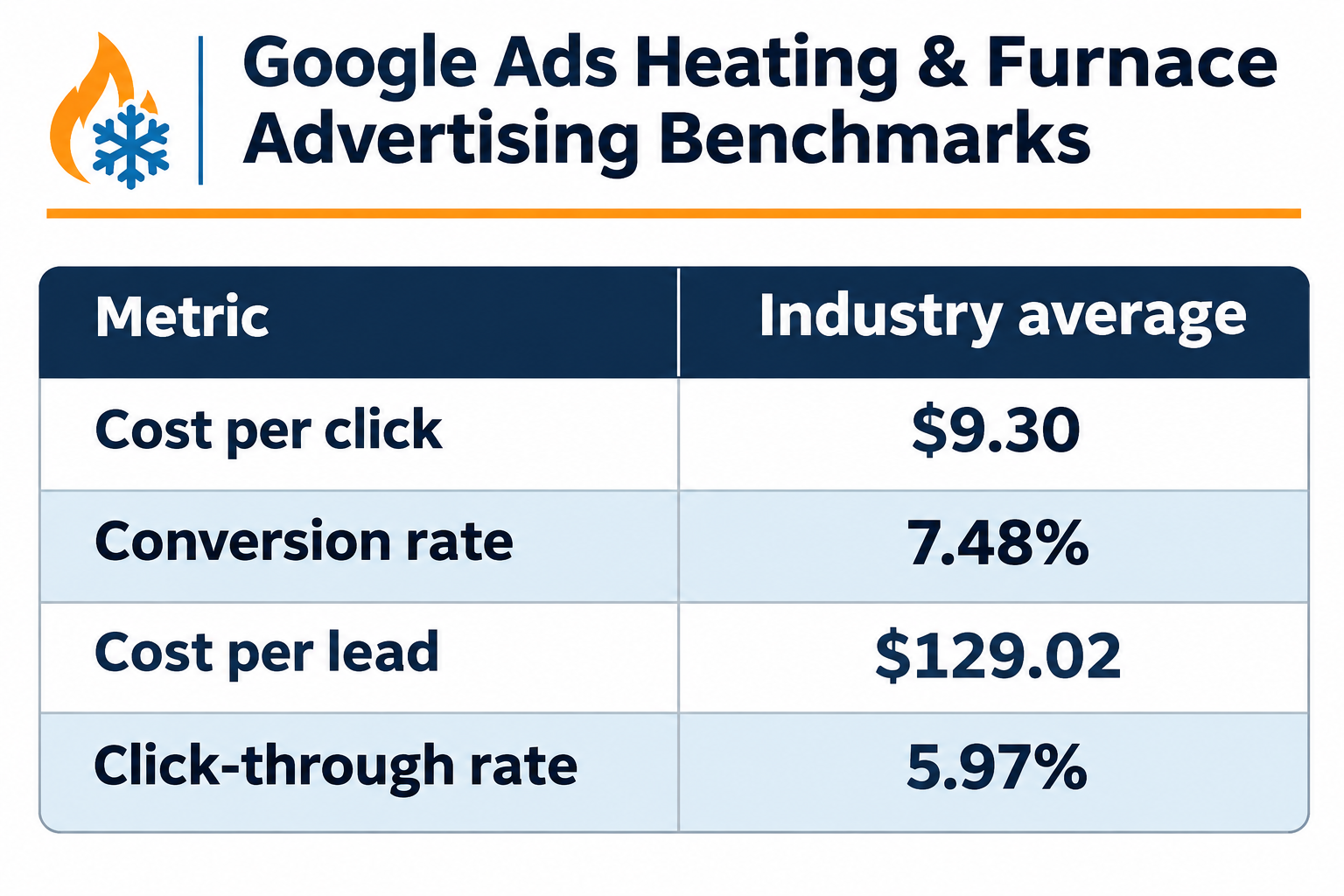
These are averages across heating and furnace advertisers, not guaranteed results for a furnace repair campaign.
Your actual numbers could be significantly different.
What Could a $1,500 Furnace Repair Google Ads Budget Produce?
Let's use the industry averages to build a hypothetical example.
At a $1,500 monthly advertising budget:
Average cost per click: $9.30
Estimated clicks: Approximately 161
Estimated leads: Around 12
Assumed booking rate: 60%
Estimated booked appointments: Around 7
Assumed completed-job rate: 75%
Estimated completed jobs: Around 5
That would put your advertising cost at roughly $300 per completed job.
Again, this is an illustration using industry averages and assumed booking rates. It isn't a forecast or a promise.
But here's where it gets interesting.
Cost Per Lead Isn't the Number That Pays Your Bills
Imagine two HVAC companies.
Company A gets 20 leads at $75 each.
Company B gets 12 leads at $125 each.
Both spend $1,500.
Company A books four jobs. Company B books eight.
Who had the better advertising campaign?
Company B, assuming those jobs are similarly profitable.
Company A paid $375 per booked job.
Company B paid $187.50.
That's why I wouldn't obsess over having the lowest cost per lead.
Your HVAC customer acquisition cost should be measured against the gross profit those customers generate, not just how cheaply you got them to call.
A $300 acquisition cost might make sense for a valuable long-term customer. It might be terrible for a small repair that generates very little profit.
You have to know your numbers.
How to Know Whether Your Furnace Repair Google Ads Are Actually Working
If I opened an HVAC company's Google Ads account today, I wouldn't start by looking at its optimization score.
I'd want to know:
What searches are we paying for?
How many of those searches turn into qualified calls?
How many calls turn into booked jobs?
How much revenue and gross profit are those jobs producing?
Those answers tell us much more than impressions or clicks.
Review Your Search Terms Report Every Week
The Search Terms report helps you see the searches that triggered your ads, although Google doesn't show every individual query.
I'd review it weekly, especially during the first month or two of a new campaign.
Look for searches that:
Have nothing to do with hiring an HVAC company
Come from people looking for DIY instructions
Attract job seekers or parts shoppers
Generate significant spending without useful leads
Produce actual booked jobs worth targeting more aggressively
Don't automatically block a keyword after one unsuccessful click.
Look for patterns and make decisions based on enough data to justify them.
Track Calls, Booked Appointments, and Completed Jobs
A phone call isn't automatically a lead.
Someone might call asking whether you sell furnace filters.
Someone else might call because they're applying for a job.
And somebody else might call about a broken furnace, speak with your dispatcher, and schedule an $800 repair.
Google Ads can count certain phone calls as conversions based on your settings, including call duration.
But those three calls don't have equal value.
At Schulze Creative, I'd rather know which campaigns are producing actual customers.
If you're using ServiceTitan, connecting Google Ads leads to booked jobs in ServiceTitan can help you measure the path from the original click to the completed job.
Don't Ignore Your Call Booking Rate
Let's say Google Ads generates 20 legitimate calls.
Your office only books eight of them.
Before spending more money on advertising, I'd want to know why the other 12 didn't book.
Were they calling after hours? Did nobody answer? Were your prices too high? Were the customers outside your service area?
Those are different problems with different solutions.
Improving your HVAC call booking rate might generate more revenue than increasing your advertising budget.
That's why I don't believe marketing performance stops when the phone rings.
It stops when the job is sold and completed.
More Furnace Repair Calls Start With Better Targeting, Not a Bigger Budget
If your furnace repair Google Ads aren't generating enough calls, increasing your budget shouldn't automatically be the first solution.
I'd start by looking at where your money is going.
Are you paying for DIY searches? Are your keywords too broad? Are people outside your service area clicking your ads? Are you sending customers to a page that doesn't make it easy to call?
And most importantly, are the calls you're getting actually turning into profitable jobs?
Google Ads can be an effective way to generate furnace repair work, especially when homeowners need immediate help.
But the goal isn't to get Google to spend your budget.
The goal is to make every dollar you spend as likely as possible to bring in a paying customer.
At Schulze Creative, we help HVAC companies improve their Google Ads, SEO, and overall marketing strategies to generate more qualified calls and booked jobs.
If you're spending money on furnace repair ads and aren't sure what's actually working, book a call with Schulze Creative and let's take a look at where your budget is going.
FAQs: Google Ads for Furnace Repair
How much should an HVAC company spend on furnace repair Google Ads?
There's no universal budget. I'd start by calculating how much you can afford to pay for a customer based on your average job value, gross profit, and close rate. Then build a budget large enough to test the market and collect meaningful data.
If your company can't profitably handle paid leads yet, there are situations where you shouldn't spend money on Google Ads.
Should I use broad match keywords for furnace repair?
Broad match can work, especially when Google has reliable conversion data and you're using an appropriate bidding strategy. But for a small or new account, I'd usually start with exact and phrase match to get more control over the initial searches.
Should I block "furnace not working" as a negative keyword?
Not automatically. That search could come from someone looking for troubleshooting instructions or someone who wants a technician immediately. I'd test the keyword, review actual search terms, and track whether it generates qualified calls.
How often should I update furnace repair negative keywords?
I'd review search terms weekly, especially when launching or making major campaign changes. You don't need to add negatives every week if there's nothing worth excluding. The goal is to make informed changes, not just grow the list.
Are Local Services Ads better than Google Search Ads for furnace repair?
Not necessarily. Google Local Services Ads generally charge for leads, while Search Ads charge for clicks. Both can generate furnace repair calls, but their costs, placement, targeting, and lead quality differ.
The better option depends on your market, budget, and results. Comparing Google LSA vs. Google Search Ads for HVAC businesses is a good starting point before deciding where to spend.
