
TL;DR: Plumber Google Ads Budget
Recent industry benchmarks put plumbing Google Ads leads around 130–190, although costs vary by location and service.
Your advertising budget should be based on your desired job volume, cost per lead, and booking rate.
Calculate your cost per booked job by dividing advertising spend by booked jobs.
Cheaper leads don't necessarily produce cheaper customers.
Increase your advertising budget when your campaigns are profitable and your technicians have capacity for additional work.
One of the first questions plumbers ask me about Google Ads is how much they should spend.
I usually start with a different question: How much can you afford to spend to get another customer?
You could spend $2,000 a month on Google Ads and lose money. You could spend $10,000 a month and wish you had the capacity to spend more.
At Schulze Creative, we approach Google Ads management by working backward from the numbers that matter to a business: booked jobs, revenue, and profit.
Here's how to calculate your plumbing Google Ads budget using those numbers.
How Much Should a Plumber Spend on Google Ads?
A two-truck plumbing company in a small town has different advertising needs than a Denver company with 20 technicians.
But, industry benchmarks can give you a starting point.
Average Google Ads Budgets for Plumbing Companies
Here are the monthly advertising budgets I would consider when planning a plumbing campaign:
1,000–1,500: A focused campaign targeting one service or a smaller geographic area.
1,500–3,000: An established local plumbing company with limited campaign coverage.
3,000–6,000: A company looking to generate consistent lead volume.
6,000–10,000+: Larger companies advertising multiple services or operating in competitive markets.
These are planning ranges, not guaranteed spending requirements, and exclude management fees. I'd rather see a plumber spend $1,500 on one well-built campaign than spread that budget across six different services.
Average Cost Per Click and Cost Per Lead for Plumbers
According to 2025 home services advertising benchmarks, plumbing campaigns produced the following median results:
Cost per click: $10.49
Cost per lead: $129.02
Conversion rate: 7.63%
Click-through rate: 4.97%
A more recent study analyzed 524 plumbing contractors and found an average non-branded Google Search Ads cost per lead of $183, a median monthly ad spend of $5,055, and a median cost per paying customer of $333.
These studies use different datasets and measurement methods, so use them as reference points rather than performance targets.
Why Your Location and Plumbing Services Affect Advertising Costs
Local competition, search demand, keyword selection, and landing page performance all influence your advertising costs.
The services you advertise matter, too.
A study found the following average Google Ads lead costs across its plumbing clients:
Backflow testing: $109
Drain cleaning: $169
Water heaters: $182
General plumbing: $197
Emergency plumbing: $219
Sewer and pipe repair: $233
Leak detection and repair: $241
A $233 sewer repair lead could be considerably more profitable than a $169 drain cleaning lead. You need to consider what each job is worth before deciding whether a lead is expensive.
Why Cost Per Booked Job Matters More Than Cost Per Lead
If your plumbing marketing agency tells you they're generating plumbing leads for $75 each, that sounds great.
But if only one out of every ten leads books an appointment, you're spending $750 to get one booking.
The Difference Between a Lead, a Booked Job, and a Paying Customer
There are several steps between someone clicking your advertisement and your business collecting revenue:
Someone clicks your Google ad.
They call or submit a form.
Your team qualifies the lead.
An appointment is booked.
Your technician completes the work or sells an estimate.
Your business collects payment.
A scheduled sewer inspection doesn't necessarily turn into a sewer replacement. Understanding that difference is essential when calculating your customer acquisition cost.
Why Cheap Plumbing Leads Can Be More Expensive
Consider two hypothetical plumbing campaigns spending $3,000 per month.
Campaign A generates 40 leads at $75 each. With a 20% booking rate, it produces eight appointments at $375 per booking.
Campaign B generates 20 leads at $150 each. With a 60% booking rate, it produces 12 appointments at $250 per booking.
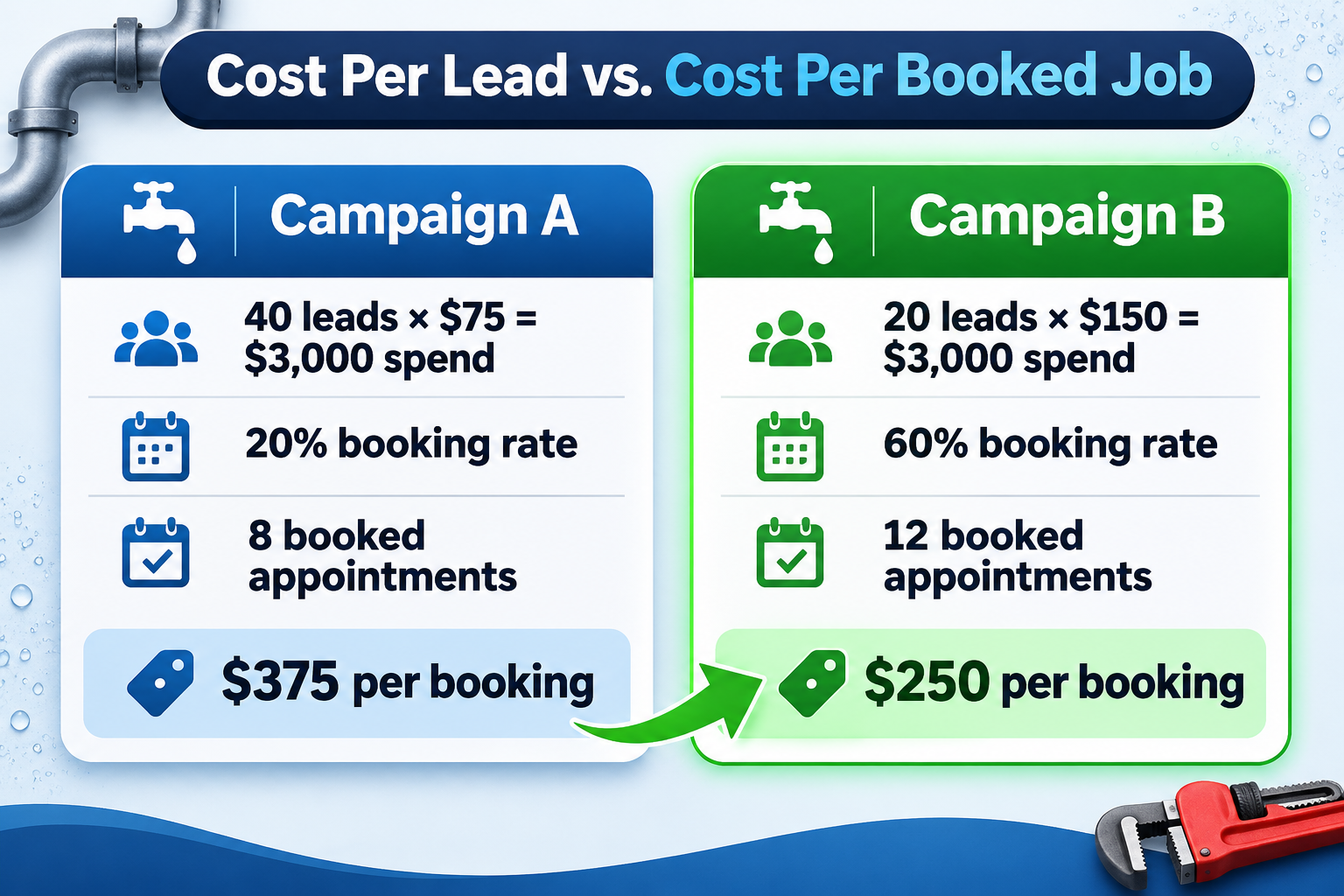
Campaign B generates half as many leads but 50% more booked appointments.
If you're judging performance solely on cost per lead, you might accidentally cut the better-performing campaign.
How Google Ads Turns Clicks Into Plumbing Revenue
Imagine spending $3,000 on Google Ads and generating the following results:
300 website clicks
30 leads
15 booked appointments
12 completed and paid jobs
$12,000 in collected revenue
Your cost per lead is $100, your cost per booking is $200, and your cost per completed job is $250. Your return on ad spend (ROAS) is 4x.
Each number tells you something different about your advertising and your business's ability to turn leads into revenue.
How to Calculate Your Plumbing Google Ads Budget in 5 Steps
Step 1: Determine How Many Additional Plumbing Jobs You Need
Start with your technician capacity.
Suppose your company can handle 100 service appointments per month. You're currently booking 80 through referrals, SEO, Google Maps, and repeat customers.
Your Google Ads campaign needs to generate another 20 appointments.
There's no reason to pay for 50 additional bookings when you can only handle 20.
Step 2: Calculate Your Lead-to-Booking Rate
Your booking rate is the percentage of incoming leads that turn into scheduled appointments.
Booking rate = Booked appointments ÷ Leads × 100
If you receive 100 leads and book 40 appointments, your booking rate is 40%.
To generate 20 appointments:
20 ÷ 0.40 = 50 leads required
Improving your call booking rate from 40% to 50% would reduce the number of leads you need from 50 to 40.
Step 3: Estimate Your Plumbing Cost Per Lead
Use historical campaign data if you have it. Otherwise, use industry benchmarks and Google Keyword Planner to estimate keyword costs in your market.
Estimated cost per lead = Average cost per click ÷ Conversion rate
If clicks cost $15 and 10% of clicks produce leads:
$15 ÷ 0.10 = $150 per lead.
Make sure your lead definition remains consistent when comparing historical costs and booking rates.
Step 4: Calculate Your Monthly and Daily Google Ads Budget
Monthly ad budget = Required leads × Estimated cost per lead
Using our example:
50 leads × $150 = $7,500 per month.
Google calculates monthly spending limits for most campaigns using 30.4 days.
Average daily budget = Monthly budget ÷ 30.4
$7,500 ÷ 30.4 = $246.71 per day.
According to Google's budgeting documentation, actual daily spending can fluctuate while remaining subject to applicable spending limits.
Step 5: Calculate Your Expected Cost Per Booked Job
Cost per booked job = Advertising spend ÷ Booked jobs
$7,500 ÷ 20 = $375 per booked appointment.
You can also calculate this directly:
Cost per booked job = Cost per lead ÷ Booking rate
$150 ÷ 0.40 = $375.
Now you know approximately what your campaign needs to spend. The next question is whether paying $375 for a booking makes financial sense.
What Is a Good Cost Per Booked Job for a Plumber?
Spending $300 to acquire a $250 drain cleaning job probably isn't sustainable. Spending $300 to acquire a $5,000 sewer replacement could be extremely profitable.
Your acquisition target depends on job value, gross profit, and how often appointments turn into paid work.
Calculate Your Maximum Affordable Customer Acquisition Cost
Suppose your average completed plumbing job produces the following:
Average job revenue: $1,500
Gross profit margin: 50%
Gross profit before marketing: $750
Desired remaining contribution toward overhead and profit: $350
Maximum acquisition cost = Gross profit per job − Desired remaining contribution
$750 − $350 = $400.
You can afford to spend $400 acquiring a completed, paid job while meeting your target.
However, if only 80% of booked appointments become paying jobs, your maximum affordable cost per booking is $320.
Include Google Ads Management Fees and Canceled Appointments
If you're spending $3,000 on Google Ads and $750 on management, your total monthly investment is $3,750.
Assuming you generate 15 bookings and 12 completed jobs:
Advertising-only cost per booking: $200
Total cost per booking: $250
Total cost per completed job: $312.50
Include other applicable acquisition expenses when calculating your fully loaded customer acquisition cost.
Set Different Acquisition Targets for Different Plumbing Services
Calculate acquisition targets separately for your major services.
Drain cleaning, water heater replacement, repiping, and sewer replacement have different job values, margins, and sales close rates.
Combining them into one average can hide unprofitable campaigns and make it difficult to know where to invest more money.
Plumber Google Ads Budget Calculator
Assuming a $150 cost per lead and a 40% booking rate, here's what different monthly advertising budgets could produce:
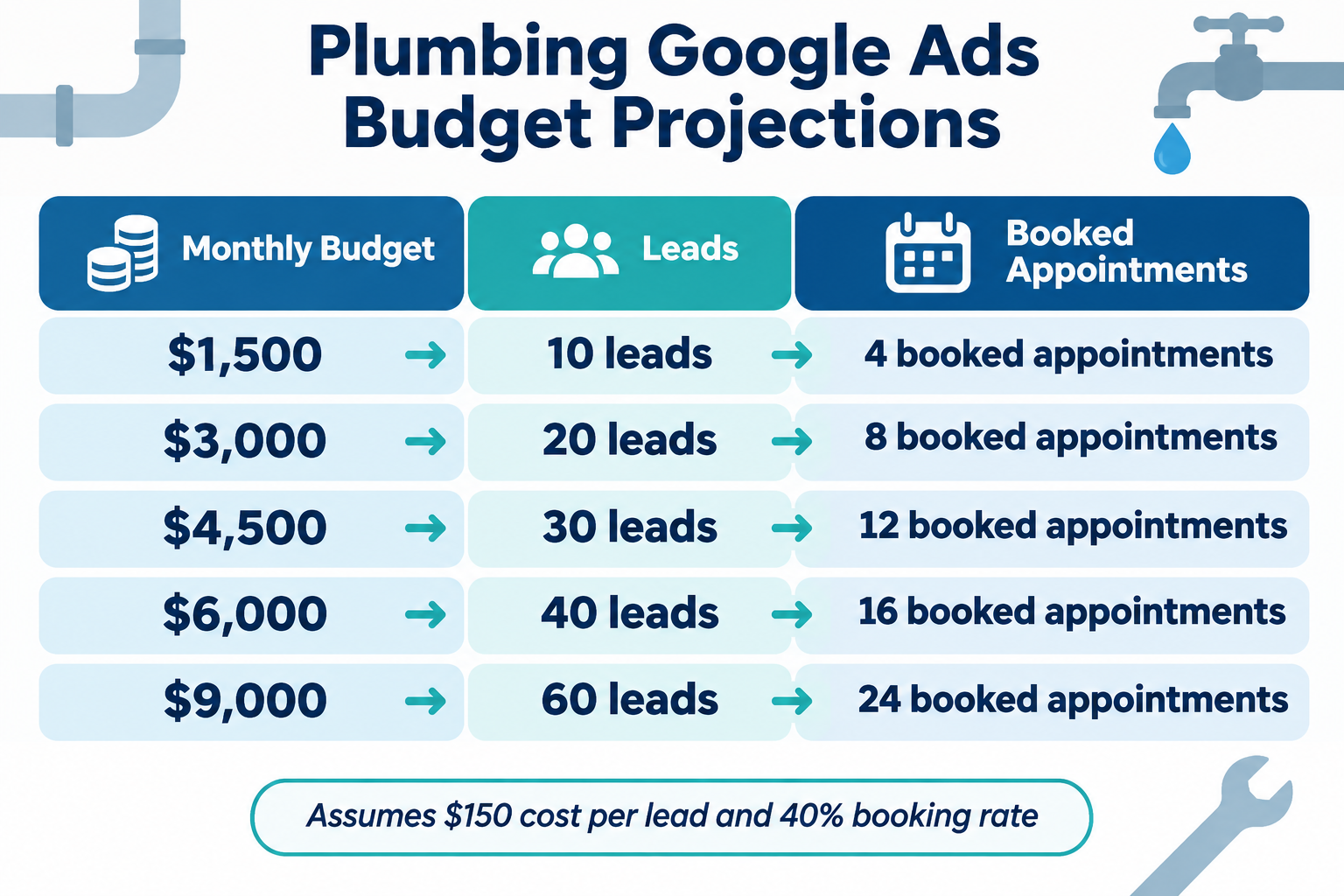
These projections assume consistent lead costs and booking rates. Actual costs may increase as you expand into additional searches, services, and locations.
Use your own campaign data whenever possible.
How to Allocate Your Google Ads Budget Across Plumbing Services
Prioritize services based on profitability, local search demand, and available technicians.
Emergency Plumbing and General Repairs
Searches like "emergency plumber near me" or "burst pipe repair" come from homeowners who often need immediate assistance.
If you're running emergency plumbing ads overnight but nobody answers your phone, you're paying for opportunities you can't service.
Match your advertising schedule to your availability.
Drain Cleaning and Sewer Services
Drain cleaning can provide consistent job volume, while sewer repair and replacement can produce higher-value opportunities.
Separate these services so you can control their budgets, messaging, and acquisition targets independently.
Water Heater Repair and Replacement
Someone looking for a water heater repair has different needs than someone researching a tankless water heater installation.
Separate keywords, advertisements, and landing pages can help you attract the right customers and understand which services produce profitable work.
Google Search Ads vs. Google Local Services Ads
Google Local Services Ads generally charge per lead, while traditional Search Ads typically charge per click.
Search Ads provide more control over keywords, landing pages, and campaign structure. LSAs can be another valuable source of phone calls.
When comparing Google Local Services Ads and Google Search Ads, maintain separate budgets and measure each channel's cost per completed job.
Don't allocate more money to LSAs simply because their leads appear cheaper.
How to Lower Your Cost Per Booked Job Without Increasing Your Google Ads Budget
Eliminate Wasted Ad Spend With Negative Keywords
Review your search terms regularly and exclude irrelevant searches, such as:
DIY plumbing instructions
Plumbing jobs and apprenticeships
Plumbing parts and supplies
Certification courses
Services your company doesn't offer
Understanding how Google Ads negative keywords work can help you spend more of your existing budget on people looking to hire a plumber.
Be careful not to block legitimate customer searches with overly broad exclusions.
Improve Your Plumbing Google Ads Landing Pages
If you're paying $20 per click and 5% of visitors become leads, your estimated cost per lead is $400.
Improve that conversion rate to 10%, and your estimated lead cost drops to $200.
Your plumbing landing pages should include:
A headline matching the service advertised.
Customer reviews and relevant credentials.
Clear service area information.
A prominent phone number and contact form.
Fast loading speeds and a mobile-friendly design.
The same principles behind effective repair and installation landing pages apply to plumbing.
Target the Right Locations and Keywords
Focus on high-intent searches within areas your technicians can serve efficiently.
Review performance by location and exclude areas generating irrelevant leads or unprofitable work.
Advertising across an entire metropolitan area isn't necessarily better than concentrating on several profitable communities.
Answer More Calls and Improve Your Booking Rate
Suppose your company spends $6,000 and generates 40 leads.
At a 30% booking rate, you'll book 12 appointments at $500 each.
At a 60% booking rate, you'll book 24 appointments at $250 each.
You've doubled your bookings without changing your advertising campaign.
Review missed calls, listen to call recordings, and train your office staff to convert more inquiries into appointments.
Improve Estimate Follow-Up and Sales Close Rates
Larger plumbing jobs often require more than one conversation before a homeowner approves an estimate.
Following up on outstanding estimates, clearly explaining repair options, and making financing available when appropriate can improve your return on existing leads.
Sometimes the best way to generate more jobs without increasing ad spend has nothing to do with Google Ads.
How to Track Your Google Ads Budget and Actual Booked Jobs
Set Up Accurate Conversion Tracking
Track phone inquiries and website form submissions.
Avoid treating every phone number click or website interaction as a qualified lead. A person clicking your phone number doesn't necessarily mean they called, booked, or became a customer.
Inaccurate conversion tracking can inflate reported results and influence Google's bidding decisions.
Connect Google Ads With Your Plumbing CRM
Whether you use ServiceTitan, Jobber, or Housecall Pro, track where leads originated and what happened to them.
Google's enhanced conversions for leads can help connect advertising interactions with offline customer outcomes.
When implemented correctly, this allows you to measure and potentially optimize campaigns toward qualified leads or actual sales rather than inquiries alone.
Track the Numbers That Matter
Review these metrics monthly, preferably by campaign and service:
Advertising spend
Leads and qualified leads
Booked appointments
Completed and paid jobs
Cost per lead
Cost per booked job
Cost per completed job
Collected revenue
Gross profit
Allow enough time for leads to become completed jobs before judging campaign performance.
Measure Return on Ad Spend and Profitability
ROAS = Attributed revenue ÷ Advertising spend
If you spend $5,000 and generate $20,000 in revenue, your ROAS is 4x.
However, that $20,000 doesn't account for labor, materials, management fees, or overhead.
A campaign can produce a 4x return on ad spend and still be unprofitable. Review gross profit and total acquisition costs alongside ROAS.
When Should a Plumbing Company Increase Its Google Ads Budget?
Consider increasing your budget when:
Your cost per completed job is consistently profitable.
Your technicians have additional capacity.
Your conversion tracking is accurate.
You're consistently generating qualified leads.
You're losing relevant search impressions because of budget limitations.
Increase spending gradually and monitor whether the additional investment continues to produce profitable jobs.
Fix existing problems before spending more if you're dealing with irrelevant searches, missed calls, poor conversion rates, or unprofitable acquisition costs.
Account for seasonal demand, too. Frozen pipes, heavy rainfall, and seasonal maintenance can change which services homeowners need.
Your advertising budget should complement your overall plumbing marketing strategy, including SEO, Google Business Profile optimization, referrals, and repeat customers.
Stop Budgeting for Plumbing Leads and Start Budgeting for Profitable Jobs
If you're running Google Ads but don't know what you're paying to acquire a customer, that's the first problem I'd solve.
Once you understand your booking rate, acquisition costs, and job profitability, you can make better decisions about how much to spend and which services to advertise.
At Schulze Creative, we help home service businesses build marketing strategies around qualified calls, booked jobs, and revenue.
If you need help determining your plumber Google Ads budget or improving your existing campaigns, get in touch with Schulze Creative.
FAQs: Plumber Google Ads Budgets
Is $1,000 per Month Enough for Plumbing Google Ads?
It can be enough to test one service in a smaller market. Competitive markets may require more spending to generate consistent leads. Avoid spreading a limited budget across too many services.
How Much Does a Plumbing Lead Cost on Google Ads?
Recent industry benchmarks range from approximately $129 to $190 per lead across different datasets. Costs vary considerably by location, competition, service, and campaign performance.
What Is a Good Cost Per Booked Plumbing Job?
A good cost per booked job leaves enough gross profit from completed work to cover acquisition expenses, overhead, and your desired profit.
How Many Plumbing Leads Can I Get With a $3,000 Google Ads Budget?
At $150 per lead, you could generate approximately 20 leads. With a 40% booking rate, that would produce eight booked appointments.
How Long Does It Take for Plumbing Google Ads to Become Profitable?
Google Ads can generate leads shortly after launching, but gathering reliable profitability data may take several weeks or months, depending on lead volume and sales cycles.
Should Google Ads Management Fees Be Included in Customer Acquisition Costs?
Yes. Include management fees and other applicable acquisition expenses when calculating your total customer acquisition cost. Track advertising-only costs separately when evaluating campaign performance.
Are Google Local Services Ads Cheaper Than Google Search Ads for Plumbers?
Sometimes. However, cheaper leads don't guarantee cheaper customers. Compare both channels based on completed jobs, acquisition costs, and profitability.
